Calabria

From Don Panizza to the farmers of Goel, stories of commitment against organised 'ndrangheta-style corporations

From Don Giacomo Panizza's Project South to the farmers of Goel, to Patrizia Rodi Morabito's Tenuta Badia, inspired by the agroecology of the peasant philosopher Pierre Rabhi

by Donata Marrazzo
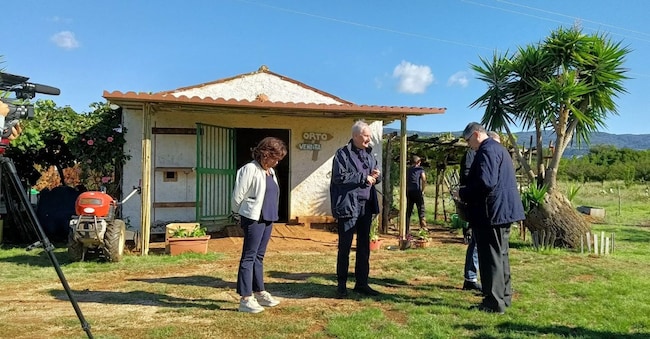
Don Giacomo Panizza ha promosso il progetto Sud

4' min read

Translated by AI
Versione italiana

4' min read

Translated by AI
Versione italiana

"The problem is price, the market chain. Accept the diktats of big retailers or leave the fruit on the tree. This is how you blackmail the farmers and enslave the labourers'.

Don Giacomo Panizza's South Project

Don Giacomo Panizza arrived in Lamezia Terme in the late 1970s from the upper Po Valley, from Brescia to be exact. He has always worked with the disabled, immigrants and drug addicts. Through socio-educational activities, he tries to give a chance to those fragile subjects who need redemption. And a job.

Loading...

Among the many activities of his Southern Project there is also the agricultural one that takes place between the Lamezia plain and Settingiano: eight hectares to produce honey, oil and grow vegetables, all at zero km. "Whoever wants our products comes and gets them,' Don Panizza is keen to point out, 'We set the price of what we sell to the large-scale retail trade. Five or eight cents per crate of orange is the price of slavery'. And the same goes for strawberries, with labourers paid between three and five euros per hour.

Goel, legal and responsible farming

Among the many who practise legal and responsible agriculture in Calabria is Vincenzo Linarello, founder and president of Goel - 'a community of people, businesses and social cooperatives working for change and the redemption of Calabria' -. He has long maintained that the problem lies in the intermediation of the agricultural supply chain of large-scale distribution: 'Too many passages, too many intermediaries, too many local wholesalers who lower the first price to the farmer. This cuts labour costs.

A fair wage for strawberry picking

In Acconia di Curinga, in the Lamezia Terme plain, on hundreds of hectares it is time for the Ligea strawberry. A cultivar that is also widespread in Amendolara, in the upper Ionian Cosentino. It was there, in a service station on the state road 106, that the horror of the four labourers burnt alive in a car took place. Waseem Khan, Fazal Amin Khogyani, Ismat Ullah Qiemi and Amjad Safi were asking for fair pay and a regular contract to pick strawberries. And it was in Amendolara that the CGIL and delegates from parties and associations marched in a procession against caporalato and exploitation. Don Giacomo was also at the demonstration. 'What has happened warns us that a new power is forming in the territories. Clans of corporals who are also immigrants, organised in 'ndrangheta style, perhaps even more ruthless, if that is possible,' warns the founder of Progetto Sud, who knows those areas well.

The rotten corporal system

"Doing justice means understanding what economic, social and labour relations made all this possible. We need to understand who recruited these workers, who organised their transports and their days, what housing conditions they lived in, which farms employed that labour using 'caporalato', which production chains benefited from it, which markets those products were destined for. The system had been rotten for a long time. Between 2020 and '21,' the priest recalls, 'we met 80 African labourers who had already rebelled against the exploiters of Pakistani nationality present in the Cassano all'Ionio area. With the support of other associations we led 18 of them to denounce'. In an open letter, Don Giacomo pleads for Taj Mohammad Alamyar, the only survivor of the Amendolara massacre, the national Referral Mechanism for assistance to victims of trafficking and serious exploitation (a protection system coordinated by the Department of Equal Opportunities).

Pierre Rabhi's agroecology in Rosarno

But in Calabria there are also those - associations, biodistricts, farms - who silently conduct their own personal battle against illicit intermediation and labour exploitation, for a healthy, fair and sustainable agriculture. In Rosarno - which 16 years ago was the scene of a violent uprising of farm labourers, which later degenerated into clashes with the population - a female farmer challenges abuse, theft and vandalism by implementing indigenous crops according to the methods of French farmer Pierre Rabhi, an Algerian-born philosopher of agroecology. He combined biodynamics and 'sobriété heureuse', happy sobriety. On her 60 hectares of Tenuta Badia Patrizia Rodi Morabito, manager of Coldiretti and member of the board of the Reggio Calabria Chamber of Commerce, grows olive and citrus trees 'with respect for the land and people'. After living art around the world, she took over the historic family business dating back to 1896 with her sister. "They burnt an entire kiwi crop. So I decided to devote myself only to local agricultural products. It's my way of reacting and resisting. Like a little hummingbird. According to an African legend, during a forest fire, it did not run away, but carried drops of water with its beak to put out the flames'.

The Lea Garofalo Prize

It was the Colibris network, built by Rabhi in the early 2000s, that inspired the entrepreneur to create a new model of society based on autonomy, ecology and humanism. Thus, two years ago she was awarded the prize named after Lea Garofalo, a victim of the 'ndrangheta, killed in November 2009 by her ex-partner. "How do I manage my land? I rely on contractors,' Patrizia Rodi Morabito concludes, 'they provide me with qualified and protected personnel. And I give my crops to local cooperatives. Gioia Succhi, for example, a company that processes and produces semi-finished natural citrus juices in San Ferdinando'.

Copyright reserved ©
Loading...

Brand connect

Loading...

Newsletter

Notizie e approfondimenti sugli avvenimenti politici, economici e finanziari.

Iscriviti