The setting

From weather forecasts to hypersonic missiles to the Russian fleet on the Kola Peninsula: why the Arctic is strategically important for defence

The guidance provided by the Chief of the Defence Staff, General Luciano Portolano, at the Second National Defence Conference on the Arctic and Antarctica

 Alamy Stock Photo / Reuters

8' min read

Translated by AI
Versione italiana

8' min read

Translated by AI
Versione italiana

The Arctic and Antarctica are not merely lands of myth and exploration. Today, they hold strategic importance, as they lie at the heart of a web of international challenges. Speaking at Second National Defence Conference on these two regions, which took place on Thursday 29 October in Rome at the CASD (Centre for Advanced Defence Studies), the Chief of the Defence Staff, General Luciano Portolano, outlined a number of points that may help to understand the significance of this issue and its concrete implications for Italia’s defence.

The general sent a clear message: ‘Even the most remote regions of the planet concern us closely. And if I were to leave just one message, it would be this: we do not look to the poles to pursue others, but we look to the poles to defend what we have. The centrality of the Mediterranean, the security of our infrastructure, the credibility of our contribution to the Alliance – all of this is also defended in the polar regions. It is a challenge that calls upon defence and diplomacy, research and industry, politics and civil society.”
Loading...

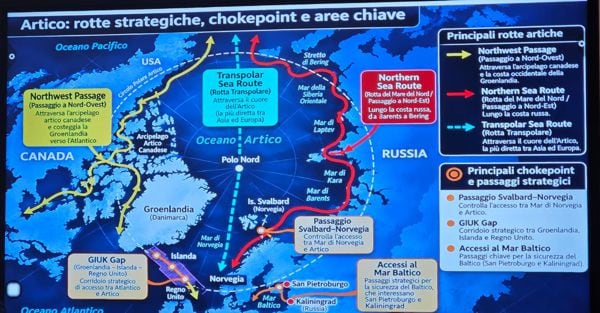
La mappa mostrata dal ministro della Difesa Guido Crosetto durante la Seconda conferenza nazionale della Difesa su Artico e Antartide.

Weather forecasts and the importance of the Svalbard Islands

Portolano began his speech with a simple question: ‘How many of us check the weather forecast in the morning before heading out? I think a great many of us do,’ he replied, ‘but I believe that a great many of us are unaware that those forecasts also pass through the Arctic. Many meteorological satellites in polar orbit transmit their data to Svalbard, those islands we saw on the map shown to us by Minister Crosetto (the minister had spoken earlier, and on that occasion showed the map shown above, ed.). These islands are closer to the Pole than to Oslo. And from there, two cables laid on the seabed carry the data to the mainland. We all recall that in January 2022, one of these cables was severed for reasons that have never been fully clarified. Communications across the archipelago were left dependent on a single cable. So this is what the polar regions mean to us. I imagine them as a sort of roof and foundation for our daily lives and our security. Above – like a roof – are orbits and trajectories. Below, like cables and submarines. And whoever exerts influence and control over the roof and foundations of a house ends up affecting the safety of those who live within its walls.”

The ‘room’ of the Mediterranean

“And one of those rooms – the one closest to us and the most important – is called the Mediterranean,” emphasised the Chief of the Defence Staff. “Minister Crosetto has just returned from a visit to Norway and Finland. Yesterday I returned from a visit to the Deep South, in Nigeria. Yet with my American counterpart, General Anderson, commander of AFICOM, we discussed the links that exist between the North, Africa, the Atlantic, the Mediterranean and communications in the Indo-Pacific region across the Pacific.”

The technological factor

‘The technology that brought the poles strategically closer even before the climate made them accessible. Satellites, ground stations, submarine cables, sensors and long-range weapon systems have turned the poles into nodes of a single network,’ continued the Chief of the Defence Staff. ‘ ‘Thus, what happens in Svalbard or in the Barents Sea can have an impact even thousands of kilometres away – and, as has been emphasised on several occasions, on our ability to observe, communicate and understand.’

The Arctic within NATO’s collective defence perimeter

‘Added to this is a political factor: the accession of Finland and Sweden to the Alliance, which has meant that, with the exception of the Russian Federation, all members of the Arctic Council are now members of NATO. So what is the consequence? The consequence is that the Arctic falls fully within the scope of the Alliance’s collective defence. It is no coincidence that our document – the military defence strategy document, which was adopted in Italia for the first time – lists the Arctic among the areas of significant interest. And from this context, in my view, a number of strategic implications arise.’ ‘At the poles, competition does not arise suddenly but advances gradually.’ Not only that: Portolano spoke of the ‘growing importance that the Far North is acquiring and the possible repercussions for our security; I wish to emphasise that, whilst the wider Mediterranean remains the main theatre of operations for our military, we cannot overlook what is unfolding in the North-West, including the polar regions’.

The Russian fleet on the Kola Peninsula

‘The Northern Fleet is based on the Kola Peninsula,’ explained Portolano, ‘the only one of Russia’s fleets capable of reaching the Atlantic without passing through straits controlled by the Alliance. Any southward movement by the fleet passes between Greenland, Iceland and the United Kingdom – the very same stretch of sea that Allied reinforcements would have to traverse. We saw this on the map shown by Minister Crosetto: that red line linking the two extremes between Greenland and the United Kingdom. Russia. Moscow is well aware of this. Its maritime doctrine regards the Arctic as an area of vital interest, an area to be defended like a bastion. On the other hand, NATO, in its 2022 Strategic Concept, defines Russia’s ability to hinder those reinforcements in the North Atlantic as an absolutely strategic challenge. I would add that it is a challenge for all our maritime lines of communication. Indeed, what happens in the far north can also shift the balance of power in the Mediterranean.”

Horizontal escalation

‘But there is a more immediate link. I would like to share an example with you. Last March, coinciding with a major NATO exercise in the far north, in the wake of the Middle East crisis, some of the Alliance’s units – including one of our destroyers, the Andrea Doria – were recalled to the Mediterranean. ‘This incident,’ said Portolano, ‘made it clear that the two theatres draw in part on the same military resources and that an adversary could exploit our commitment in one to exert pressure in the other. This is what, in strategic terms, is known as horizontal escalation. And for our armed forces, this is not merely a theoretical scenario, but a very real one – one for which we must plan so as not to be caught unprepared. Added to this is the economic dimension: a permanently navigable Arctic route – what Beijing calls the Polar Silk Road – would be an alternative to Suez. And every ship that chooses the northern route is a ship that does not cross the Mediterranean and does not call at our ports. In short, the centrality of the Mediterranean is not guaranteed by geography alone. Rather, it is a competitive advantage that must be defended, even as we look northwards. And from Moscow we turn to Beijing. For Beijing, the Arctic route is a way of reducing its dependence on the Strait of Malacca, the bottleneck through which the bulk of its energy imports pass.”

The Arctic and the Indo-Pacific have become interdependent

‘So the Arctic and the Indo-Pacific have become even more interdependent than we could ever have imagined. That is why we must strengthen – and we are doing so – our partnerships with the nations of the Indo-Pacific that share our interests, starting with freedom of navigation. In short, what happens in the far north has repercussions from the Atlantic to the Mediterranean and right across to the Indo-Pacific.”

The grey area

‘I shall now return to what is the second strategic implication, namely that competition at the poles does not erupt suddenly, but unfolds gradually. It develops through a process of consolidation. A research station housing a satellite dish, a claim to the continental shelf filed with the United Nations, a commercial port that, if necessary, becomes a logistics base. These are dynamics typical of the grey zone: gradual and ambiguous initiatives carried out below the threshold of armed conflict. And in a region where a physical presence is rare – and, for that very reason, all the more significant – a simple rule applies: those who are there set the facts; those who are not there are subject to them. One example of this is the joint Russian-Chinese patrols in the Arctic, which began in 2024. And on this point, our competitors are showing greater initiative than the other Arctic Council countries – and, in this case, the Alliance as well.”

Loading...

The drivers of the economy

‘Furthermore, in the polar regions, security is linked to economic factors. One example is the agreement of 22 September between the United States, Denmark and Greenland, which makes investments by third countries in sensitive sectors subject to the consent of all three parties. As for Antarctica, I would like to dispel the common misconception regarding the alleged expiry of the Madrid Protocol in 2048 – a protocol concerning the ban on mining activities other than those for scientific research. In fact, the Protocol does not specify any expiry date, but provides for the possibility of making amendments 50 years after its entry into force – I believe that was in 1998. However, the conditions required to do so are so stringent as to make it highly unlikely.”

The real risk of dual-use scientific infrastructure

‘The real risk, in my view, lies elsewhere: the slow, continuous and silent erosion of the Antarctic Treaty system through the dual use of scientific infrastructure. This is a risk that American analysts have highlighted precisely in the bay that is home to our Mario Zucchelli Station. And the response to dynamics such as these lies in our presence, expertise and credibility. The final implication – the strategic one to which I referred – is that deterrence also plays out in the polar regions. The shortest routes between North America, Europe and Asia pass through the Arctic. Strategic carriers and hypersonic missiles would pass through there, and it is precisely there that some of the early-warning radars are located. And above the poles, as I mentioned at the outset, satellites orbit, transmitting data to ground stations that are undeniably critical infrastructure. The Alliance has responded to this with concrete measures of deterrence and defence. Since February, Operation Arctic Sentry has brought allied activities in the region under a single command. Since June, the Forward Air Forces Finland have ensured an advanced ground presence. This is a form of deterrence by denial, which consists of making it clear to the adversary that any hostile action against us would, in any case, prevent them from achieving their objectives. In this context, the European Union too, with its new Arctic strategy adopted on 20 October, is placing security at the heart of its actions in the region. The Alliance defends, whilst the European Union, in a complementary manner, should make what needs defending more resilient. And it is precisely in the interface between the two organisations that Italia can play a distinctive role, acting as an ambassador for European priorities within the Alliance and translating their dialogue into shared capabilities. This brings me to the implications in terms of capabilities.”

The polar regions as a laboratory

Question: “What do the polar regions teach us about how to prepare ourselves to operate anywhere?” “At 40 degrees below zero, batteries lose their range,” explained Portolano, “drones struggle to fly, materials become brittle, and at high latitudes, satellite navigation and communications deteriorate.” “The cold lays bare all our vulnerabilities at once – vulnerabilities that an adversary would exploit one by one. That is why polar capabilities should not be seen as a niche luxury, but as a laboratory of resilience that benefits the entire military.” Hence the conclusion of the Chief of the Defence Staff: “Today, security depends less on distance and increasingly on interdependence. Even the most remote regions of the planet concern us closely. And if I were to leave just one message, it would be this: we do not look to the poles to chase after others, but we look to the poles to defend what we have. The centrality of the Mediterranean, the security of our infrastructure, the credibility of our contribution to the Alliance – all of this is also defended in the polar regions. It is a challenge that involves defence and diplomacy, research and industry, politics and civil society,’ concluded Portolano.

Copyright reserved ©
Loading...

Brand connect

Loading...

Newsletter

Notizie e approfondimenti sugli avvenimenti politici, economici e finanziari.

Iscriviti