
From weather forecasts to hypersonic missiles to the Russian fleet on the Kola Peninsula: why the Arctic is strategically important for defence
The guidance provided by the Chief of the Defence Staff, General Luciano Portolano, at the Second National Defence Conference on the Arctic and Antarctica

Key points
- Weather forecasts and the importance of the Svalbard Islands
- The ‘room’ of the Mediterranean
- The technological factor
- The Arctic within NATO’s collective defence perimeter
- The Russian fleet on the Kola Peninsula
- Horizontal escalation
- The Arctic and the Indo-Pacific have become interdependent
- The grey area
- The drivers of the economy
The Arctic and Antarctica are not merely lands of myth and exploration. Today, they hold strategic importance, as they lie at the heart of a web of international challenges. Speaking at Second National Defence Conference on these two regions, which took place on Thursday 29 October in Rome at the CASD (Centre for Advanced Defence Studies), the Chief of the Defence Staff, General Luciano Portolano, outlined a number of points that may help to understand the significance of this issue and its concrete implications for Italia’s defence.
The general sent a clear message: ‘Even the most remote regions of the planet concern us closely. And if I were to leave just one message, it would be this: we do not look to the poles to pursue others, but we look to the poles to defend what we have. The centrality of the Mediterranean, the security of our infrastructure, the credibility of our contribution to the Alliance – all of this is also defended in the polar regions. It is a challenge that calls upon defence and diplomacy, research and industry, politics and civil society.”
Weather forecasts and the importance of the Svalbard Islands
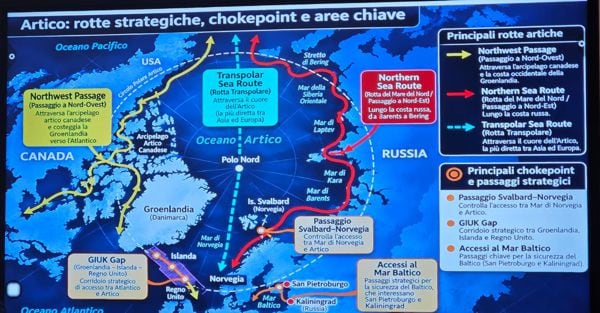
Portolano began his speech with a simple question: ‘How many of us check the weather forecast in the morning before heading out? I think a great many of us do,’ he replied, ‘but I believe that a great many of us are unaware that those forecasts also pass through the Arctic. Many meteorological satellites in polar orbit transmit their data to Svalbard, those islands we saw on the map shown to us by Minister Crosetto (the minister had spoken earlier, and on that occasion showed the map shown above, ed.). These islands are closer to the Pole than to Oslo. And from there, two cables laid on the seabed carry the data to the mainland. We all recall that in January 2022, one of these cables was severed for reasons that have never been fully clarified. Communications across the archipelago were left dependent on a single cable. So this is what the polar regions mean to us. I imagine them as a sort of roof and foundation for our daily lives and our security. Above – like a roof – are orbits and trajectories. Below, like cables and submarines. And whoever exerts influence and control over the roof and foundations of a house ends up affecting the safety of those who live within its walls.”
The ‘room’ of the Mediterranean
“And one of those rooms – the one closest to us and the most important – is called the Mediterranean,” emphasised the Chief of the Defence Staff. “Minister Crosetto has just returned from a visit to Norway and Finland. Yesterday I returned from a visit to the Deep South, in Nigeria. Yet with my American counterpart, General Anderson, commander of AFICOM, we discussed the links that exist between the North, Africa, the Atlantic, the Mediterranean and communications in the Indo-Pacific region across the Pacific.”
The technological factor
‘The technology that brought the poles strategically closer even before the climate made them accessible. Satellites, ground stations, submarine cables, sensors and long-range weapon systems have turned the poles into nodes of a single network,’ continued the Chief of the Defence Staff. ‘ ‘Thus, what happens in Svalbard or in the Barents Sea can have an impact even thousands of kilometres away – and, as has been emphasised on several occasions, on our ability to observe, communicate and understand.’


