The lesson

From ‘I’ to ‘we’ without losing sight of talent: leadership according to Julio Velasco

The leadership principles of the head coach of the women’s national volleyball team: putting people first, managing differences without forcing uniformity, and building trust through the right words and actions

by Gianni Rusconi

6' min read

Translated by AI
Versione italiana

6' min read

Translated by AI
Versione italiana

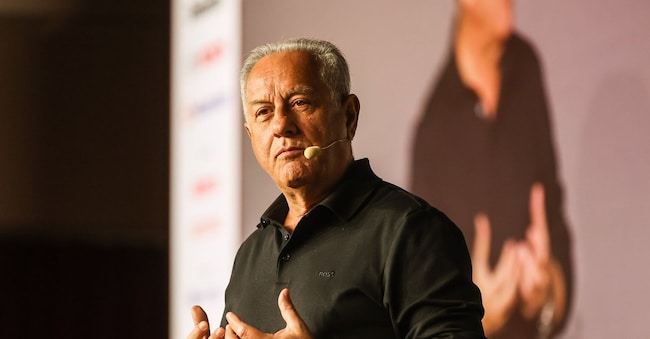
From the stage of the Velasco Day 2026 organised by the ROI Group in Milan at the end of March, the head coach of the Italian women’s national volleyball team spoke to an audience of around two thousand entrepreneurs, managers and professionals about leadership based on listening, valuing differences and the ability to transform individual talent into collective success. Looking back on that speech a few months on, the message from this great sports manager has certainly not gone out of fashion – quite the contrary. In this article, we aim to highlight the most significant points of his speech, focusing on some key components of Velasco’s philosophy: people and relationships, organisational culture and the role of the individual within the group, trust as the driving force behind performance, and the perception of fairness as the foundation of authority.

A team’s strength does not come from uniformity

When we talk about leadership, particularly in a business context, there is a risk of resorting to clichés: vision, motivation and team spirit are words that have been a staple of conferences and management development programmes for years. Julio Velasco, however, takes a different approach and bases his thinking on a premise that is as simple as it is counterintuitive: people come before the team. The coach who led the Italian women’s volleyball team to Olympic gold in Paris 2024 and the world title in 2025 does not offer ready-made formulas for success, but rather describes an approach to leadership that is in line with the needs of contemporary organisations, which are called upon to manage groups that are increasingly diverse in terms of age, culture, sensibilities and expectations.

Loading...

The key to Velasco’s ‘recipe’ breaks decisively away from the idea of standardisation and embraces the opportunity to bring together differences that are often difficult to manage. In the traditional narrative of sport, the team is almost always portrayed as a unified entity, capable of putting individuality aside in the name of a common goal. But what if we were to turn this perspective on its head and focus on understanding people before even thinking about the results to be achieved? ‘Every single person,’ argues the philosopher-coach, ‘has not only different goals and different motivations, but above all a unique nervous system.’ This concept touches on one of the central themes of contemporary management: the growing complexity of organisations, where managers find themselves managing multiple generations of individuals with different cultural backgrounds and sensibilities within the same framework. It is therefore difficult, if not impossible, in such a context, to apply uniform models of motivation or people management.

To explain this concept, Velasco often draws attention to her experience as head coach of the women’s national team – a setting where very different personal stories and backgrounds coexist, prompting a search for a more sophisticated balance that seeks to celebrate what sets people apart without compromising what unites them. For this reason, even a term widely used in organisational discourse such as ‘integration’ is not at the heart of his reasoning. ‘I don’t use that word,’ adds the most successful and charismatic head coach in Italian volleyball, ‘because it works better when different cultures are shared.’ The organisational approach we need to focus on is no longer merely one of assimilation but must become truly inclusive – a theme that is, after all, increasingly prominent in leadership strategies.

Why the ‘I’ must not disappear

Among the most powerful images used by Velasco, one in particular challenges a widely held dogma found in both sport and business: ‘I do not believe that “I” becomes “we”. The ‘I’ always remains the ‘I’.” A statement at the heart of his vision, which suggests that the “we” is not the result of the disappearance of the “I”, but rather the outcome of the ability to bring together different individualities within a shared project. The importance of teamwork – for years portrayed as a process of gradually relinquishing individuality and espoused by many leaders who foster a sense of belonging through generic references to collaboration or team spirit – thus stands out in comparison to other assumptions.

According to the Argentine coach, in fact, exhortations are of little use, and people do not become a team simply because someone asks them to or imposes it on them. Organisations, like sports teams, are characterised by personal ambitions, relationships, affinities, conflicts and individual expectations: pretending that these elements do not exist means failing to understand them. The challenge, as Velasco urges, is to manage these elements by creating the conditions for differences to generate value rather than friction; and leadership, from this perspective, is the expression of the ability to manage complexity, rather than merely the art of eliminating it.

Words that build trust

A key theme running through Velasco’s entire argument is the importance of words, given that language is a tool that goes beyond the sphere of communication and becomes a means of constructing organisational reality. In emphasising this importance, he draws a clear distinction between criticising and judging, upholding the value of the former whilst rejecting the latter. Criticism, in other words, concerns a behaviour, a decision or a performance and opens up scope for improvement; judgement, on the other hand, is directed at the person themselves and often triggers a defensive reaction.

Velasco uses an expression that effectively sums up this logic and which becomes all the more necessary for a leader to use when one of their colleagues fails to do something. ‘You’re not doing it right yet. But you will do it right.’ That word, ‘yet’, reflects a concept of leadership based on trust and learning, which does not interpret human error as a sign of inadequacy but as a stage in the journey of growth. This shift in perspective, linked to the appropriate use of this adverb, is significant because it steers the manager’s thinking away from organisational cultures based on control and towards those that value development, autonomy and empowerment.

It is no coincidence that he emphasises another crucial aspect: when a correction triggers an emotional reaction of defensiveness, communication breaks down; when, on the other hand, it elicits a solution-oriented response, learning takes place. ‘A leader,’ emphasises Velasco, ‘must be and appear fair, and one must always ask oneself whether the way I manage things holds up when the team loses,’ thereby reducing any perceived favouritism or unequal treatment (which erode internal trust), and making the criteria guiding decisions transparent so that the reasoning behind them is clear to everyone. And this is particularly true during difficult times, following a defeat or during a period of crisis and underperformance.

The trust that fosters a sense of belonging

Towards the end of his talk in Milan, Velasco then addressed another topic particularly close to the hearts of managers and entrepreneurs, namely the sense of belonging, which, in his view, stems from dynamics that are very different from those often described in corporate engagement programmes. Motivational campaigns, solemn declarations or identity-based slogans may have a limited effect, whereas what truly builds a sense of belonging is the quality of the relationships that an organisation or a leader manages to develop with people, and the ability to show genuine care for them when they are going through important moments in their professional or personal lives. This concept is brought to life by his recollection of an episode involving one of his players, who was allowed to stay by his wife’s side during the birth of their first child despite having been called up for an official match: that gesture, even years later, has continued to symbolise a bond and mutual appreciation between coach and player, between the team leader and one of his players.

Building trust that stems from the conviction – one that is felt, not merely stated – that the leader truly believes in the people who work with him is, in essence, at the heart of the Velasco philosophy. ‘I have to like my players because they’re mine’ is a phrase that may be far removed from traditional managerial jargon, but it conveys a clear message: no method can work if there is a lack of genuine regard for individuals. And no team becomes strong if its members give up being themselves; it becomes strong when it manages to value the diverse identities that make it up and put them at the service of a shared goal.

Copyright reserved ©
Loading...

Brand connect

Loading...

Newsletter

Notizie e approfondimenti sugli avvenimenti politici, economici e finanziari.

Iscriviti