
From masks, to actors, to the audience: Ara Pacis exhibition opens, a look at theatre in ancient Rome
More than 240 works are on display: the story starts from the Greek, Sicilian, Magna Graecia, Etruscan and Italic roots of the Roman theatre, from the religious origin of the 'ludus' and the first wooden stages, to the splendour of the frons scenae of the great theatres for tens of thousands of spectators, architectures that - like the forum or the temple - would characterise the forma urbis of the empire
by Andrea Carli
5' min read
Key points
5' min read
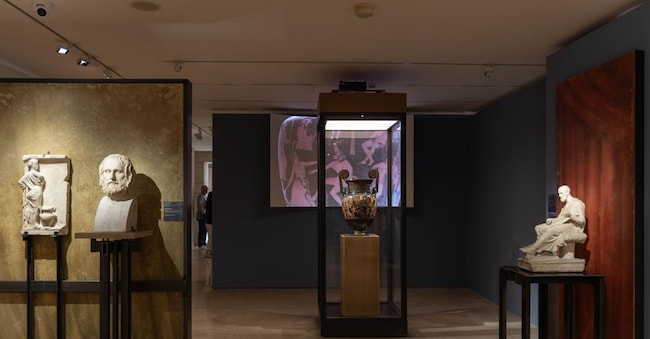
An all-round look at the theatrical world in ancient Rome: its roots, protagonists, music, stage design, architecture, the fascination of storytelling, the voice of history, entertainment. Over 240 works provide an insight into an art, derived from the Greek tradition, that was one of the most important cultural institutions of antiquity, but also an instrument of political propaganda. The Ara Pacis Museum hosts from Tuesday 21 May to 3 November the exhibition 'Theatre. Authors, actors and audiences in Ancient Rome'.
It is a journey through the centuries, with focus on the Augustan age. The story starts from the Greek, Sicilian, Magna Graecia, Etruscan and Italic roots of the Roman theatre, from the religious origin of the 'ludus' and the first wooden stages, to the splendour of the frons scenae of the great theatres for tens of thousands of spectators, architectures that - like the forum or the temple - would characterise the forma urbis of the empire.
Masks will be the leitmotif of this "immersion": from the most ancient of those that have survived to the present day (5th century B.C.) to the Hellenistic masks of the 3rd-2nd century B.C., up to the spectacular ones of the Roman era. The masks are also long-lasting scenic 'characters', tragic, comic and grotesque: the visitor will thus discover the very ancient origin of many characters in modern theatre, from the misanthropic old man to the seductive young man, from the shrewd servant to the young lovers hindered by different social conditions.
The most effective mass media of antiquity
.Visitors immerse themselves 'beyond' the stage, inside the production mechanisms, in the actors' dressing rooms, on the stages and in the stands of ancient theatres. They go in search of a living reconstruction, in which the protagonists themselves - through ad hoc created multimedia interventions - will involve the public by telling their lives, the stories they played, their role as authors or performers in a society so similar and at the same time so different from our own. A society that had in the more than 1,000 large monumental theatres that stood in the Roman empire what we would today call the most effective mass media of antiquity..
Over 240 works on show
.More than 240 works from 25 different lenders will be on show, with an itinerary characterised by some rarities such as, for example, the Attic-produced cup from the National Archaeological Museum in Florence with one of the very rare representations of a phallophoria, a procession in honour of Dionysus, god of the theatre. And then a unique specimen of an ancient terracotta mask from the Museo Archeologico Regionale 'Paolo Orsi' in Syracuse or the famous 'vase of Pronomos' from the Museo Archeologico Nazionale in Naples, perhaps the most important of the artefacts with a theatrical subject that has come down to us.


