The document

Defence: 22 billion in investment in armaments beyond 2031 – here is the full picture

The 2026–2028 Multi-Annual Defence Policy Document (DPP 2026–2028), signed by Minister Crosetto and submitted to Parliament. 22 billion in investment in armaments is planned beyond 2031

4' min read

Translated by AI
Versione italiana

4' min read

Translated by AI
Versione italiana

Over six billion euros to strengthen the Italian Army’s heavy armament from 2026 to 2031, plus eight billion for the following years. But also, of course, for the sixth-generation fighter, the GCAP. Here, the allocation is 875 million for this year, 695 in 2027, 152 in 2028, and then 866 from 2029 to 2031. Finally, six billion in the following years, with funding set to end in 2037.

The document

The details are set out in the annex to the 2026–2028 Multi-Annual Defence Programme Document, which was signed on Tuesday 10 November by Defence Minister Guido Crosetto and has been submitted to Parliament, and which *Il Sole 24 Ore* has seen. The document provides detailed information on the Ministry’s individual investment projects, outlining their programmatic and financial parameters.

Loading...

It sets out the strategic guidelines, objectives and financial plan for the modernisation of the armed forces. It is submitted to Parliament every year, followed by a hearing with the Minister of Defence, Guido Crosetto, to report to the Houses.

These are investments that have been given the go-ahead by Brussels, at the same time as the green light was given for the flexibility provided for under the clause allowing for an increase in defence spending by up to 0.3 percentage points of GDP per year in 2027 and 2028.

22 billion in arms spending planned beyond 2031

One point that emerges from adding up the figures contained in the annex to the document is that the planned investment in armaments and ammunition from 2027 onwards, extending beyond 2031, amounts to approximately 22 billion. The items cover the period from 2026 onwards, extending beyond 2031. The figures represent the total of the estimated investment calculations over the years, as set out in paragraph 5 of the annex to the document, which concerns ‘weapons and ammunition’: from ballistic missile defence systems such as the Grifo or Samp-T systems, to anti-ship missiles, ground-based artillery, anti-drone systems and aircraft self-defence systems.

The budget

In terms of the resources available, according to the Multi-Annual Policy Document, the integrated defence budget is set to rise to 37.5 billion euros by 2027, comprising resources from the Ministry of Infrastructure and Transport (MIMIT) for defence investments, the Ministry of Economy and Finance (MEF) for international missions, and allocations from the National Recovery and Resilience Plan (PNRR). The figure for 2026 is 36.7 billion, whilst a fall to 36.49 billion is forecast for 2028.

Investments in detail

To go into more detail, approximately 22.3 billion euros are earmarked to cover projects for land-based vehicles, 20.3 billion euros for ships, submarines and maritime systems, €42.5 billion for aircraft (fighter, transport and training), helicopters and drones, €14 billion for armaments, ammunition and missiles, €5.2 billion for digitalisation, cyber security and simulation systems, and €1.4 billion for space programmes, which will be concentrated mainly over the next five years.

Furthermore: 1.4 billion is earmarked for research and development. A total of 8.5 billion euros is allocated for bases, logistics hubs, healthcare facilities and installations of the Army, Navy and Air Force. For maintenance and upgrades to vehicles and technological equipment, as well as for stocks of materials and various modernisation projects, 13.4 billion is earmarked up to 2039.

Dpp: integrated budget rises to 37.5 billion in 2027

As regards the NATO budget, which includes additional items not covered by the integrated budget (such as INPS pensions and other expenditure by ministries contributing to national defence), the figure quoted in the document remains that for 2026, amounting to 48.31 billion euros, representing 2.1 per cent of GDP. Last year’s figure was 47.183 billion.

The armoured component of the Italian Army

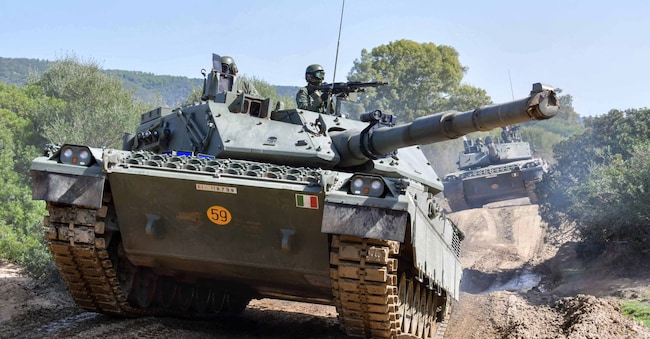
As regards heavy combat vehicles, the programme aims to strengthen the Italian Army’s heavy armoured component through three lines of action. The first concerns the modernisation of the Ariete tanks. The second concerns the project known as the Army Armoured Combat System (A2CS), involving the procurement of Armoured Infantry Fighting Vehicle (AIFV) platforms and support platforms. The third involves the renewal of armoured capabilities through the acquisition of new-generation Main Battle Tank (MBT) platforms and their variants, intended to replace obsolete systems.

Loading...

New-generation minesweepers

As regards naval vessels, the programme to develop a new generation of minesweepers will account for 152 million this year, 198 in 2027, 262 in 2028, and 904 million for the period from 2029 to 2031. For subsequent years, 1.1 billion euros have been allocated. There is no end date for the funding. The programme envisages the development of new Mine Countermeasures and Seabed Warfare vessels, as well as supporting infrastructure, featuring a high degree of automation and versatility thanks to their ‘multi-purpose-by-design’ approach. These units will replace obsolete ones and will be capable of supporting the Civil Protection Agency in the event of disasters, as well as carrying out activities for other ministries, such as environmental monitoring, the clearance of unexploded ordnance and the protection of submerged cultural heritage.

Underwater surveillance

The “U-212” programme provides for Italian-German cooperation to maintain adequate capabilities within the maritime component of the Defence Forces for underwater surveillance in scenarios of strategic importance. The programme is funded from the budget of the Ministry of Enterprise and Made in Italy. In this case, we are talking about 359 million for this year, 257 for next year, 339 in 2028 and 560 million from 2029 to 2031. Finally, 539 million is earmarked for subsequent years. Here too, no end date has been set for the funding.

Copyright reserved ©
Loading...

Brand connect

Loading...

Newsletter

Notizie e approfondimenti sugli avvenimenti politici, economici e finanziari.

Iscriviti