Hormuz

From the non-magnetic fibreglass hull to the sonar, all the features of Italian minesweepers

There is also a frigate among the Defence-prepared vessels currently in port in Italia, available to be sent in the event of a possible reclamation operation with two mine destroyers and a logistics ship in the Strait of Hormuz

by Andrea Carli

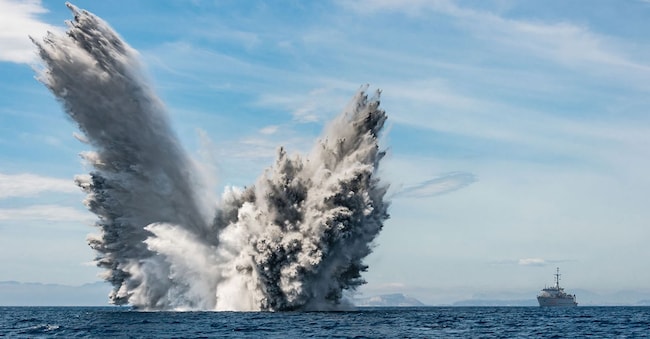
Un cacciamine della Marina Militare in azione  Foto: Marina Militare

4' min read

Translated by AI
Versione italiana

4' min read

Translated by AI
Versione italiana

There is also a frigate among the means prepared by the Defence, currently in port in Italia, davailable to be sent in the event of a possible reclamation operation with two minehunters and a logistics ship in the Strait of Hormuz.

For the deployment to take place - which will take place only in safety - three conditions will be necessary: a truce, then the cessation of hostilities in the same area, an international mandate and finally the authorisation of parliament. But what are the characteristics and strengths of the Italian minesweepers? Some information provided by the Marina Militare can help answer this question. Modern search sensors, wire-guided vehicles capable of laying an explosive device suitable for destroying the mine in the vicinity, and a team of specially trained underwater operators form the backbone of the minesweeper component.

Loading...

How many destroyers and crew characteristics

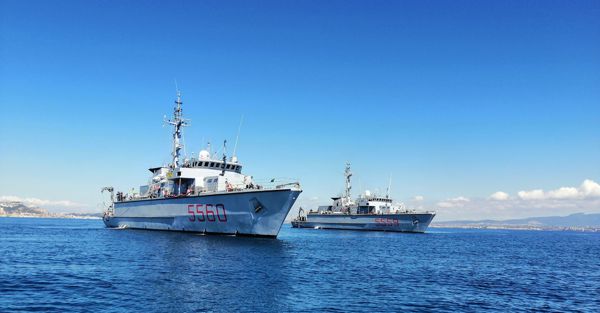
There are eight "Gaeta" class minesweepers in the Navy's fleet, characterised by high operational standards thanks to modernisation processes that have provided the crews with mine search sensors, as well as command and control and communication systems. The crew consists of around forty people, plus a team of operators from the Underwater Operations Group (GOS) of the COMSUBIN of the Navy.
In mare

I cacciamine dispongono di sistemi particolarmente sofisticati

Due cacciamine della Marina Militare (foto Marina Militare)

From sonar to optical mine identification

Minehunters can rely on particularly sophisticated systems. These include variable depth sonar for mine detection and classification, which is very effective up to altitudes of over 400 metres for this type of target (with larger objects it can be effective even beyond 1000 metres). They have an autonomous underwater REMUS 300 vehicle that, with a team of divers and specialised technicians, is used for the discovery, localisation and classification of naval mines and for mapping and scanning the seabed at operating altitudes over 300 metres. They also have ROV PLUTOs in the GIGAS version and in the PLUS version, for optical mine identification and counter-mine operations, with operating altitudes over 600 metres (GIGAS version) or over 300 metres (PLUS version). They also have counter-mine charges.

How to take action to neutralise a bomb

In particular, the search and classification of objects in the underwater dimension are carried out by means of variable depth sonar. Underwater wire-guided vehicles carry out the identification and neutralisation of the ordnance. During underwater threat operations, however, the team of divers, specialised in the search, identification, defusing and neutralisation of any type of explosive device, can be used as an alternative to wire-guided vehicles for the placement of a counter-mine charge near the mine.

The divers

Thanks to the availability of non-magnetic, silent and bubble-crushing self-contained breathing apparatus, divers can operate against any type of naval mine (including for neutralisation and operational information gathering). On the basis of their systems, the minesweepers are able to search and explore the seabed beyond 1,000 metres, identify, by means of optical sensors, objects on the seabed up to an operational altitude of more than 600 metres, and carry out explosive ordnance clearance.

The non-magnetic GRP hull

The Navy's mine hunters are equipped with a non-magnetic fibreglass hull, which is more resistant than traditional wooden hulls and, above all, able to inhibit magnetic mine sensors. The propulsion system of the minesweepers is also designed to reduce acoustics as much as possible: during the conduct and detection of mines, the engines and other equipment are acoustically isolated in order to inhibit the acoustic sensors of the minesweepers.

The convoy guide

In addition to de-mining the waterways, the Navy's minesweepers can conduct convoy guidance along a previously cleared channel, with a width of approximately 600 metres, with the aim of keeping the convoy on the axis of the channel and, where suspicious objects are identified on the passageway through the previously described sensors, guide the convoy itself so as to avoid passing over the area at risk.

World War II ordnance removal

In addition, the minesweepers carry out continuous support activities for the GOS divers' units for the removal and blasting of World War II ordnance (an average of 15 ordnance per year).

German Fulda destroyer in the Mediterranean for possible deployment in Hormuz

A possible intervention in Hormuz should not only involve Italia, but a coalition of countries. News has just reached us that, with a view to a possible deployment to secure the Strait, the German Navy minesweeper 'Fulda' will depart from the Kiel-Wik naval base bound for the Mediterranean.

According to the German Ministry of Defence, the deployment represents a preliminary positioning measure. The deployment in the Strait of Hormuz requires a mandate from the Bundestag. Should parliamentarians give the green light, the ship would then be closer to its final destination.

The Fulda will be withdrawn from the NATO mission in the North Sea and Baltic Sea and initially integrated into a NATO group for mine countermeasures in the Mediterranean.

The German Defence Minister, Boris Pistorius, had already announced the deployment. A spokeswoman for the ministry explained that the 'early deployment' would 'save valuable time to quickly deploy the mine fighter capabilities of the 'Fulda', which are highly valued within the alliance, once the conditions set by the federal government have been met'. Time is thus a major factor in the game for the reopening of the Strait.

Indeed, one fifth of the world's oil passes through this waterway.

Trump launches Project Freedom in Hormuz

Meanwhile, the United States launched the Operation "Project Freedom" to unblock maritime traffic in the Strait of Hormuz and ensure the passage of commercial ships, but the initiative announced by President, Donald Trump, immediately met with a harsh reaction from Iran, which said it had prevented the entry of US naval units and attacks against American ships, while strong operational and security criticalities remain in a theatre where the tug-of-war between Tehran and Washington has been going on for weeks.

Iran, Trump: "Via al progetto per aiutare navi bloccate a Hormuz"

The United States Central Command (Centcom) announced on X that military support for the operation will include 'missile launchers, over 100 aircraft, multi-domain platforms', both air and sea, for surveillance, reconnaissance or rapid threat intervention, and '15,000 military personnel'.

Copyright reserved ©
Loading...

Brand connect

Loading...

Newsletter

Notizie e approfondimenti sugli avvenimenti politici, economici e finanziari.

Iscriviti