Italia's Moves

Chief of Naval Staff: 'Four ships planned to be sent to Hormuz'

Admiral Giuseppe Berutti Bergotto: 'Ready to mine at the end of the war, risks are always there. We have eight fibreglass minesweepers. Every year we clear an average of 14,000 explosive orders'

by Andrea Carli

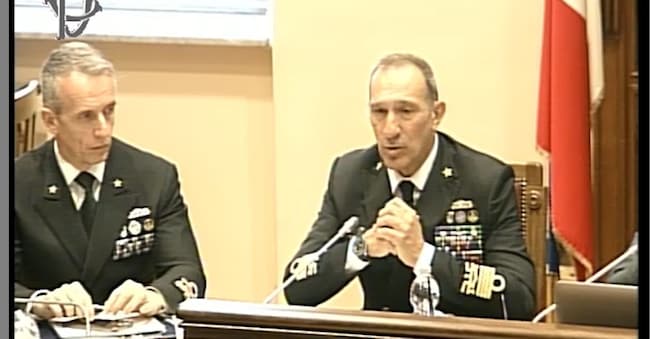
Il Capo di Stato maggiore della Marina militare, ammiraglio di squadra Giuseppe Berutti Bergotto, interviene in audizione davanti alla Commissione Difesa della Camera  Foto: frame tratto dalla diretta della Camera

5' min read

Translated by AI
Versione italiana

5' min read

Translated by AI
Versione italiana

Italia is ready to make its contribution in the demining of the Strait of Hormuz, in the context of the crisis between the USA, Israel and Iran, but the involvement of Italian minehunters can only be developed in a phase of truce or end of the conflict between the parties. This is the message launched by the Navy's Chief of Staff, Admiral Giuseppe Berutti Bergotto. At least four vessels will set sail to reach the waters in whose depths the Iranians have deposited the ordnance. A group based on two minesweepers with an escort and a logistical support unit. The escort could be a frigate or a destroyer. The ships are in Italian ports ready to leave.

Speaking on Wednesday 22 April at a hearing before the Committee on Defence of the Chamber of Deputies, he clarified that 'the Navy is ready to carry out a de-mining operation. Obviously,' he added, 'these operations must be done in a non-conflict situation because they are very delicate and like all operations in sensitive areas carry risks. Our task is to keep the risks as low as possible, we do this through very advanced technology,' he explained.

Loading...

"We have seen that the closure of Hormuz is done quickly, even with a few lira," said the Navy Chief of Staff, "because the mines that the Iranians have put in Hormuz cost very little and are also dated. But this means that there is an area of uncertainty and, above all, an increasing decline in the safety of navigation'. 'I'm only talking about the mines because then there are all the other threats that can be carried by missiles,' he added. 'In that area the Iranians have significant missile launch points that can actually hit all the ships that transit the Strait. Hormuz at the end is 33 km, not a lot. The part that has been dedicated to merchant traffic is the central part, so we are talking about a distance from the Iranian coast of about 18 km, which can be reached quickly with a barge going 50-79 km. So it is very important for us to ensure freedom of navigation.

Crosetto's words

On the hypothesis of a mission to secure the Strait of Hormuz, in the last few days Defence Minister Guido Crosetto has expressed the hope that there would be a UN aegis, but also added that 'I will be formalised if instead there are 42 nations with a mandate and a multilateral peacekeeping force. And I don't think that, in the face of an international mission, Parliament can make any distinctions'. "Italia, which has one of the best navies in the world, could think about minehunters,' added the Defence chief. 'For 20 days I have been telling the head of Defence and the Navy to be ready with two ships. But to send them we need the end of hostilities, because nobody wants to enter a war'.

Berutti Bergotto: 'Planning to send 4 ships to Hormuz'

Before the cameras of Cinque Minuti, Berutti Bergotto spoke of four ships. "The prudential planning that the Chief of Defence Staff has done," he explained, "envisages a group based on two minehunters with an escort unit and logistics that allows us to increase the period. A total of four ships. Obviously we are not going alone, we are going as part of an international coalition, other nations will also send minesweepers. In Europe we have France, England and a joint group between Holland and Belgium.

"We have eight fibreglass destroyers"

At the audition Berutti Bergotto gave some details: 'We have eight fibreglass minesweepers that are from the 1990s, but over the years they have always been modernised to the state of the art. So now we have means that are technologically advanced, using remotely piloted and autonomous means for the search and then for the charge that allows us to defuse and clear the mine. But the intervention of minesweepers, but not only Italian ones, also those of all other nations, in a mined area must be done once the hostilities are over'.

"Ready to go at first indication from the government"

"It is obvious that we have always been ready," said the Chief of Staff during the House hearing. The Navy maintains a high state of readiness, we always have certain ships that are ready to go in accordance with the instructions we receive from the government, and I feel I can say that we are ready and we are prepared for this work.

"Every year we clear an average of 14,000 explosive orders"

Berutti Bergotto emphasised one aspect: 'We,' he said, 'have a high demining capacity, we are a reference nation in this field because we have always carried out demining. Just think that every year we clear an average of 14,000 explosive ordinances that are found either at sea or on our beaches. They are all remnants of war, of course. And this has allowed us to maintain a high level of preparation, a high level of training for our personnel'.

Pasdaran boats need escort ships

The Navy Chief of Staff recalled that the threat of mines is not the only threat to free navigation in the Strait of Hormuz. 'Obviously,' he said in front of the Defence Commission deputies, 'there is not only the threat of mines, there is also the threat of bargees, those go on merchant traffic and there it is another story. We should use ships to escort, but again intervening in that area means intervening when the conflict has ceased'.

The case of the Oman waters route

'The Strait of Hormuz,' Berutti Bergotto pointed out, 'is really a strait, so Iran has the ability to attack ships, even if they pass within united waters, so the difficulty of passage remains in both areas, i.e. those near Iranian territorial waters or those in united territorial waters. What I wanted to point out is that just recently, two days ago, three ships passed using the Omani route, they passed without any particular problems, they were not attacked, while others that a week ago were trying to pass by the route that was supposedly open, Iranian territorial waters were victims of attacks, they turned back because first there had been the opening and then after a short time the blockade and they were passing when the passage was blocked.

"Despite international missions, there are only Italian ships"

"The activities that we do in international environments," explained the Navy Chief of Staff, "are done either within NATO coalitions, the European Union or fairly large international coalitions, this is because it helps the effectiveness of the operation: there is an exchange of information, there are more means available and also from the international point of view there is greater security. Therefore, I believe that an operation in Hormuz, even if this is a government decision, can be developed in an international environment. In the Red Sea and the Indian Ocean we are also within a coalition and we are there as Europe, but I would like to say that to date, in both operations, there are only Italian ships. In the Red Sea there is currently only our ship, we are Force Commander, that is, we are the Commander of the Sea, and at the beginning of May a Greek ship will also be part of the Force, but to date there is only one Italian ship," Bergotto concluded

Copyright reserved ©
Loading...

Brand connect

Loading...

Newsletter

Notizie e approfondimenti sugli avvenimenti politici, economici e finanziari.

Iscriviti