Defence

The Navy aims to equip the aircraft carrier Cavour with the TB3: here are the features of the super drone

The indication came from the Navy Chief of Staff, Admiral Giuseppe Berutti Bergotto, during his speech at a hearing before the Senate Foreign Affairs and Defence Commission

by Andrea Carli

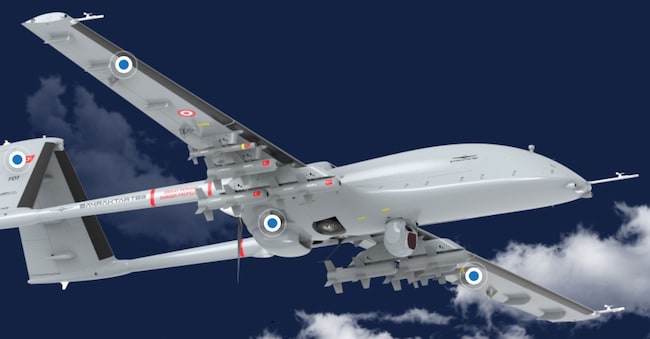
Un’immagine del drone Bayraktar TB3. Se ne vuole dotare la Marina Militare

3' min read

Translated by AI
Versione italiana

3' min read

Translated by AI
Versione italiana

TheNavy aims to acquire a new combat drone. It is the TB3 system developed by Baykar. The drone is called the Bayraktar TB3. It should operate from the deck of the aircraft carrier Cavour. The Chief of Staff of the Navy, Admiral Giuseppe Berutti Bergotto, has spoken on the issue in recent days during his speech in a hearing before the Senate Foreign Affairs and Defence Committee. Bergotto showed footage of the Bayraktar TB3 taking off from the Turkish aircraft carrier TCG Anadolu. The Navy - and defence in general - is increasingly looking at unmanned systems, including drones.

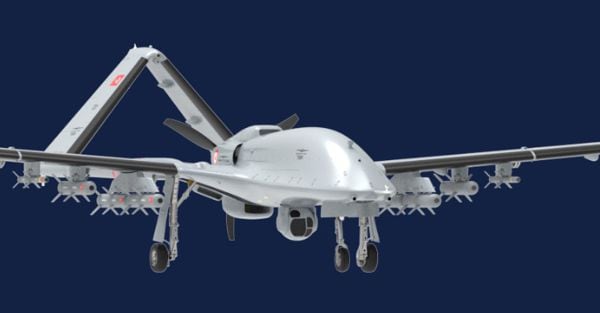
With a length of 8.35 metres, a wingspan of 14 metres, a load capacity of 280 kg, a maximum take-off weight of 1,600 kilograms and over 24 hours of autonomy, the TB3, an evolution of a model already tested in several international scenarios, is designed specifically for naval use. It has foldable wings, designed to optimise space on board, and a reinforced structure suitable for operational conditions at sea. It is a versatile drone, with capabilities ranging from reconnaissance to light attack.

Loading...

For the Italian Navy, the introduction of this type of aircraft could translate into a greater capacity for remote intervention. Indeed, drones allow for longer missions, lower costs compared to traditional fighter jets and less risk for personnel.

This drone is capable of taking off and landing autonomously on aircraft carriers with short runways. In addition to reconnaissance, surveillance and intelligence missions, the Bayraktar TB3 is equipped to carry out attack missions using 'smart' munitions mounted under the wings.

The system supports remote control over long distances, thanks to its line-of-sight (LOS) and beyond line-of-sight (BLOS) communication capabilities, making it functional for both short- and long-range missions.
The programme, they explain from the Navy, also fits into a precise industrial framework. The channel indicated goes through Leonardo and is linked to the cooperation with Baykar on unmanned systems. The reference is to a strategic joint venture designed to combine technology, industrial development and access to the European market. For this reason, the TB3 is important beyond the single deployment on the Cavour. It becomes the signal of a broader line, in which unmanned systems are considered a force multiplier and a component destined to affect the balance between surveillance, deterrence and capability.

The steps that will accompany the realisation of the project, starting with the timing and size of the acquisition, remain to be defined.

Berutti Bergotto: 'We should integrate it soon'

"I have a video where I wanted to show you where we are going," the Navy Chief of Staff explained to the senators. "The first is an unmanned underwater system that we should acquire in early June. It is completely Italian, 12 metres, and has a range of about 15 days. It can be used for ISR (Intelligence, Surveillance, Reconnaissance) activities, that is, intelligence, surveillance, but also as a defence capability for our critical infrastructures. The second (the Bayraktar TB3, ed),' continued the admiral, 'is a surface system, also built in Italia, very fast, 9 metres. It can be embarked aboard all our ships. It reaches 50-60 knots depending on propulsion. We should also integrate this soon. This is a slightly more complex system. It is made by Baykar, a Turkish company. You know that this company has signed a collaboration agreement with Leonardo. Therefore the acquisition is through Leonardo and it can be integrated on board the ship Cavour. This allows surveillance, but also the possibility of armament'.

Il drone Bayraktar TB3

The Cavour

The Cavour is the flagship of the Italian Navy. This aircraft carrier is capable of carrying fifth-generation F-35 vertical take-off fighters, as well as military helicopters. It has a 234-metre-long flight deck, equipped with six take-off and landing points for aircraft and helicopters, two aircraft parking areas and two 30-tonne lifts connecting the flight deck with the hangar. It can embark a mixed flight group, aircraft and helicopters, consisting of about 20 aircraft. The aircraft used on the Cavour are AV8Bs, short take-off and vertical landing, with tasks of air protection of the fleet and close support to amphibious and ground operations. The helicopters are all those currently in line in the Navy and in particular the new EH101 and SH90. The hangar, necessary for the sheltering and maintenance of helicopters and aircraft in navigation, is 134 m long and 21 m wide, with the capacity to accommodate up to 11 aircraft. The Cavour is equipped with the most modern systems for self-defence: the SAAM-IT surface-to-air missile system, built in cooperation with the French Navy and equipped with modern ASTER 15 missiles. And the 76mm-calibre guns, double-loaded and in DAVIDE configuration, equipped with DART (Driven Ammunition Reduced Time of Flight) radio-guided ammunition. Waiting for the super drone.


Copyright reserved ©
Loading...

Brand connect

Loading...

Newsletter

Notizie e approfondimenti sugli avvenimenti politici, economici e finanziari.

Iscriviti