
From the Royal Air Force to Virgin Galactic: meet Villadei, the frontrunner for a new private space mission
The mission, known as Axiom 5, will be discussed at the next meeting of the Interministerial Committee for Space and Aerospace Research Policy (Comint)

Key points
A new space mission is being prepared for an Italian astronaut, likely Walter Villadei with Axiom Space. Foreign Minister Antonio Tajani announced this in Rome on Monday 2 November at the Farnesina, as he opened the proceedings of the General Assembly of the Space Economy. The mission, known as Axiom 5, will be discussed at the next meeting of the Interministerial Committee for Space and Aerospace Research Policies (Comint).
Pilot Colonel in the Italian Air Force
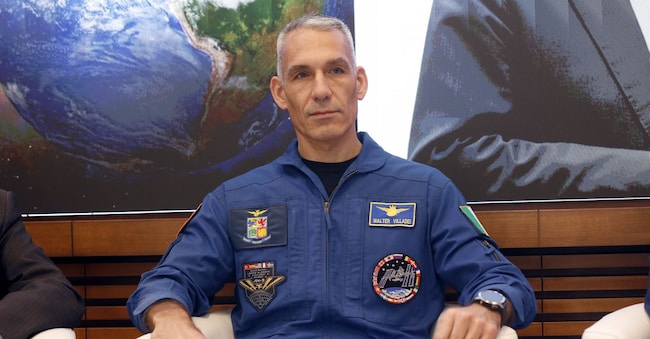
Villadei is one of the leading figures of the new generation of Italian astronauts, specialising in aerospace engineering and space activities. His career combines the fields of the Air Force, space exploration, and scientific and technological research. Born in Rome on 29 April 1974, he is a pilot colonel in the Italian Air Force. He graduated from the Air Force Academy in Pozzuoli. He obtained his degree as the Italian Air Force’s first aerospace engineer from the University of Naples ‘Federico II’. He took part in the ‘Galactic 01’ suborbital flight organised by Virgin Galactic, the company founded by tycoon Richard Branson to offer suborbital space flights to the commercial market. This was the company’s first commercial space flight. Following an agreement between Axiom Space and the Italian Ministry of Technological Innovation and Digital Transition, Villadei was designated as a reserve crew member for the Axiom 2 mission. He was subsequently assigned as a pilot for the Axiom 3 mission, which launched on 18 January 2024. During the Axiom 3 mission – named ‘Voluntas’ in honour of Italia – he served as pilot of SpaceX’s Crew Dragon spacecraft.
He spent 18 days on board the International Space Station
Villadei spent 21 days and around 16 hours in space; 18 days on board the International Space Station. He took part in numerous scientific experiments, including some from Italy, relating to microgravity, human health and space technologies.

