
From water cooling to new HPC for Cineca: the data centre for AI according to Lenovo
Alessandro de Bartolo, Country General Manager and Managing Director of Lenovo's Infrastructure Solutions Group division, speaks
6' min read
6' min read
Increasing computing power and reducing energy consumption: the equation is simple (on paper) and at the same time a very complex matter when it comes to finding the right solution to bring it down to earth. The demand for computing capacity to train generative AI models and to deploy and power AI applications is steadily increasing (according to the AI Now Institute's findings, it is doubling every six months) and it is reasonable to assume that it will continue to grow. Not least, data centres are already responsible for between 1.5 and 2 per cent of global electricity demand (says the IAEA, the International Energy Agency) and this percentage is also set to rise in the years to come. Containing the costs and environmental impact of High Performance Computing systems is therefore a shared obligation for the technology industry, and the strategy of one of the main infrastructure suppliers for this sector, namely Lenovo, goes precisely in this direction. Its boast? Its sixth-generation Neptune liquid cooling systems, capable of cutting server farm consumption by up to 40%.
Gen AI's impact on GPUs
.Alessandro de Bartolo, Country General Manager and Managing Director of the Infrastructure Solutions Group division of the Chinese-origin manufacturer, points out how the scenario to be referred to reflects a series of converging factors, starting from the greater requirements imposed to interrogate a Gen AI to the ever-increasing demand for data processing and computational capacity, from the fact that we are moving towards the physical limits of GPUs and CPUs to the correlated need to miniaturise systems to optimise data centre spaces. To give a vague idea of the impact of the power and computing density required for the development of generative artificial intelligence models, one figure, based on Goldman Sachs' estimates and related to an operation that is now common to millions of people on the planet, may probably suffice: each 'query' made in ChatGpt requires almost ten times more energy than a classic interaction with the Google search engine. AI that exploits large-format languages therefore requires increasingly 'energy-hungry' hardware (and in counting consumption, one should not forget the ever-increasing pervasiveness of digital services) and opens up the front to several new challenges, including that of managing the increased heat coming from the graphics processing units that support the workloads. In fact, the energy required by GPUs is five to ten times higher than that absorbed by CPUs (due to the greater number of integrated transistors), and the process of miniaturising the components, which further increases their power density, also leads to greater heat generation within the systems where they are installed. Hence the use of more electricity to cool the machine rooms.
Energy costs and consumption: towards a sustainable model
One of the challenges to be measured against, the manager explained to Sole24ore.com, "is to distribute the place where data is processed and therefore to be able to manage workloads that require different processing power, power supply and cooling". The edge computing paradigm, in short, plays an important role in the game that must lead data centres to be more sustainable, and in this sense Lenovo's vision looks to a (very near) future in which the infrastructure supporting AI will be hybrid, between compute-intensive spaces (data centres) and places at the edge where data is processed on site. The present, on the other hand, requires substantial interventions inside the machine rooms, 'the most energy-consuming component and,' the manager goes on to emphasise, 'where energy efficiency must be maximised also thanks to the support of Gen AI, which will modulate the operation of the systems with respect to the consumption required for the various phases of its management'. The other side of the same coin is the cost of energy: a recent simulation by IDC showed how the cost of the electricity needed to run data centres (the calculation was made on facilities with a PUE, Power Usage Effectiveness, the unit used to measure the energy efficiency of a data centre, of 1.5) could grow at a compound annual rate of around 20%, with an upward trend that would jeopardise the economic sustainability of the sector. 'The most relevant impact,' de Bartolo emphasises, 'is the operation and maintenance of the technology over time, not its acquisition. Technology must lead systems to do more with less: and if we look at energy costs in Italy, when consumption is cut by 40 per cent, the benefits obtainable become very important". The contribution of cutting-edge technologies and the increasingly strategic recourse to renewable sources are therefore "compulsory" ways to lower the management costs and reduce the environmental impact of data centres, and equally important are the ways in which the large machine rooms are cooled, due to the fact that traditional air systems are proving to be no longer efficient to support the imperative of reducing carbon emissions. And it is on this specific level that Lenovo is convinced it can make a difference.
The benefits of water cooling that Nvidia likes
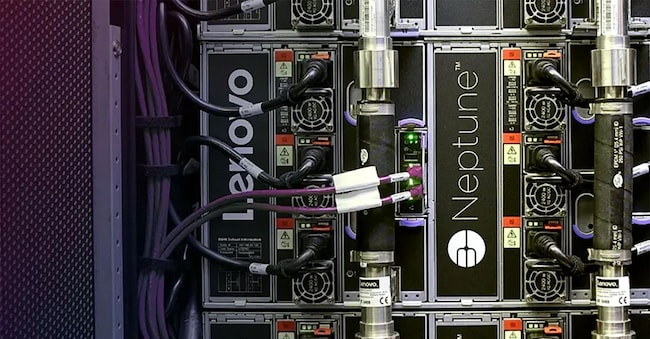
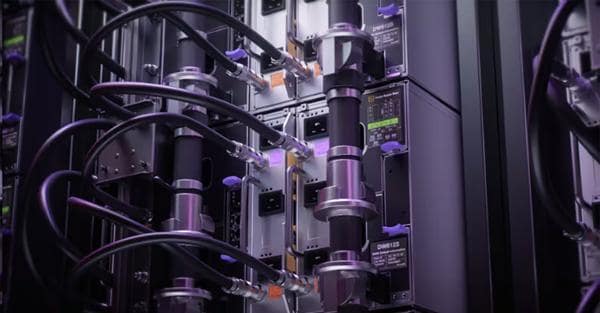
The Chinese multinational's approach, when it comes to cooling technologies in environments where AI applications and models are processed, reflects the assumption that the determining factor is not just the power of the components operating within the data centre but their density. Unless servers become three times larger, systems that guarantee efficient heat removal and liquid cooling will become indispensable to support the mainstream deployment of artificial intelligence and a crucial element in the design of the new generation of data centres used by hyperscalers, medium and large enterprises, and public research centres,' de Bartolo points out. The latter, not surprisingly, were among the first to believe in the effectiveness of liquid cooling to support their HPCs' work in AI, while companies, which are notoriously more cautious about investing in innovative solutions, are gradually winking at this technology, particularly those in the financial sector and the automotive industry. To them, and to all industries, the Chinese multinational can offer its customers a decade of experience with its Neptune systems, which use pure water with sockets at room temperature and promise to dissipate up to 98% of the heat produced by supercomputers while maintaining CPU temperatures at values that guarantee maximum operating frequency. The impact on consumption, Lenovo confirm, is significant both at the level of individual servers and (above all) of the data centre as a whole, precisely because (as a rule) only two thirds of the energy used by an engine room is for processing, while one third is used to cool it on a perimeter basis. But that's not all. Liquid-optimised data centres allow more equipment to be placed in a high density of racks, using less physical space and consequently reducing the need to build new buildings, and to collect the heat from the hot water escaping from the machines to heat the buildings. "In the long term," de Bartolo confirms, "we will be able to water-cool 100 per cent of the systems that adopt Nvidia's Blackwell generative AI GPU architecture.
Italian best practices for sustainable supercomputing
Italy, and this must be read as very good news, is a pioneer in the adoption of water-cooling systems, and this news is in line with the projections of forthcoming investments in the data centre sector, estimated by the IDA (Italian Datacenter Association) to be between 10 and 13 billion euros for the next five to ten years, with some twenty projects in the pipeline and in the presentation phase, and an overall economic impact that could exceed 15 billion, including IT equipment and operating costs. If the capacity of commercial data centres in Italy is expected to reach almost 1 GW of installed IT power by 2028 (or even 1.2 GW if the race ahead driven by artificial intelligence continues at a sustained pace), all the supercomputing-related projects in the belly of the main Italian research centres on which Lenovo is working contemplate the adoption of Neptune technology. The names to refer to are those of the CSCC in Lecce, which studies the effects of climate change, the University of Pisa, ENEA (the national agency for new technologies, energy and sustainable economic development) and Cineca. It is precisely these last two, hand in hand with

