Cultural heritage

The revival of Palazzo Saladini Pilastri in Ascoli, funded by the PNRR: a neoclassical gem with an ethical restaurant attached

The construction project involved over 200 workers and dozens of local businesses, and was funded with 39 million from the National Recovery and Resilience Plan. Prime Minister Giorgia Meloni was also present at the opening ceremony.

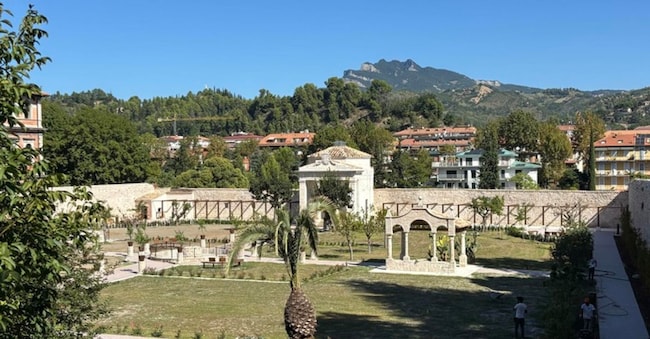
I giardini di Palazzo Saladini Pilastri ad Ascoli Piceno ANSA

3' min read

Translated by AI
Versione italiana

3' min read

Translated by AI
Versione italiana

“It is the greatest project in the history of the Municipality of Ascoli Piceno.” Marco Fioravanti, mayor of the Marche municipality, describes Palazzo Saladini Pilastri in this way as he presents the magnificent restoration project involving the building and its monumental park. The official inauguration of the regeneration works took place today in the presence of Prime Minister Giorgia Meloni. The complex, which was formerly the private property of Count Saladini Pilastri, will open to the public in 2027, but on 10 and 11 October it will be open to visitors as part of the FAI (Italian Environment Fund) Autumn Open Days.

PNRR funds

The building’s regeneration project was funded with €39 million from the National Recovery and Resilience Plan (PNRR) as part of the Ministry of Infrastructure and Transport’s National Innovative Programme for Quality of Living (Pinqua), and was managed using cutting-edge technologies such as BIM digital modelling.

Loading...

This major construction project involved over 200 workers and dozens of local businesses. The works covered around 9,000 square metres of public spaces and an Italian-style garden spanning approximately one hectare. The aim of the restoration was to return part of the city’s important historical and architectural heritage to the community.

The social function

The concept behind the redevelopment of the complex – which involves the refurbishment of the building and its repurposing through a special public-private partnership – combines heritage conservation with a social mission. Inside the building, in fact, there will be a hotel and an ethical restaurant run by young people with disabilities, alongside 138 affordable housing units for those who choose to make Ascoli their home.

There will also be a third-sector administrative centre and a community-based healthcare centre. The project therefore aims to turn the facility into an urban welfare hub capable of integrating healthcare, social and housing services.

The opening ceremony

During the opening ceremony, the complex’s historic garden was named after Pope Nicholas IV. “It is a magical place where the people of Ascoli can enjoy the silence, read a book, listen to music and recharge their batteries right in the heart of the historic centre” explained Mayor Fioravanti, adding that it had been decided to present the building ‘in its raw state to showcase the cultural, artistic and historical value of the restored frescoes, as well as the restoration of the fountain, the aedicule and the coffee house’.

At the press presentation of the work, Professor Stefano Papetti, director of the Civic Museums of Ascoli Piceno, emphasised the great significance of the cultural heritage brought to light thanks to the restoration work. The project has, in fact, made it possible to recover important historical and artistic artefacts. “This project has brought together a high level of technical expertise, extraordinary operational capability and the determination to complete the work within a very short timeframe,” observed Papetti.

The archaeological finds and the church within the complex

Papetti highlighted the significance of the finds uncovered during the excavation work. ‘Among these,’ he added, ‘the large underground travertine wash houses stand out – which are now open to the public – having been used first by the Benedictine nuns and then by the Saladini Pilastri family, as well as decorations that had long remained hidden, such as the large hall frescoed with scenes from the life of Saint Egidio. The archaeological surveys and restoration work have also revealed precious 13th- and 15th-century frescoes, alongside 16th-century traces, bearing witness to over five hundred years of historical stratification.”

The professor went on to describe the church within the complex as ‘of exceptional beauty and, together with the Church of the Carmine, the only entirely Baroque church in the city’. Designed and built between the 17th and 18th centuries, the building houses the striking ceiling paintings by Ludovico Trasi and the high altar sculpted by Lazzaro Giosaffatti. ‘These are leading figures in Baroque painting and sculpture in Ascoli Piceno. A restoration of the highest calibre,’ he concluded, ‘which combines scientific rigour, cultural identity and renewed accessibility for the community’.

The history of the building

The building was constructed in the 16th century on a site previously occupied by a Benedictine nunnery and stretches for approximately 119 metres along Corso Mazzini. The building features an imposing travertine façade in the neoclassical style and, to the north, overlooks an Italian-style garden covering almost 9,000 square metres, which also houses a private hexagonal chapel and a partially underground washhouse. The complex also includes a cloister, stables, storehouses and service rooms.

Loading...

The Benedictine monastery remained in use until the Napoleonic era and was purchased in 1820 by Count Ludovico Saladini Pilastri. In 1848, work began on a major renovation project entrusted to the Modena-based architect Luigi Poletti, a leading figure of the Neoclassical movement. The last member of the noble family that owned the property, Count Saladino Saladini Pilastri, transferred the building to the Municipality of Ascoli in 2022.

Copyright reserved ©
Loading...

Brand connect

Loading...

Newsletter

Notizie e approfondimenti sugli avvenimenti politici, economici e finanziari.

Iscriviti