
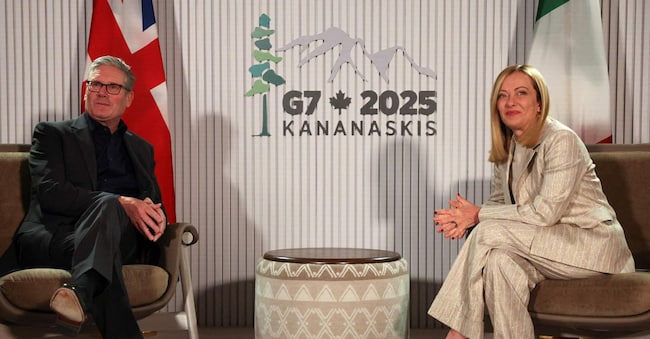
G7 meeting in Canada between Meloni, Macron, Merz, Starmer and Carney
All eyes are on Donald Trump, who on the very eve of the summit displaced the allies by opening up to a possible mediator role for Vladimir Putin in the conflict between Tehran and Tel Aviv that will be the focus of the working dinner to be held this evening

2' min read
Key points
2' min read
From our correspondent
KANANASKIS - The meeting between Giorgia Meloni, Keir Starmer, Friedrich Merz and Emmanuel Macron, held at the bar of the lodge in Kananaskis where the leaders are staying for the G7, ended around 10.30 p.m. (6.30 a.m. in Italy). The aim of this informal summit: to find a common position to facilitate the descalation of the conflict between Israel and Iran that has become the star of this G7 in Canada.
Trump's proposal: Putin to play mediator in the crisis between Israel and Iran
All eyes are on Donald Trump who, on the very eve of the summit, displaced the allies by opening up to a possible mediator role for Vladimir Putin in the conflict between Tehran and Tel Aviv that will be at the centre of the working dinner to be held this evening. A hypothesis that, however, does not please the Europeans (Emmanuel Macron said this even before arriving in Canada) who do not consider it plausible to entrust the person who invaded and bombed Ukraine with the role of peacemaker. Volodymir Zelensky, who will participate tomorrow in the session devoted to the ongoing war but also to reconstruction, hopes to obtain reassurances from Trump on the American commitment that remains essential for Kiev.
Europeans' support for Kiev 'for as long as it is needed'
The main European leaders - starting with the four big ones present at last night's summit - have repeatedly reiterated that they will maintain support for Kiev 'for as long as it is necessary'. At the moment, however, not even a joint declaration is planned precisely because of the fear that a text that would find unanimous consensus cannot be reached. Fear also linked to Trump's unpredictability. Unpredictability that also looms over another war: that of tariffs declared by the US President.
The tariffs node
The dossier on tariffs is not part of the G7 agenda (nor is the Iran-Israel war) but it is a topic that is certainly very much on the agenda, not least because there are only about twenty days left before the tariff truce expires on 9 July, after which the tariffs decided by the US President on European goods will return to 50%. Ursula von der Leyen is also in Canada, but no face-to-face talks between the US leader and the president of the European Commission are scheduled at the moment to facilitate an agreement.


