Middle East

Gaza, Rafah crossing reopens to pedestrians. Tuesday Witkoff from Netanyahu

Al Jazeera: '3-year-old Palestinian boy killed by Idf'

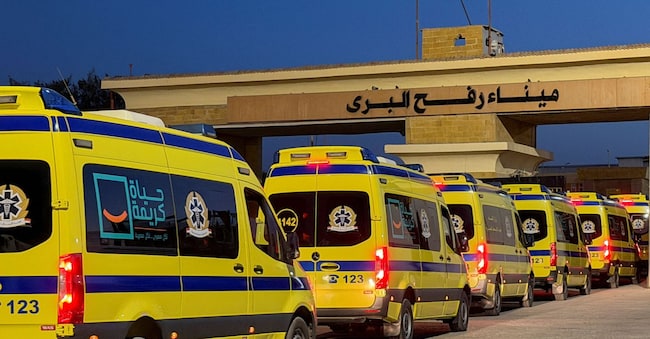
Le ambulanze egiziane si mettono in fila per raggiungere la Striscia di Gaza attraverso il confine di Rafah dal lato egiziano, dopo che lunedì Israele ha riaperto il confine tra Gaza ed Egitto per i pedoni, a Rafah, Egitto, 2 febbraio 2026. REUTERS/Stringer

5' min read

Translated by AI
Versione italiana

5' min read

Translated by AI
Versione italiana

A three-year-old Palestinian boy was killed by Israeli troops in the al-Mawasi area of southern Gaza, near the town of Khan Younis. The attack occurred outside the Israeli army's deployment areas in southern Gaza, sources at the Nasser Medical Complex told Al Jazeera.

Located along the Gaza coast, near the southern city of Khan Younis, al-Mawasi is home to a vast refugee camp with tens of thousands of Palestinians living in miserable conditions, Al-Jazeera recalls. Despite the continuing deadly attacks, the Arab news outlet continues, Israel has described the area as a 'humanitarian safe zone'.

Loading...

The victim was a 3-year-old boy named Iyad Ahmed Naeem al-Raba'i, according to the Wafa news agency. He was killed when Israeli gunboats shelled tents housing displaced people in al-Mawasi. Since the ceasefire came into effect on 10 October 2025, Israel has killed more than 500 Palestinians in Gaza and wounded another 1,400, according to the Palestinian Ministry of Health.

Rafah crossing reopened for pedestrians: 'A window of hope'

Meanwhile, the Rafah crossing point in Gaza, on the border between Egypt and the Gaza Strip - closed since May 2024 - has been reopened for residents to enter and exit on foot, an Israeli security official announced. However, the crossing requires prior authorisation from the Egyptian and Israeli authorities.

According to the agreed operational plan, up to 150 people would have to leave Gaza every daythrough the crossing to reach Egypt and 50 would take the opposite route.

Hamas, designated a terrorist organisation by the West, criticised the daily ceiling, saying that at least 15,000 wounded Palestinians need treatment outside Gaza and that another 20,000 are in Egypt waiting to return. Nevertheless, the opening of the crossing - and the fact that Israel has agreed to reopen it under these conditions - is a step that can be built on, Hamas official Taher al-Nunu told Al Jazeera.

A European Union delegation is monitoring the transit at the Rafah crossing, while Israel, for the time being, is limiting aid deliveries to Gaza to the crossings it controls.

Sources involved in the preparations for the opening have told the Saudi daily Asharq Al-Awsat that the names of hundreds of patients in need of urgent medical treatment have been submitted to the WHO, which is coordinating with Arab and international health authorities the procedures for their deportation to Egypt. They would be , according to Reuters,

The Palestinian Ministry of Health reported that the departure of the sick and wounded will take place at this stage through the Kerem Shalom crossing and not through the Rafah crossing. Meanwhile, the Qatari Al-Arabi channel reported that around 150 wounded Palestinians were transferred from the Red Crescent hospital in the Gaza Strip through the Kerem Shalom crossing, which allows exit to both Israel and Egypt.

Slow entry and exit operations

On the first day of reopening, operations are proceeding very slowly and at 2.45pm local time (1.45pm in Italy) no one had crossed, in either direction. Sources in the Sinai Governorate reported this. Waiting on the Palestinian side are hundreds of wounded people on their way to Egyptian hospitals, and on the Egyptian side about fifty people treated in Egypt who want to return to their country. The governor of North Sinai, Khaled Maghawer, inspected the crossing from the Egyptian side and supervised the reception of patients. The Ministry of Health arranged for hundreds of ambulances to receive the injured and transport them to various hospitals in North Sinai and Cairo. The source attributed the delays to the fact that the names of those waiting had not yet been submitted to the Israeli authorities for approval.

The Egyptian Red Crescenttold Arab media that it is providing assistance at two humanitarian assistance centres in the arrivals and departures halls of the border crossing. The organisation's statement reads that these services include creating safe spaces to provide psychological support to children, providing wheelchairs, assisting and accompanying the sick, injured and elderly, and running a humanitarian kitchen. Last week, the IDF announced that the exit and entry of residents from Gaza is allowed in coordination with Egypt, subject to security approval by Israel and under the supervision of the European Union delegation, similar to the mechanism activated in January 2025, during the ceasefire under the second hostage agreement. Return from Egypt to the Gaza Strip will only be permitted to residents who left Gaza during the war.

Still no glimmer of hope, however, for international journalists, banned by Israel since the beginning of the conflict. The leaked information, gathered by news agencies, all comes from local reporters. Dozens of them have died trying to photograph the situation in Gaza.

The reactions

"This step is not just an administrative measure, but marks the beginning of a long process" to "open a real window of hope for our people in the Gaza Strip". This is how Ali Shaath, head of the Palestinian Technical Committee, commented on the reopening of the crossing.

"This is an important step towards a sustainable peace," the EU High Representative for Foreign Affairs, Kaja Kallas, echoed him at a press point in Oslo, stressing the urgency of "really moving to the second phase of the peace process in Gaza" and confirming the Union's readiness to contribute to this.

This news was also welcomed by the United Kingdom. "I welcome the reopening of Rafah to allow people to cross the borderin both directions on foot, allowing some who desperately need it to access medical treatment in Egypt," said British Foreign Secretary Yvette Cooper on X. "But much more needs to be done," she continued. "Aid must be allowed in, restrictions on essential supplies must be eased and aid workers must be allowed to operate," Cooper demanded.

For Madrid, however, the decision is definitely "insufficient". This was said by the Spanish Foreign Minister José Manuel Albares. In an interview with La2Cat and Radio 4, he called for the opening of all land crossings to allow humanitarian aid to enter the Strip. "Humanitarian, food and medical aid must be able to enter Gaza in a completely normal way," Albares said, denouncing Israel's "almost recurrent" violation of the ceasefire in Gaza.

Tomorrow Witkoff to talk to Netanyahu

US President Donald Trump's envoy, Steve Witkoff, will visit Israel for meetings with Prime Minister Benjamin Netanyahu and the chief of staff of the IDF (Israel Defence Forces), Army General Eyal Zamir. This was reported by two senior Jewish state officials. Witkoff's visit is scheduled to begin Tuesday 3 February. Zamir was in Washington, DC, over the weekend for a series of talks with US defence officials regarding Iran. The semi-official Iranian news agency Tasnim in turn reported that direct talks between Washington and Tehran could take place in the coming days, citing "an informed source".

Copyright reserved ©
Loading...

Brand connect

Loading...

Newsletter

Notizie e approfondimenti sugli avvenimenti politici, economici e finanziari.

Iscriviti