

Gaza: oncologists sound the alarm – asbestos found in 15 per cent of the rubble
Contaminated air and water, and 5,000 patients waiting for authorisation to travel for treatment: the devastating effects of the conflict on health

Key points
For decades, the population of the Gaza Strip – in a context where cancer care has been completely wiped out by the war – will remain at risk of developing cancers such as pleural mesothelioma, lung, laryngeal and ovarian cancer – that is, the main cancers linked to exposure to asbestos fibres. This has shone a spotlight on the massive health risk, which comes on top of already tragic conditions – with UNICEF having just launched an appeal for $97.5 million to prevent the devastating effects of the approaching winter, in which children are once again likely to be the first victims – is the Italian Association of Medical Oncology (AIOM) through its Foundation
Asbestos found in 15 per cent of the ruins
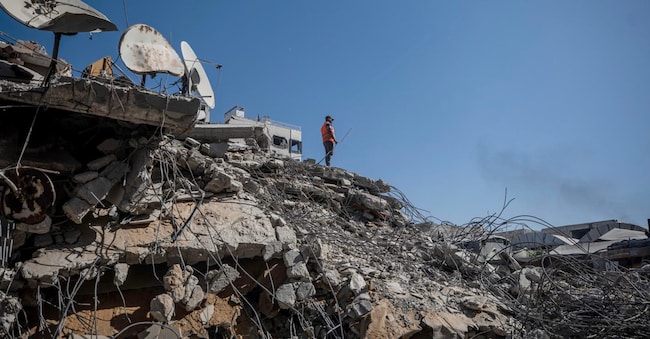
The doctors, gathered in Erice in the province of Trapani for the Ethics Conference – dedicated this year to ‘War, Global Health and Oncology’ – begin by setting out the figures relating to the disaster: the war in Gaza has generated 61 million tonnes of rubble, equivalent to the volume of 25 Eiffel Towers. It is estimated that 15 per cent of this rubble is contaminated with asbestos, industrial waste or heavy metals. A veritable environmental catastrophe, which adds to the conflict’s death toll not least because asbestos mixed with the rubble represents the main obstacle to any clean-up operation.
Cancer deaths have tripled in the Gaza Strip
“In regions affected by conflict,” explains Massimo Di Maio, President of AIOM, “cancer patients face urgent challenges due to a shortage of anti-cancer drugs, damage to hospitals, staff shortages and difficulties travelling to and from treatment centres, partly due to the malfunctioning of healthcare facilities, which are overwhelmed by war casualties. In Gaza, the situation was already at breaking point before 7 October 2023, the day of Hamas’s attack on Israel. Due to the resulting total siege imposed on Gaza by the Israeli authorities, hospitals have suffered a severe shortage of medicines, food and fuel.
According to the president of Aiom, following the destruction in 2025 of the Turkish-Palestinian Hospital – the only specialist facility for cancer treatment in the Gaza Strip – around 10,000 cancer patients have since been unable to receive specialist diagnoses and treatment, the necessary medicines and treatments. The hospital had 200 beds and was the centre of excellence for chemotherapy and cancer training. ‘Today, oncology no longer exists in Gaza, and Palestinian patients continue to face difficulties in obtaining permission to leave the Strip via Rafah to receive specialist medical care. It is estimated that 5,000 cancer patients are awaiting authorisation to leave. According to doctors in Gaza, people with cancer in the Strip are dying at a rate two to three times higher than before the war began,” explains Di Maio.
Italian oncologists have endorsed the World Health Organisation (WHO) manifesto, published in *The Lancet*, to improve care for people affected by cancer in conflict zones, and are ready to engage in international collaboration through concrete actions, ranging from fundraising for the reconstruction of cancer care infrastructure to supporting healthcare staff.

