Middle East

Israel, Shin Bet chief's brother accused of smuggling to Gaza Strip

Women returned from Rafah crossing: 'Journey of horror, humiliation and oppression'

by Giulia Riva
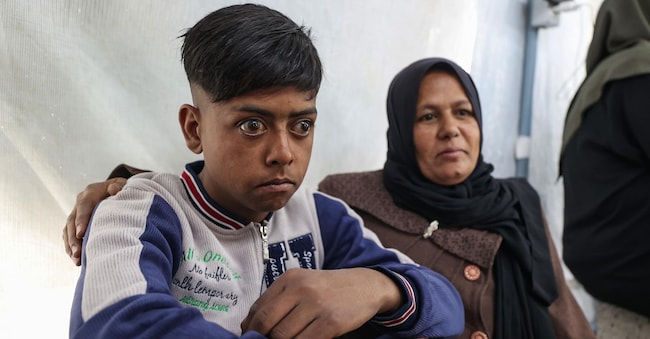
Pazienti palestinesi riuniti all'interno dell'ospedale della Mezzaluna Rossa palestinese a Khan Younis, nella Striscia di Gaza meridionale, il 2 febbraio 2026. Cinque pazienti palestinesi potranno attraversare il confine di Rafah per ricevere cure mediche, dopo che l'Organizzazione Mondiale della Sanità ha comunicato che la parte israeliana ha approvato il loro viaggio in Egitto. Israele ha riaperto il confine di Rafah tra Gaza e l'Egitto, consentendo ogni giorno il passaggio a un numero limitato di persone.  EPA/HAITHAM IMAD

7' min read

Translated by AI
Versione italiana

7' min read

Translated by AI
Versione italiana

A group of Palestinian patients treated in Egypt stand in a queue on the Egyptian side of the Rafah crossing, hoping to be able to return to their families in Gaza. Associated Press reports. On Monday, on the first day of the Rafah crossing's opening to pedestrians since 2024, only 12 people - as opposed to the 50 initially announced by the Israeli authorities - made it back into the Strip. The Palestinian Interior Ministry said this, while a report by the Qatari television channel Al-Araby reported that "30 of the 42 Palestinians who wanted to re-enter the Strip were sent back to the Egyptian side".

Gaza, altro gruppo di palestinesi feriti lascia Khan Younis per raggiungere Rafah

Leaving the Strip

For those trying to get out of the Strip, however, the situation is slightly smoother although equally cumbersome. After a day of waiting, Egypt received 50 people in need of medical care and 84 accompanying persons from the Gaza Strip through the Rafah crossing late yesterday evening. This was reported by the Egyptian state broadcaster Al Qahera, pointing out that they were accompanied to several hospitals in North Sinai, mainly in the city of Al-Arish, where emergency services and intensive care units had been put on high alert. This morning, the crossing was reopened in both directions to allow Palestinians stranded in Egypt to return to the Strip and patients to arrive from Gaza. These included not only war wounded but also the chronically ill, whose condition has worsened dramatically due to the shortage of medicines. A new group of Palestinians entered the crossing area this morning awaiting the completion of procedures and Israeli approval for their return to the Strip, while ambulances await the arrival of more patients from Gaza. The governor of North Sinai, Khaled Megawer, said that current arrangements allow the entry into Egypt of 50 sick people per day, with one or two escorts per patient, and that the governorate is overseeing logistical arrangements for both the delivery of humanitarian aid and medical evacuations. Patients are initially rounded up at the Karem Abu Salem (Kerem Shalom in Hebrew) crossing before being transferred to the Palestinian side of Rafah and then to Egypt.

Loading...
Gaza, riapre il valico di Rafah: i primi pazienti palestinesi diretti in Egitto

Twenty-two thousand patients waiting

According to Gaza health officials, some 22,000 patients are waiting for the crossing to be fully reopened.

 Gaza hospitals reported that Israeli forces killed a 19-year-old Palestinian man in the southern town of Khan Younis.

The NPA news agency Wafa reports that a Palestinian was killed by the IDF near the separation wall south of the city of Qalqilya, near the security barrier between Israel and the West Bank, late last night. According to local sources, Israeli soldiers opened fire near the village of Ras Tira at Omer al-Swarki, 21. The army has not yet provided any information.

Israeli fire has killed at least three people in the past 24 hours and injured 15 others in the Strip, the Gaza Health Ministry said in a statement. According to the ministry, other victims remain trapped under rubble and are inaccessible to rescuers and medics. Since the beginning of the ceasefire,the Jewish state has killed 529 people in Gaza, injuring another 1,462, according to the ministry. Rescuers recovered717 bodies trapped under rubble in the Gaza Strip during the truce.

According to the same source, Israel has killed 71,803 Palestinians in Gaza and injured another 171,570 since 7 October.

There are more than 18,500 patients in need of "specialised medical care that is not available within the Gaza Strip". This was stated on X by the director-general of the World Health Organisation (WHO), Tedros Adhanom Ghebreyesus, after reporting on yesterday's support provided by the WHO "to the medical evacuation of five patients and seven escorts to Egypt through the Rafah crossing". The Oms director then described as a 'top priority' the reconstruction of Gaza's health system >to reduce dependence on medical evacuations".

"A rapid upgrading of health services inside Gaza is needed, with an increase in medical supplies, rehabilitation of damaged facilities and expansion of essential services to build a resilient and sustainable health system," Ghebreyesus explained, also returning to call for the "immediate reopening of the medical transfer route to the West Bank, including East Jerusalem".

The logo of the National Committee for the Administration of Gaza

The office of Israeli Prime Minister Benjamin Netanyahu criticised the new logo of the National Committee for the Administration of Gaza (Ncag), saying that the logo 'presented to Israel is completely different from the one published' on Monday evening, 2 February. The Times of Israel reports.

"Israel will not accept the use of a Palestinian National Authority symbol; the Palestinian National Authority will have no role in the administration of Gaza," the office added. The National Committee for the Administration of Gaza has replaced its phoenix logo with the emblem of the Palestinian National Authority, which depicts Saladin's eagle. At the moment, according to the Times of Israel, the only difference between the two graphics would be the abbreviation Ncag - National comittee for the administration of Gaza - instead of Palestine, Palestine.

Witkoff from Netanyahu

Meanwhile, the US president's envoy Steve Witkoff met in Israel  Prime Minister Benyamin Netanyahu, army chief of staff Eyal Zamir and Mossad director David Barnea. A conversation, various Israeli media sources and rumours, centred on the Trump administration's talks with Iran. Israel's demand would be as follows: that any agreement with Tehran include the cessation of uranium enrichment, the removal of enriched uranium from the country, limits on ballistic missile production and an end to support for Hezbollah, Houthi, Hamas and Islamic Jihad in Gaza. This was stated by a source in Haaretz. If the demands are not included in an agreement between the US and Iran, Israel is expected to support an attack on Iran with the aim of overthrowing the Islamic Republic regime.

Brother of Shin Bet chief accused of smuggling to Gaza

An indictment will be filed against Bezalel Zini, brother of the head of the Shin Bet -the Israeli internal intelligence service - David Zini, as part of the investigation into alleged smuggling from Israel to the Gaza Strip. This was reported by the Israeli media. According to a prosecutor's statement filed in court today, Zini and two other suspects will be indicted for the crime of smuggling cigarettes into the Strip. The file also includes 13 other suspects for security offences, accused of participating in the transfer of goods that could also be used for terrorist purposes. Bezalel Zini, who was arrested over a fortnight ago, plays an important role in the reserve service and, according to the investigators, was aware of the activities and involved in the operations. Zini is one of the commanders of the 'Uriya Force', engaged in the demolition of buildings in the Gaza Strip. He also serves in the reserve as the logistics manager of the unit, which uses heavy engineering equipment. During the hearing, his brother Shmuel Zini stated that 'the truth will come to light'. Defence lawyers opposed the publication of the names of the suspects, arguing that this could endanger them.

Women back in Gaza: 'Journey of horror, humiliation and oppression'

In a testimony collected by Reuters, a number of Palestinian women - among the few people allowed to return to Gaza after Israel's delayed reopening of the Rafah crossing - told of being blindfolded, handcuffed and interrogated by Israeli forces as they tried to return home.

Their journey from Egypt, on Monday 2 February, through the border crossing and the 'yellow line' area controlled by Israel and an allied Palestinian militia group, involved long delays and the confiscation of gifts, including some toys, one of the women recounted.

"It was a journey of horror, humiliation and oppression," Huda Abu Abed, 56, said by phone from the tent where her family lives in Khan Younis, in the south of the Gaza Strip.

An account, hers, confirmed by that of another woman interviewed by Reuters and by the statements of a third woman interviewed by an Arab television station.

In response to a request for comment from Reuters, the Israeli army denied that its forces acted inappropriately or mistreated Palestinians crossing the border into Gaza, but did not specifically address the allegations made by the two women interviewed.

Some 50 Palestinians were supposed to enter the enclave on Monday, but by the end of the day only three women and nine children had been allowed through - according to both Palestinian and Egyptian sources - while 38 others remained stuck waiting to pass security checks.

Abu Abed recounted that those trying to return to the Strip - with a limit of one suitcase per person - encountered their first problems at the border crossing, where European border monitors confiscated the toys they were bringing home as gifts.

Huda spent a year in Egypt for heart treatment, but returned before completing it because she missed her family. One of her adult daughters had also travelled to Egypt for medical treatment. An adult son was killed in December 2024 and she was unable to say goodbye to him. Two other sons are in Gaza.

Once they had crossed the crossing and reached the Gaza side of the border, the 12 returnees boarded a bus for the journey through the Israeli-controlled area and over the 'yellow line' that demarcates the areas controlled by Israel and Hamas.

A second woman, Sabah al-Raqeb, 41, said the bus, escorted by two all-terrain vehicles, was stopped at a checkpoint manned by Israeli-backed Palestinian gunmen, who identified themselves as belonging to the Popular Forces, commonly known as the Abu Shabab militia.

The women's surnames were read aloud over a loudspeaker and each was led by two men and a woman from the Abu Shabab militia to a security point where Israeli forces were waiting for them. Then they were blindfolded and handcuffed, she and Abu Abed said.

They were asked what they knew about Hamas, the 7 October 2023 attack on Israel that triggered the war, and other militancy-related issues, the two women reported.

"The officer asked me why I had returned to Gaza. He said it was destroyed. I told him I came back for my children and my family," said Raqeb, who returned to her seven children living in a tent after leaving Gaza two years ago for what she thought would be a short trip for medical treatment.

Abu Abed said the interrogation lasted more than two hours.

In a statement denying any wrongdoing,the Israeli army said there were no reports of inappropriate conduct, mistreatment, detention or confiscation of property by the Israeli security apparatus.

He also said that there is a "process of identification and screening at the 'Regavim' control facility, run by the security apparatus in an area under control" mulitim Israeli. A process that would involve screening by European personnel under an agreed mechanism.

Copyright reserved ©
Loading...

Brand connect

Loading...

Newsletter

Notizie e approfondimenti sugli avvenimenti politici, economici e finanziari.

Iscriviti