
Geely’s production in Europe at Volvo and Ford plants: the reasons behind it and the anti-tariff strategy
The Chinese group is circumventing the tariffs by using its facilities in Sweden, Belgium and Spain

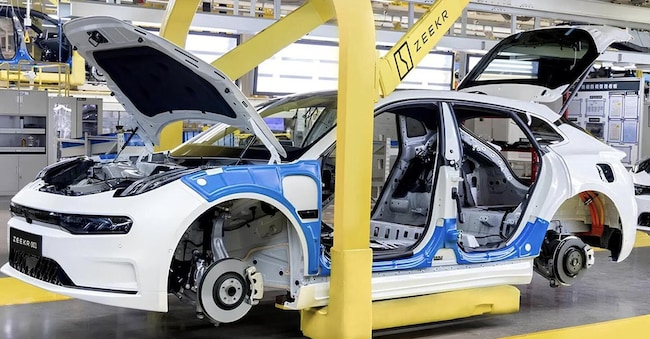
The European Union is working to impose tariffs on cars manufactured in China, in an attempt to halt the advance of Chinese car brands. The solution? To manufacture Chinese cars directly in Europe, thereby reducing any potential tariffs. Whilst BYD has chosen to build a new plant in Hungary, the Geely Group can rely on the facilities it already owns on the European continent, thanks to its acquisition of Volvo in 2010. In addition to the announcement regarding the plants in Sweden, the brand led by An Conghui, the new chairman of Geely Auto Group, has recently signed a joint venture with Ford to acquire a stake in the large Almussafes plant in Valencia, which covers an area of approximately 2.7 million square metres, including the stamping, vehicle assembly and engine production departments.
Geely to produce Chinese models at Volvo’s plants
The decision to build Geely, Zeekr and Link & Co models at the Swedish plants stems from a significant production advantage: the shared use of the SEA (Sustainable Experience Architecture) platform, which is already used for the Volvo EX30 and the Zeekr X. It is precisely this shared platform with the EX30 – which will also be produced at the Ghent plant from 2025 – that would suggest the Belgian plant as a possible choice for the assembly of Chinese models in Europe. This differentiation of brands and models is already taking place at the Chinese plants owned by the Geely Group, where models from completely different brands and with different powertrains are produced on the same production line, with the aim of maximising production capacity.
Geely and Ford in Valencia
Whilst production at Volvo’s plants did not require any further agreements, in the case of Ford’s Almussafes plant in Spain, a joint venture (66% Ford, 34% Geely) between the two automotive groups was necessary. This collaboration will result, from 2028 onwards, in two Geely models and a new Ford-branded multi-energy crossover produced on the Gea platform (Global Intelligent New Energy Architecture, which supports electric, hybrid and range-extender powertrains).
Almussafes plant
The Almussafes plant, which in the past employed over 10,000 people – compared with the current figure of 4,142 – is one of Europe’s largest automotive complexes. The factory covers an area of approximately 2.7 million square metres and currently produces only the Ford Kuga, with 98,591 cars assembled in 2025 and around 48,400 units in the first six months of 2026. These figures are a far cry from the levels achieved before the various rounds of downsizing. The production record dates back to 2004, when 449,101 cars rolled off the Valencia production lines, whilst Ford and Geely indicate that the plant has a potential capacity of up to approximately 500,000 vehicles a year. Since the 1990s, one of Europe’s leading components hubs has developed around the plant, with the Juan Carlos I Industrial Park directly linked to Ford’s production lines via supply chains. Prior to the current decline in production, Ford and the associated industrial park were credited with a turnover of nearly 12.2 billion euros and over 30,000 direct and indirect jobs. Today, the entire automotive and mobility cluster in the Valencian Community has a turnover in excess of 10 billion euros and employs over 24,000 people directly. The return to full capacity at Almussafes therefore represents an industrial development that affects not only Ford and Geely, but the entire Valencian supply chain.

