Towards Europe

Germany, moderate parties besieged by right-wing and left-wing extremism

Amid asphyxiating growth and geopolitical tensions, traditional groups register a slight erosion of support. The extreme right grows

from our correspondent Isabella Bufacchi

Aggiornato il 23 maggio 2024

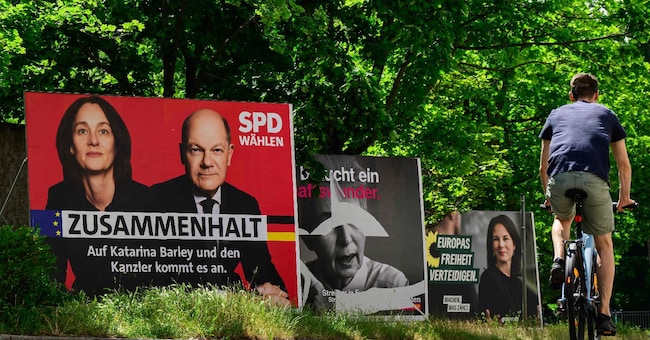
Manifesti elettorali a Berlino

7' min read

7' min read

FRANKFURT - The number of German citizens eligible to vote in the European elections this year will be around 65 million, not 61 because for the first time 16- and 17-year-olds will be able to vote. But all of them, young and old, will arrive at the ballot box disoriented, concerned about the future of democratic values, climate change and also about the loss of purchasing power and savings to be protected. In pointing out Germany's 96 MEPs in the European Parliament, unlike the 2014 and 2019 European ballot box, the 9 June vote will reflect geopolitical tensions, growing threats to democracy at home, the continuing sluggishness of economic development, and the loss of income of the less affluent classes caused by the triple pandemic, inflationary and energy shocks.

Goodbye pacifism

.

The fact that never before since the Second World War have there been so many (there are 60) conflicts in the world, with the Russian war in the Ukraine and the war between Hamas and Israel on Europe's borders, shakes the pacifist soul of the Germans, who are slowly resigning themselves to the idea that Germany will have to strengthen and enlarge its army, that more public spending on rearmament and the military will be needed, that only a more united Europe can seriously defend itself against the overbearing authoritarian governments.

Loading...

And never since the post-war period have German citizens felt they had to protect democratic values in Germany itself, due to the rise in recent years of the far-right AfD (Alternative für Deutschland) party, which is expanding from the stronghold of the former GDR Länder to a federal scale. Even if a recent series of 'over the top' episodes and a crescendo of gaffes at national and international level could reduce AfD's grip on the far-right electorate, just a handful of days before the European elections.

German voters, like all Europeans, are daily confronted with the great challenges of our time, from the green transition to digital transformation, from the disasters of climate change to the artificial intelligence revolution. But in the meantime, Germany's GDP has stopped growing: after -0.2% in 2023, this year's economic growth is expected to be around a meagre +0.2% or +0.3%. Even in 2025, GDP, which continues to be fuelled by exports, will fail to reach 1%: exports are struggling to return to the China of yesteryear, real wage growth has not grown cumulatively for the last five years, and workers have lost income and are poorer. Pre-Covid purchasing power will return in 2025.

General Election Test

.

In Germany too, the European elections will be an important test for all parties: the dress rehearsal for the federal elections next year. The scenario is complicated: all major German parties arrive at the European election rather battered.

The Cdu-Csu union has regained ground after collapsing in the lost 2021 elections, but is still struggling to fly high, travelling around 30% in the polls, a far cry from Angela Merkel's 40% golden age. The 30% does not allow for the formation of a Grand Coalition with Cdu-Csu and Social Democrats. At the moment, according to predictions and with respect to the 2019 vote, in the European elections on 9 June the Christian Democrats should remain stable at 30%: if they go further, to 31%, they will have something to celebrate. In 2014 they reached 35.3 per cent of the vote, in 2019 around 30 per cent.

The parties of the semaphore coalition Spd, Greens, Fdp, a first for a three-party government at the federal level, lost consensus while leading the country during multiple crises (pandemic and post-pandemic, Russia's war in Ukraine, Hamas-Israel conflict, energy shock and soaring inflation, ECB monetary tightening, derisking from China). It remains to be seen whether the Social Democrats and Greens will be able to overtake AfD in the Europeans and still remain around 15% (in 2014 and 2019 respectively Spd took 27.3% and 15.8% while the Greens took 10.7% and 20.5%).

The polls, the advance and the troubles of AfD

All major parties, with the exception of AfD, are actually expected to fall in the European elections.

The Social Democrats are indicated by some pollsters at 14%, thus worsening the European vote by 15.8% in 2019, the lowest in the party's history.

The SPD will not be the first party in the European elections, as it was in the 2021 federal elections, because it will be outclassed by Cdu-Csu. But it is not clear who will be the second party to vote for the European Parliament. AfD has been the second largest party in Germany for about a year in the polls measuring voter approval for the next federal elections: after peaking at 22% between the end of 2023 and the beginning of 2024, the far-right party is now settling at around 16% nationwide: very close to the SPD and the Greens. And it is not certain that it will also reach 16% on a European scale.

The Bündnis 90/Die Grünen, after almost doubling from 10.7 per cent in 2014 to a spectacular 20.5 per cent in 2019, should manage to reach 15 per cent in this election round: a good result, because it is close to the Spd and AfD, confirming that Germany is 'green'.

The Liberals, after returning above 5% in the 2019 European elections, fear they will fall below this threshold again in June. On the far left front, there is news: the arrival of the BSW party, founded last January by the charismatic Sahra Wagenknecht. It could take 7%, making Die Linke fall to 3%.

The only party that is expected to do better in the European vote than in 2014 and 2019 is AfD: paradoxically the only seriously anti-European party in Germany. If the polls are confirmed and AfD reaches around 15 per cent on 9 June, it will double the 7.1 per cent of 2014 and exceed 11 per cent in 2019: in a way, it can sing victory.

But the statements by Maximilian Krah, the AfD's leader in the European parliamentary elections, who in an interview with Repubblica and the Financial Times about the SS said 'that they are not all automatically criminals', have made the 'AfD' case explode with serious repercussions for the future of the party, at least in the EU.

The bureau of the Identity and Democracy (ID) group, the most right-wing group in the European Parliament, decided on 23 May to expel all nine AfD MEPs. The decision was taken after Rassemblement National founder Marine Le Pen and Lega leader Matteo Salvini said they no longer wanted to be part of an MEP group together with AfD: the stance of RN and Lega came after Krah's statements on SS.

Krah meanwhile, after the collapse of the party's reputation caused by the contents of the interview, has been forced to resign from the AfD leadership, from the federal executive committee, and will no longer be able to participate in the European election campaign: but the damage has been done and may be irreparable.

In addition, investigations are ongoing in Germany against Maximilian Krah because of his relations with China and Russia. It seems that one of his employees passed on internal information from the European Parliament to the Chinese secret service. Krah dismissed the employee, but said he knew nothing about his relations with China.

Krah is also accused of allegedly being involved in Russian propaganda in Europe and of accepting money to do this: he denies it.

The statements on the Waffen-SS by the way are not the first incident between Le Pen and AfD: they are rather the 'straw that broke the camel's back', according to German political commentators.

A serious problem had previously arisen over the use of the term 'remigration'. While AfD used this term (which means wanting to expel citizens from Germany who do not have 100 per cent German origins), Le Pen distanced herself with negative comments on remigration.

Party leaders Alice Weidel and Tino Chrupalla are flaunting confidence. They are looking forward 'optimistically to election night and the following days'. And they reassured their voters in this way: 'we are therefore confident that we will have reliable partners at our side in the new legislature'.

The moderate parties in Germany, encouraged by heartfelt public appeals launched by some 30 large listed German companies, are all working to stop the anti-democratic drift.

Also putting a spoke in AfD's wheels is the Bundesamt für Verfassungsschutz (BfV), the body that oversees the constitution and works to safeguard democratic principles: it has the power to declare AfD outlawed. AfD responds blow by blow, turns to any state court to appeal, poses as a victim of the system.

Campaign Themes

.

One does not hear much about Europe in the election campaign. But one should not be misled: this does not mean that Germany is dominated by anti-Europeanism. Quite the contrary. With the exception of the supporters of the extreme right and extreme left parties, all other large and small parties orbiting in the centre-right and centre-left area are distinctly pro-European. Europe, whether Eurozone or EU, is not in the least questioned by a large part of the electorate: so much so that the main parties, in their programmes for the European elections, sponsor the enlargement of the EU to the Baltic States, Ukraine and Moldova, advocate the mechanism of majority voting and not unanimity to speed up decision-making.

The issues that are holding sway in the election campaign in Germany, therefore, are transversal, national and European at the same time: more moderation in immigration, more spending on infrastructure, digital and defence, but without sending public accounts into a tailspin and without common debt; maintaining ecological policies for the protection of the environment; maintaining the goals of the green transition, but without ultra-costly acceleration and destabilising ambitions.


Copyright reserved ©
  • Isabella Bufacchi

    Isabella Bufacchivicecaporedattore corrispondente dalla Germania

    Luogo: Francoforte, Germania

    Lingue parlate: inglese, francese, tedesco, spagnolo

    Argomenti: mercato dei capitali, ECB watcher, fixed income e debito, strumenti derivati, Germania

    Premi: Premio Ischia Internazionale di Giornalismo per l’analisi economica, Premio Q8 per giovani giornalisti economici

Loading...

Brand connect

Loading...

Newsletter

Notizie e approfondimenti sugli avvenimenti politici, economici e finanziari.

Iscriviti