Broken-down locomotive

Germany, government sees recession in 2024

The Executive lowered its GDP estimates and is preparing for a contraction of 0.2 per cent this year. Structural problems and industry crisis are the main factors that are affecting the German economy. Inflation is also down. And the debt brake debate is reopened

by Gianluca Di Donfrancesco

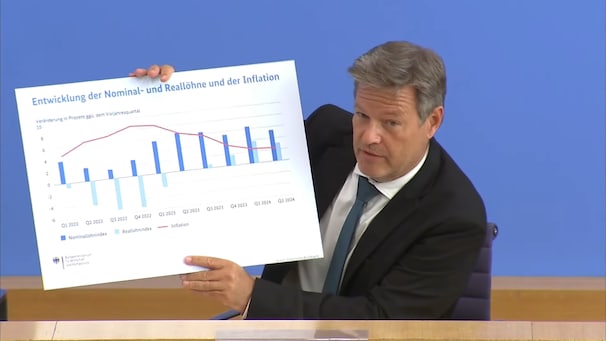
Il ministro dell’Economia Robert Habeck presenta le stime sulla  crescita tedesca

3' min read

3' min read

The German government surrenders to the trail of negative economic data that has been chasing each other for months and resigns itself to lowering its GDP growth estimates for 2024: the new forecasts indicate a contraction of 0.2 per cent, following the 0.3 per cent drop already experienced last year. Two consecutive years with a minus sign in front of the GDP change have only occurred once, since the reunification of Germany, in 2002 and 2003, when the government of the time launched a series of welfare reforms.

Resumption in 2025

.

The executive's new forecasts are in line with those of the country's main economic institutes and the Bundesbank. They are a significant but unavoidable deviation from the April estimates, when growth of 0.3% was still targeted. The scenario was explained on Wednesday, 9 October by the Minister of Economics, Robert Habeck.

Loading...

For a recovery we will therefore have to wait until 2025, an election year (voting takes place in September), when the Executive expects a rebound to 1.1%, followed by an acceleration to 1.6% in 2026. Inflation is expected to slow from 5.9% last year to 2.2% in 2024 and 2% in 2025.

Structural nodes

.

Habeck emphasised the urgent need to address the country's 'structural problems', which in his view are primarily the lack of energy security, excessive bureaucracy and the shortage of skilled workers, which, together with geopolitical uncertainty, are weighing on economic activity.

"The German economy has stopped growing significantly since 2018 and now the cyclical problems are being compounded by worsening structural problems," he explained. "In the midst of the crisis, Germany and Europe are squeezed between China and the US and must learn to stand up for themselves," he added.

https://www.ilsole24ore.com/art/pechino-risponde-dazi-ue-mirino-brandy-e-auto-grossa-cilindrata-AGHzEZR

The German economy, as the Bundesbank also indicated recently, may already be in a technical recession, with a GDP contraction in the third quarter, following the 0.1% drop in the April-June period. The crisis of its industry is exemplified by the crisis of the car industry and the country's most representative group, the Volkswagen, which is threatening the closure of plants in Germany (never happened in its history) and is preparing for a tough confrontation with the trade unions. But the difficulties are across the board, as shown by Intel's decision to postpone the construction of a new EUR 30 billion semiconductor plant.

With Germany stuck, the Eurozone loses the pull of its locomotive and pressure mounts on the ECB for a faster rate cut.

Release uncertainties

.

The coalition government, led by Chancellor Olaf Scholz, approved in July a package of measures to boost the economy. In it there is a bit of everything: tax relief, incentives to keep older people in the labour market and attract foreign skilled workers, permanent reduction of energy prices for industry, cutting red tape, and boosting public and private investments. Habeck, leader of the Greens and vice-chancellor, stated that these measures could add about half a percentage point to the growth rate, but several economic institutes consider this estimate very generous. The package must be approved by both houses of parliament by the end of the year.

The counter-trend in exports, which rose by 1.3% in August on a monthly basis and by o.1% on an annual basis (according to data released yesterday by Destatis), was not enough to change the general climate of weakness, even when combined with the rebound in industrial production, also in August.

Lindner: growth cannot be bought with debt

According to Habeck, the economy could be helped out of the crisis by a reform of the debt brake in the state constitutions and the federal budget.

But the Minister of Finance, Christian Lindner (leader of the Liberals), immediately put his foot down: 'The state cannot buy growth with debt,' he said, adding that 'a recovery is based on confidence, motivation, entrepreneurial risk and innovative strength. The framework conditions in Germany are no longer suitable for this. Our economy has been shackled for years by bureaucracy and tax burdens, but also by planning and increasing redistribution policies'.

Copyright reserved ©
Loading...

Brand connect

Loading...

Newsletter

Notizie e approfondimenti sugli avvenimenti politici, economici e finanziari.

Iscriviti