
Gibellina, the story of a rebirth from the '68 earthquake to capital of contemporary art
In January it was the protagonist, despite itself, of the first real emergency of the post-war period, being completely destroyed in the Belice events
3' min read
3' min read
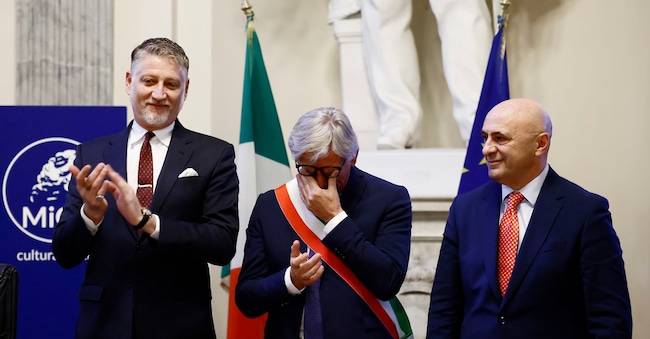
A virtuous example of rebirth, from catastrophe to a work of art. It happened in Gibellina, a small Sicilian town in the Trapani area, which is today proclaimed first Italian Capital of Contemporary Art for 2026. The title was introduced this year by the Ministry of Culture, and Gallarate, Carrara, Pescara and Todi were also in the running, but Gibellina "with its candidacy offers our country an organic and solid project," said Minister Alessandro Giuli, justifying the jury's choice, "delivering to today's Italy an exemplary model of cultural intervention based on values and actions that recognise a social function to art and the status of common good to culture.
The devastation of the earthquake
.In January 1968, Gibellina was the protagonist, despite itself, of the first real emergency of the post-war period, being completely destroyed in the Belice earthquake. Montevago, Poggioreale and Salaparuta are also razed to the ground, the valley is devastated. Shocks of magnitude 6.5 hit western Sicily and, in particular, the provinces of Palermo, Trapani and Agrigento. The toll is heavy: 296 people lose their lives, over a thousand are injured and almost 100,000 are homeless. The tremors followed each other for many months and over a year later a fireman lost his life, due to a violent tremor, while he was busy with rescue teams still among the rubble. The city now no longer exists, thousands of families see their lives changed forever and the economy, almost exclusively agricultural, suffers serious repercussions.
An open-air laboratory
.On 2 March 1968, it was the Belice earthquake victims themselves, together with numerous students, who asked the then Prime Minister Aldo Moro in front of Parliament for an ad hoc law for the reconstruction and development of the Belice Valley. It would take years to complete the project. The Belice became an open-air laboratory: it was decided to recreate the town some twenty kilometres downstream on the territory of the municipality of Salemi, and the former mayor, Ludovico Corrao, called together a group of artists and intellectuals to make their contribution. From Mario Schifano to Arnaldo Pomodoro, from Mimmo Paladino to Leonardo Sciascia, all offer an innovative perspective on artistic experimentation and planning. Alberto Burri refused to place one of his works in the new urban context and created the Cretto di Burri, or Grande Cretto, on the old Gibellina. From above, the work gives us a Gibellina composed of concrete blocks on the ground, 1.60 metres high, and fractures two to three metres wide, as if to freeze the historical memory of the town with a white robe that covers and protects at the same time. The work of contemporary art has an area of about 80,000 square metres and is among the largest in the world.
"From catastrophes, new realities can be born"
.According to the mayor of the Sicilian town Salvatore Sutera, awarding Gibellina is a 'signal to say that even from dark moments, marked by the many catastrophes we experience, absolutely new realities can be born. It is a message that Italy can give to the whole world'. For the first citizen, a project shared with many institutes both on a territorial and national level was presented. "From this point of view we are therefore taking on an even greater responsibility. I would be happy to find a way to collaborate with the other finalist cities that presented absolutely valid projects. We all deserved this title.

