
Glass, Prosecco bottles at risk under new EU standards
Among the recyclability rules under discussion for the implementation of the Packaging Regulation (Ppwr) is also an index that would put too thick and dark containers off the market

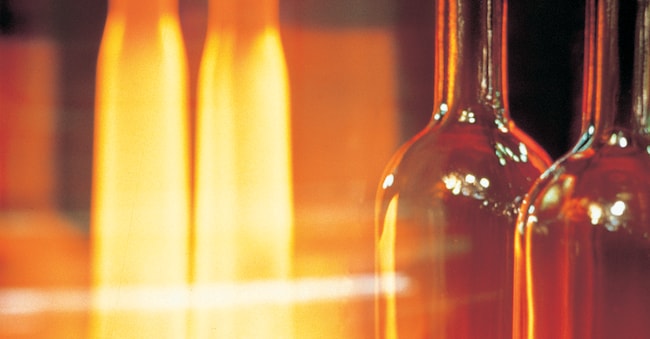
With the rules being discussed in Europe under the new packaging regulation (Ppwr), Italian prosecco bottles are at risk: the concern comes from Coreve, the Italian glass recycling consortium. "The Ppwr stipulates that by 2030 a packaging, a bottle, consisting of more than 30% by weight of non-recyclable material can no longer be put on the market," explains president Gianni Scotti. "In Brussels, work is in progress to define the guidelines for this recyclability," he continues.
The German and Danish position
Now, the German and Danish positions are arguing that glass with a transmittance (i.e. the ability to let light through, ndr) of less than 10% cannot be classified as recyclable. If even 30% of the material in a bottle therefore had a low capacity for light to pass through, this would render it unsuitable. This means that glass that is too dark and thick, precisely that which characterises some parts of our prosecco bottles, but also champagne and wine bottles, could be classified as non-recyclable and thus put out of business. We would like to remind you that these bottles were developed with these characteristics in order to effectively filter out light that is harmful to the contents and to resist internal pressure, especially of products with bubbles'.
The point of view of the two countries comes from national regulations and standards: in Germany, the Minimum standard for determining the recyclability of packaging, revised annually (latest version in August 2025) by the central packaging agency (Zsvr) with the German environmental agency; in Denmark, the Bek Packaging Ordinance No. 323 of 20/03/2025, which codifies the extended producer responsibility (EPR) system in the sector.
The national supply chain
"The German and Danish approach stems from consumer and industrial systems based on beer bottles, i.e. amber-coloured glass that has a higher light-filtering capacity, i.e. transmittance, than prosecco, champagne and wine bottles. Downstream, in their waste treatment systems, for the optical machines that discard opaque impurities such as ceramics in the glass recycling process, even a piece of glass with low transmittance, i.e. very dark, could be seen as opaque and therefore discarded as non-recyclable. But these are old systems, outdated by the Italian ones,' says Scotti again. 'We, after all,' he emphasises, 'are the largest glass-producing country in Europe, third in the world after China and the USA, and we have a recycling rate of over 80 per cent'.
Coreve, together with Assovetro and the research centre of the Stazione Sperimentale del Vetro (Ssv), started experimental trials of processing artificially produced cullet from very thick and dark bottles in an advanced Italian plant. The results show that the rejection level is 1%: glass with low transmittances is recognised and recycled correctly. "They did tests with samples down to 3% transmittance: everything was sorted," Scotti points out.


