
Green tax review, but also Hormuz crisis, Gaza and Lebanon: the dossiers on the EU table today and tomorrow
The indications provided in a dossier compiled by the Chamber's European Union Relations Service

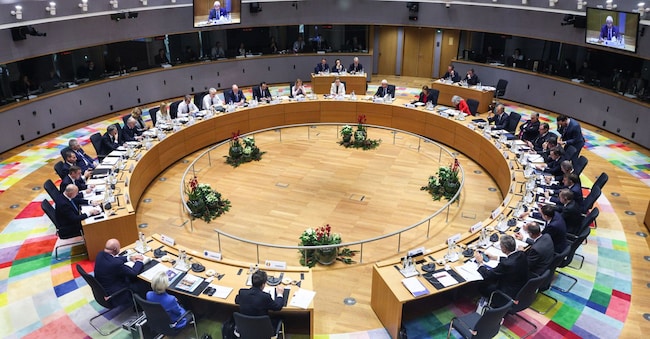
There is the issue of energy prices, which have recorded an acceleration after the US and Israeli attack on Iran and Tehran's decision to close the Strait of Hormuz, through which about a fifth of the world's oil tankers and gas tankers transit. But on the table of the European Council, scheduled for 19 and 20 March in Brussels, there is so much Middle East in general, starting with the Gaza and Lebanon chapters. Some indications are given in a dossier compiled by the Chamber's Service for Relations with the EU.
The green tax review game
The topic is the Ets (Emissions Trading System), Europe's carbon dioxide emissions trading system. In a letter addressed to EU leaders, the leaders of Italia, Austria, Croatia, Greece, Romania, Bulgaria, the Czech Republic, Hungary, Poland and Slovakia call for a "thorough review" of the system that includes "an extension of free EU allowances beyond 2034", as well as a "phased approach to the elimination of free allowances from 2028". The heads of state and government of the ten countries, including Prime Minister Giorgia Meloni, also call for an acceleration of the review, which should be presented "at the end of May at the latest," the text reads.
The Italian position has gradually faded away: the tipping point, Minister Gilberto Pichetto noted in Brussels, can also be a "different solution", as long as it is strong enough to cool prices. A line that clashes, however, with the front formed by the Nordic countries, Spain and Portugal, determined to preserve the ETS system and supported - in general terms - also by Berlin, which is oriented towards limiting interventions to 'minor adjustments', in particular to protect the most exposed sectors such as chemicals.
The European Council should invite the European Commission to examine all components of wholesale and retail electricity prices, to urgently come forward with proposals for concrete actions to reduce electricity prices in the short term; to present a revision of the Emissions Trading Scheme (ETS) by July 2026, in order to reduce carbon price volatility and mitigate its impact on electricity prices, while preserving the essential role of ETS in the climate and energy transition through a market-based price signal for carbon emissions that stimulates investment and innovation.
Hormuz crisis
The European Council is expected to discuss the evolution of the conflict involving Iran and its regional implications, with particular reference to energy security, freedom of navigation and the stability of the Middle East. European Council President António Costa and Commission President Ursula von der Leyen expressed the European Union's readiness to strengthen the maritime security operations conducted in the area, in particular the Aspides and Atalanta naval missions, aimed at protecting strategic maritime routes and safeguarding international supply chains.


