
Guglielmo Fonda, from Trieste to San Francisco to support 'solo' start-ups
Fonda came to San Francisco from Trieste, via Duino, Abu Dhabi, New York. And he understood something valuable about the role of relationships and that of artificial intelligence

3' min read
3' min read
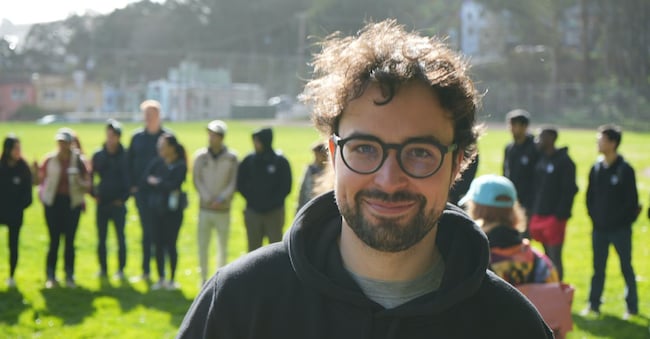
Guglielmo Fonda helps potential entrepreneurs find the conviction, strategy and collaborators they need to found their start-up. He is now in San Francisco to work at ODF, which offers weekly accelerator programmes. The latest service is dedicated to solo founders: those who started their start-up with the help of artificial intelligence to create the product, without other partners. "They come to us, meet people like them and help each other," says Fonda, who himself had created a start-up accelerator in the UAE called Arrayah. "I deal with that phase of innovation stories in which people with their project go from zero to one: a moment of creation and validation of the idea dense with problems and potential satisfactions, during which it is essential to define what you want, find the right collaborators, open up to potential partners suitable for teaming up, cultivating a flexible strategy in the face of the response that comes from reality".
Fonda arrived in San Francisco from Trieste, via Duino, Abu Dhabi and New York. It sounds like an itinerary fit for few explorers. But his story shows that it is entirely feasible. And that even a long route is made up of small steps.
The first step took him from Trieste to Duino, less than twenty kilometres. But a leap into the vastness of a global perspective. "For me the big leap was being admitted to the United World College," recalls Fonda: "I applied very casually because a friend of my sister recommended it to me a few days before the deadline. That school was the greatest experience of my life". With that school, Fonda entered an international and scientific dimension. "I went to the College thinking it was a normal school where you learn certain subjects. I found a project-based education system. In which the aim was research while the subjects were the tools to achieve the goal. I met children from ninety countries around the world. I did a programme with mathematics, physics and chemistry. I learnt English naturally. I took the Sat tests and then I found out that they were necessary to get into international universities. And so I found it easier when I actually applied to study in the US or the UK. In the end, I got a scholarship that completely covered my expenses to study at New York University in Abu Dhabi'. A series of small steps to get very far. Because a little at a time they got around that apparent barrier that sometimes makes access to the international dimension seem so difficult.
"The United World College paved the way for me. And it helped me cultivate a purpose. A meaning. It taught me that it is possible to try to tackle important problems in the world and hope to make an impact. I was not alone. The University of New York in Abu Dhabi was equally satisfying. His experiences abroad, such as in New York, allowed Fonda to think about the possibility of founding his own start-ups. "We were not just doing theoretical studies. We would start from a product prototype and create it. I contributed to the creation of a bicycle for disabled people. I found that this kind of innovation is done quickly, thinking about the technology, the business model, the support network, while you make the prototype and see if it works."
Of course, at Arrayah and then at ODF, Fonda also discovered that the path to innovation is also changing. Relationships between people are increasingly important for imagining the path of start-ups, while the importance of artificial intelligence to perform practical functions, from software production to GUI and more, is growing in turn. "It used to be said that software eats the world. Then it was said that the taste that drives the ways in which users interact with the product, the interface in short, is even more important. Now that these things are increasingly the preserve of artificial intelligence, start-ups are focusing on winning users' attention. The video of the start-up's launch has become a key element of success if it becomes very well known and if it gains a lot of space on social media.


