
The legacy of Guglielmo Marconi and the click that lit up the world
At Villa Griffone, near Bologna, another stage in the celebrations for the 150th anniversary of Guglielmo Marconi's birth. 2025 is dedicated to the first wireless signal, in 1895
4' min read
4' min read
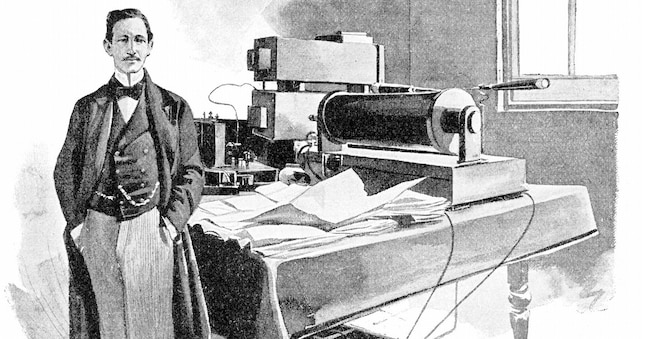
There is a click that continues to resonate. Not on a screen, but in the ether. A dry sound, like a gunshot (also because, in fact, it was a gunshot). It was 1895 and from an attic in Villa Griffone - in Pontecchio Marconi, a stone's throw from Bologna - a young 21-year-old was changing history. Guglielmo Marconi transmitted his first wireless signal, which went over the Celestini hill and reached his brother Alfonso, lurking beyond with a rifle. That gunshot served to confirm that what had hitherto been invisible, inaudible, unimaginable - waves travelling through the air - had just become reality.
Today, 130 years later, that click has become global infrastructure. And at Villa Griffone, now the headquarters of the Guglielmo Marconi Foundation, the beginning of modern communication was celebrated a few days ago with a day that is both a tribute and a look ahead: towards satellites, artificial intelligence, space.
"We believe it is our duty," said the Undersecretary for Culture, Lucia Borgonzoni, "to make the name of Guglielmo Marconi and the echo of his revolutionary intuitions resound more and more, especially among the younger generations. The Ministry recognises in this celebratory day, full of events designed to underline the furrow left by the passage of the Bolognese genius through history, a further important opportunity to remember the talent of a great Italian to whom we all owe so much".
"Marconi Day is a special moment each year to celebrate not only Guglielmo Marconi's pioneering vision and extraordinary entrepreneurial spirit, but also to recognise the timeless value of his scientific and cultural legacy," explains Giulia Fortunato, President of the Marconi 150 National Committee.
A Life for Waves
.Guglielmo Marconi was born in 1874. He was not interested in theorising: he wanted to see if it worked. He had read Maxwell and Hertz, of course, and studied with Augusto Righi and Vincenzo Rosa, but his method was all empirical. Experiments, failures, intuitions. Absolute pragmatism. From his attic, he moved on to the villa grounds, then across the ocean. And finally to win a Nobel Prize, in 1909.


