
The genius of Guglielmo Marconi, father of wireless and radio, on show in Rome
Hundreds of documents, inventions, photos, artefacts and period films delve into the entrepreneurial adventure and the human aspect of the Bolognese inventor, lord of the wireless, father of the radio and founder of the BBC
3' min read
Key points
3' min read
"Position 41.46 N - 50.14 W. Requires assistance struck iceberg'. So wrote Titanic's marconians John George Phillips and Harold Bride when they issued the Morse-coded distress signal on the night of 14-15 April 1912, after the British liner had collided with an iceberg on its maiden voyage. Three days later, Guglielmo Marconi was among the more than two thousand people thronging New York harbour to witness the disembarkation of the shipwrecked passengers. The distress call was picked up by the Carpathia's radio operator Harold Cottam thanks to the wireless telegraph, Guglielmo Marconi's invention, which proved crucial in rescuing the Titanic's survivors, enabling the steamer Carpathia, some 60 miles away, to save 705 passengers. The exhibition "Guglielmo Marconi. Vedere l'invisibile", in the spaces of the Vittoriano and Palazzo Venezia in Rome until 25 April 2025, promoted by the Ministry of Culture and organised and produced by Cinecittà and Archivio Luce. The exhibition is realised with the patronage and contribution of the Marconi 150 National Committee and with the collaboration of the Guglielmo Marconi Foundation.

Man and Entrepreneurial Adventure
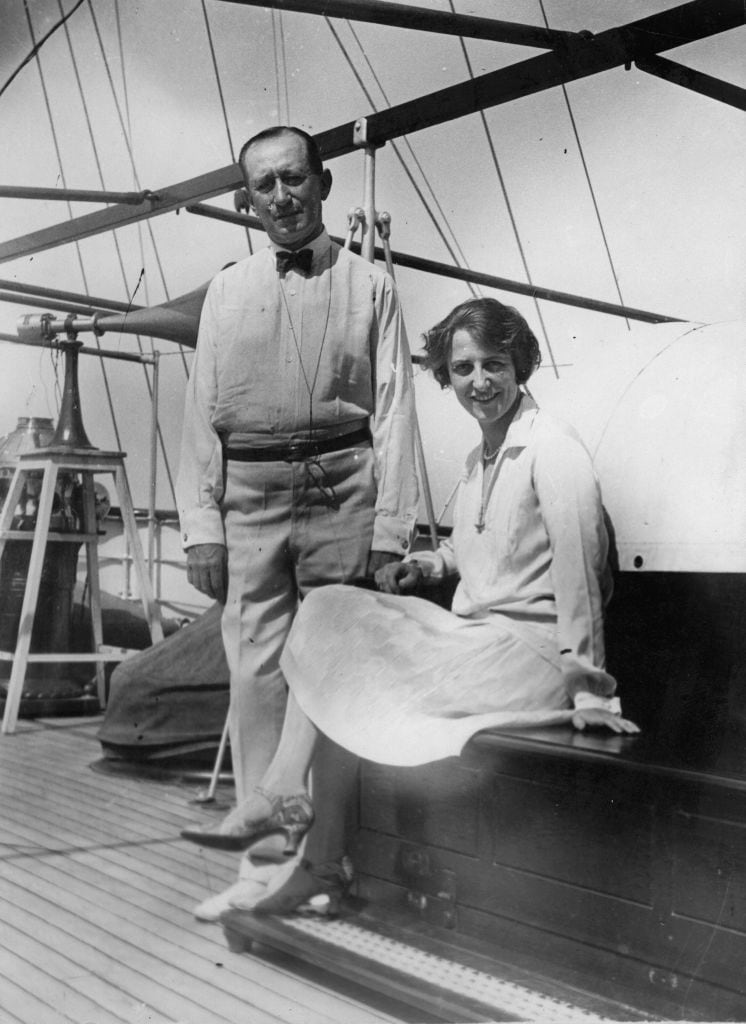
.Hundreds of documents, inventions, photos, artefacts and period films from national and international archives delve into the entrepreneurial adventure and human aspect of Guglielmo Marconi. A tribute that celebrates not only the father of wireless and radio, the founder of the BBC, but also the young visionary who was able to broadcast the first radio report of the America's Cup in 1899. Marconi was only 25 years old. On the one hand the profile of startupper and entrepreneur, on the other that of statesman, with the experiments that brought him international prominence and private events, without forgetting his great passion for the sea. Starting with the laboratory ship Elettra, which plied the waters of the world, from which the inventor carried out many radio experiments. The same name he gave years later to the beloved daughter he had in his second marriage, from his marriage to Maria Cristina Bezzi-Scali.
On 12 December 1901, the signal between Cornwall and Canada
.The scientist and businessman did his first experiments in the attic of his house: Hertzian waves were already known to physicists at the end of the 19th century, but Guglielmo Marconi sensed the possibility of using them to transmit messages, bridging distances and crossing oceans. As a self-taught telegrapher in 1895 at his family's country residence in Villa Griffone, he succeeded in emitting a signal that travelled two kilometres, climbing over a hill and reaching a receiver. First experiment in wireless telegraphy. On 12 December 1901, at 12 noon, he succeeded in transmitting a wireless telegraph signal from the radio station at Poldhu in Cornwall to the island of Newfoundland in Canada. The signal travelled over 3,000 kilometres and was hailed by the New York Times as the most extraordinary scientific achievement of the time. Many years later, in a very scenic experiment, Marconi managed to switch on the lights of the Sydney Town Hall by pressing a button on board the Elettra, in the port of Genoa, over 16,500 kilometres away. It was 26 March 1930.
Nobel Prize in Physics in 1909
Marconi is credited with the development of wireless telegraphy, the evolution of which led to the development of radio and television and all modern radio systems using wireless communication. For his contribution to the development of wireless telegraphy he was awarded the Nobel Prize in Physics in 1909, shared with Carl Ferdinand Braun.


