Formula 1

Hamilton cries in Italian: Ferrari’s first victory in Barcelona, the 106th

In the first Catalan Grand Prix, the British driver secured his 106th victory and overtook Schumacher in the all-time winners’ list at Montmeló. Antonelli overtook Russell on the track but was forced to retire due to a mechanical failure; Leclerc capped off a disastrous weekend. There were no fewer than eight retirements.

by Alex D'Agosta

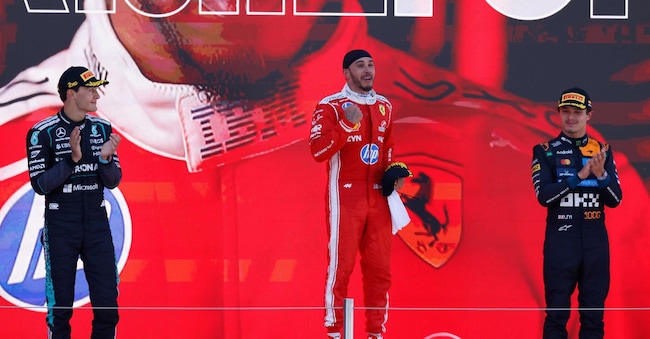
Il pilota della Ferrari Lewis Hamilton, al centro, festeggia sul podio accanto al connazionale George Russell della Mercedes, a sinistra, secondo classificato, e al pilota della McLaren Lando Norris durante il Gran Premio di Spagna di Formula 1 sul circuito del Camp de Catalunya a Montmeló, vicino a Barcellona, domenica 14 giugno 2026. (AP Photo/Joan Monfort)

6' min read

Translated by AI
Versione italiana

6' min read

Translated by AI
Versione italiana

It was great to see a young Italian like Kimi Antonelli take the lead again, put Russell under pressure and overtake him in the closing stages when the outcome seemed all but decided. But the moment that really summed up Sunday came from Lewis Hamilton’s Ferrari: emotional, almost in disbelief, with a thank you in Italian to the pit wall and the team.

In Barcelona, Hamilton realised the dream he had been chasing ever since he chose Maranello: to win a Grand Prix in red. Not ‘just’ a Sprint race, as had already happened in China in 2025, but a proper race, built on pace and strategy. On his 31st start for Ferrari, the seven-time world champion secured the 106th victory of his career and ended the Prancing Horse’s drought, having not won a Grand Prix since Mexico in 2024.

Loading...

Last but not least, another source of pride for the UK: no fewer than three Britons on the podium (Hamilton, Russell and Norris), something not seen since 1968 at Watkins Glen, where legends of the calibre of Stewart, Hill and Surtees are remembered.

Latest statistics

The Catalan circuit also sets another significant record in the sport: Montmeló is the track where Michael Schumacher won his first race for Ferrari in 1996, in the rain, and where Hamilton and Schumacher had gone into this weekend level on six wins. With his victory in the first Barcelona-Catalunya Grand Prix – the race’s new name following the transfer of the Spanish Grand Prix title to Madrid – Hamilton moves to seven wins and stands alone at the top. The parallel is inevitable: two giants at the wheel of a Ferrari will always be remembered for their exploits on this circuit, which has always been characterised by a large crowd, largely made up of Ferrari fans. The years of Sainz and Alonso, Spaniards in red; the importance of sponsors for the teams and for F1 itself; the large number of Italian residents; the long tradition of winter testing; the almost always perfect weather: ingredients for perfect weekends.

The match had started in the most predictable way

Russell, starting from pole, held off Hamilton at the first corner and set the pace for the opening stint. Hamilton and Verstappen had opted for the soft tyres, but the extremely hot track surface – reported to be over 50 degrees at the start – dampened any immediate challenge. The softer tyres did not deliver the expected boost: Hamilton remained second, Antonelli third, Norris fourth and Verstappen fifth. At the front, the race seemed deadlocked, with Mercedes in control and Ferrari forced to rely on pit stops.

The first round set the tone for the match

Hamilton and Verstappen pitted as early as lap 11; Russell followed suit two laps later, Norris on lap 14 and Antonelli on lap 15. Leclerc, who started tenth after his mistake in qualifying, extended his first stint and for a few laps took a provisional lead that was more useful to his strategy than to his actual position in the standings. That was when Ferrari began to make sense of Hamilton’s Sunday: not chasing a single window, but accepting a three-stop race, consistent with tyre degradation, track temperature and the need not to get stuck behind the Mercedes.

Russell realised the risk straight away

Over the radio, he wasn’t happy with the timing of the first call, because he knew he could end up exposed to Antonelli. And the Mercedes issue became the second key factor in the race. On lap 36, the pit wall called in Russell first, leaving Antonelli out for one more lap. It was a precautionary move, but also a matter of internal politics: Toto Wolff could not humiliate the pole-sitter by openly asking him to let his team-mate through. At the same time, the stopwatch was revealing an uncomfortable truth: in the middle stages, Antonelli had the pace and tyres to put Russell under pressure.

Ferrari wins it on the third pit stop

The decisive moment came shortly afterwards. Fernando Alonso, who had started from the pit lane in a struggling Aston Martin, ended up on the grass and came to a halt on lap 41, triggering the Virtual Safety Car. For Alonso, that VSC has a bitter taste that goes beyond the standings: Montmeló is the track of his home victories, in 2006 with Renault and 2013 with Ferrari — the latter still his last career win to this day. To finish like this, from the pit lane, on the track where he had triumphed at that level, feels like a sporting epitaph. But his stop also had an immediate technical impact: Verstappen pitted, Ferrari called Hamilton in for his third stop, and the Briton rejoined the race still in the lead.

From then on, Hamilton’s race was all about managing the situation. Ferrari emerged from the VSC with a clear run ahead, fresh tyres and a growing lead. By lap 48, Hamilton was the fastest of the lot, even faster than Verstappen on his medium tyres. With ten laps to go, his lead over Russell was already over twelve seconds, a sign that Ferrari had not only benefited from the safety car period but had turned it into a result because they had the pace to make it decisive.

Behind him, Mercedes had a tougher race than Russell’s second-place finish suggests. Antonelli, having spent a long time in his team-mate’s slipstream, overtook him on lap 61 at the first corner. This was the most telling statistic for the Brackley team: although perhaps someone on the pit wall was ‘pushing’ for Russell to score vital points, the head-to-head battle told a different story. Before the shutdown, the Italian had overtaken him on the track. For the second time in a few weeks, following the Canadian duel that ended with Russell’s retirement, Antonelli gave the impression of clearly having the edge in the internal team battle. Then the power unit brought him to a halt, through no fault of his own.

Norris literally inherited the podium: a solid but by no means dominant performance from McLaren on Sunday. Verstappen showed flashes of pace, including a fast lap on the medium tyres in the middle of the race, but he never had the position or the consistency to really challenge for the win. The rest of the points-scoring zone is irrelevant, apart from the unexpected feat of two Alpines finishing in the points, with the exception of the retirements: eight cars out is a lot on a track that often selects drivers based more on tyre degradation than on mechanical failures.

Leclerc, fluctuating energy levels and a tough weekend

The day at Ferrari, precisely because it was such a huge one for Hamilton, proved tough for Leclerc. The Monegasque driver had gone into Sunday already weighed down by Saturday’s events: his second crash in six days, following Monaco, and clear-cut words about his own responsibility. He had said he was “ashamed of the mistake”, ruling out that the change in braking material to match Hamilton’s feel was the cause. He made up ground in the race, then pitted himself. Ferrari returns to winning ways with Hamilton, but the other side of the garage is going through its toughest spell since the internal dynamic began to shift. Following the contract renewal, two costly mistakes and a retirement are hardly minor details.

Barcelona also shed some light on the new 2026 technical cycle. The energy aspect was less visible than the pit stops, but it played a significant role in the race analysis. With the 2026 power units, it is not enough to have speed at the end of the straight: you have to decide where to use energy, where to recover it and how to avoid running out of power at the points of attack or defence. Montmeló is a track offering various scenarios that provide an indicative overall assessment of the project’s quality, rather than a judgement on the engine alone. A true test bed that has pushed both top and lower-ranked teams to their limits.

Catalonia holds its ground, Madrid moves forward

The race’s new name is no mere formality. Montmeló is no longer the Spanish Grand Prix: that title will pass to Madrid, with the IFEMA project and a commercial platform more in line with modern F1. Catalonia has defended its event with investment, spectators and a top-tier economic impact, but its continued presence is now a compromise. For Europe, this is a sign: it is not losing ground simply because Asia or the United States are advancing, but because its traditional circuits are competing with one another over TV and sponsorship budgets, hospitality, accessibility and local returns.

Copyright reserved ©
Loading...

Brand connect

Loading...

Newsletter

Notizie e approfondimenti sugli avvenimenti politici, economici e finanziari.

Iscriviti

Tutto mercato WEB