
Hegseth again attacks Europe: 'We want partners, not protectorates'
The Pentagon chief reserved a warning for Europe whose countries "have not done their part".
from our correspondent Marco Masciaga
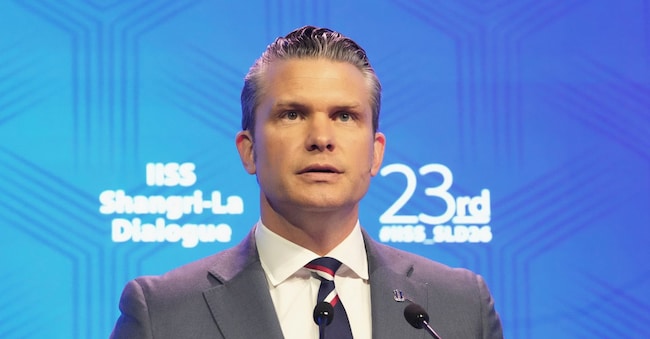
NEW DELHI - IU.S. Secretary of Defence Pete Hegseth used the podium at the Indo-Pacific's premier strategic forum to attack European partners, divide Asian ones into good and bad according to the percentage of GDP they spend on defence, disguise the shift of the US strategic centre of gravity towards the Western Hemisphere, and insistently magnify US President Donald Trump's foreign policy choices. Speaking of China's growing military assertiveness - which he had described as "a real and imminent threat" last year, infuriating Beijing - Hegseth moderated his tone, adjusting to the cordial atmosphere of the recent summit between Trump and his Chinese counterpart Xi Jinping.
During his speech at the Shangri-La Dialogue in Singapore, the Pentagon number one outlined a vision of the world and of relationships with allies ostentatiously based on power relations and the pursuit of the national interest, at the expense of 'ideal values', 'idealism' and what he branded as the 'old, weak, utopian, globalist approach to foreign policy'. In case there were any doubts about the recipients of the message, Hegseth added: 'When our interests coincide, we act together with determination and clarity of purpose. When our interests diverge, we adapt pragmatically, without drama or moralising. I think Western Europe would do well to take note of this'.
A notion reiterated later when, in one of the most strident passages of his speech, Hegseth recalled the 'calls that have fallen on deaf ears for European allies to spend more on their own defence', stigmatising a past in which the US 'allowed itself to be distracted by empty globalist rhetoric about a "rules-based international order" while European capitals opened their borders and weakened their armed forces. Europe and NATO have some important decisions to make, and we will return to this issue soon'.
In the absence of weighty representatives from the Old Continent, it fell to Australian Defence Minister Richard Marles to point out that, although the rules-based international order is not perfect, 'the task before us, all of us, including the major powers, is to reform that order, not dismantle it. When the rules are applied,' Marles continued, 'smaller states have the capacity for action and decision-making autonomy. When, on the other hand, rules give way to force, sovereignty becomes, as others have observed, the prerogative of the most powerful; and no state in this room today, regardless of its size, benefits from this'.
As was to be expected, Hegseth returned to the subject of China, but did so with more circumspection than in the past. Aside from not pronouncing on the possible $14 billion US arms sale to Taiwan, which Trump recently called 'a good negotiating card' in trade negotiations with Beijing, the Defence Secretary was less aggressive than in the past. He acknowledged 'legitimate concern about China's unprecedented military build-up and expansion of its military activities', but did not go much further, merely acknowledging that 'a Pacific Ocean dominated by any one hegemonic power would upset regional balances and undermine the stability we all seek to preserve'.


