
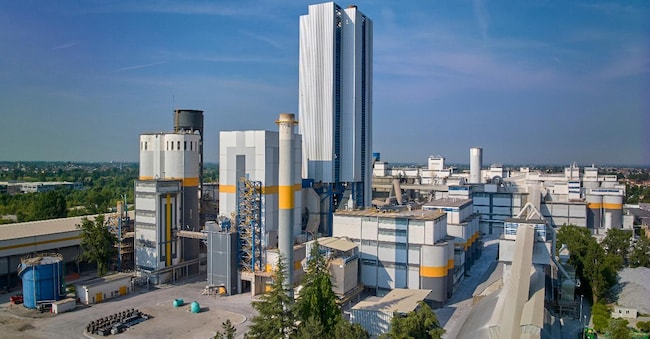
Heidelberg Materials, CO2 capture plant for cement plant in Brescia
Started feasibility study for factory in Rezzato: it will be the first in Italy

3' min read
3' min read
Heidelberg Materials has started the feasibility study for the decarbonisation project of the Rezzato-Mazzano cement plant in the province of Brescia, through the application of CO2 capture technologies (focus will be on oxyfuel and amines): it could thus become the first plant in Italy to produce a zero-emission cement locally.
The first plant in Norway
."An immediately available lever for CO2 reduction in our production plants is the replacement of fossil fuels with secondary solid fuels (Css) derived from the processing of non-hazardous waste, which contain biomass. The substitution rate is currently 20 per cent and we aim to reach the European average of 60 per cent by 2030. However, this is not enough: two-thirds of our emissions depend on the nature of the materials used (limestone, in particular) and to reach the net-zero target, CO2 capture is necessary,' notes Agostino Rizzo, Technical Director Italy of Heidelberg Materials, who also adds: 'The first plant in the world that will apply such technologies is our cement plant in Brevik, Norway, which will start producing net-zero cement in 2025. The group has then started other decarbonisation paths in plants in Europe and North America, including the one in Rezzato-Mazzano, which would become the first net-zero cement plant in Italy. This is a challenging and demanding project, not only on a technological and industrial level but also on a financial level, for which the support of a national strategy with which to establish synergies will be indispensable, as well as important support from national and European public funding'.
Heidelberg Materials, which acquired Italcementi in 2016, through its carbon capture use and storage (Ccus) projects globally aims to capture 10 million tonnes of CO2 by 2030. Recently, the group presented evoZero, 'the world's first Net zero carbon captured cement', as it has been called: a decarbonised product thanks to the CO2 capture technology of the Brevik plant.
Storage
.The Norwegian project involves chemical adsorption with amine-based solvents, with the carbon dioxide subsequently stored off the country's coast, in the deep sea. The completion of the decarbonisation process involves the use or storage of the captured CO2. In the Italian project, "a positive and important new development is represented by the start-up of phase 1 of the Ravenna Ccs project, realised by the joint Eni-Snam joint venture," reads a group note: "This milestone opens up new possible scenarios also for the Rezzato-Mazzano project, which could take part in the future process of conferring transport and storage capacity for CO2 in the depleted gas fields offshore Ravenna. In this regard, Heidelberg Materials has initiated talks with Eni and Snam for a preliminary technical assessment'.
The impact on Ets credits
.The application of CO2 capture technologies also has repercussions on the emission quotas within the Ets system that the cement industry, like other hard-to-abate sectors, must pay. Federbeton - a national federation that brings together companies in the cement and concrete industry with over 35,000 employees and a production of 19 million tonnes of cement per year - reports that direct emissions referred to the cement sector alone amount to 10.7 million tonnes of CO2, for which the industry disburses around one hundred million euro per year to buy Ets credits. To decarbonise, out of 6.5 million tonnes (those produced per process: two thirds of the total) one can only intervene with CO2 capture, a technology that Federbeton estimates requires investments of 4-500 million for a standard cement plant, with only one firing line.


