Digital Economy

Here is Lyria 3: Google with Gemini brings generative music to smartphones

With Lyria 3 integrated in Gemini, all it takes is a sentence, an image or a document to obtain a complete trace, including text and anti-deepfault watermark
by Luca Tremolada

3' min read

Translated by AI
Versione italiana

3' min read

Translated by AI
Versione italiana

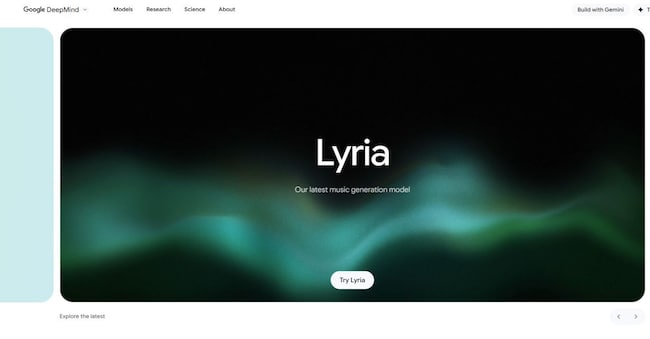
Generative music comes out of the lab and into the smartphone. Google presses play. And it does so with a stage name: Lyria 3. It is Google DeepMind's latest generative audio model, now integrated into the Gemini app. Translation: write a sentence, get a song. In 30 seconds.

It is not a synthesiser. It is a jukebox that reads prompts.

Loading...

The mechanism is simple. You describe an idea - 'slow, comic R&B about a sock who finds his soul mate' - and Gemini composes a complete track, including lyrics. You don't need to know how to write verses. Lyria 3 generates them. You don't need to know BPM. You can ask for them. You don't need a band. A phrase is enough.

Le novità di Lyria 3

The platform creates 30-second tracks, with cover art generated by Nano Banana, ready to download or share with a link. It is not the album of the year. It is the soundtrack of the everyday. A meme that plays, a voice message with rhythm, a greeting card turned into a mini-hit.

Compared to the previous version, the leap is technical. Lyria 3 automatically writes lyrics from the prompt. It offers more control over style, vocals and beats per minute. And above all, it improves realism: more complex musical structures, less mechanical arrangements, a more 'human' feel. It is the difference between a polyphonic ringtone and a home studio demo.

Behind the scenes there is a multimodal model. It does not only work on text. It can start from images, documents, slides. Upload pictures of the dog in the woods and you get an indie ballad. Insert a corporate presentation and it becomes a motivational jingle. It is the logic of large language models applied to audio: tokens that are not just words but notes, timbres, rhythms. If chatbots predict the next word, Lyria predicts the right note.

The target audience is not just the curious. It's the creators. Lyria 3 also arrives on YouTube's Dream Track and extends to creators outside the US . In an ecosystem where millions of shorts are uploaded every day, the soundtrack is identity. A customised track is worth more than stock music. It is instant sound branding.

The copyright node remains. All tracks generated in the Gemini app incorporate SynthID, Google's invisible digital watermark. It serves to identify AI-generated content. One can even upload an audio file and ask Gemini if it was produced with Google AI . It is the seatbelt of musical AI. It doesn't eliminate traffic, but it does put the lights on.

Google promises attention to rights and filters to avoid direct imitations of existing artists . If you quote a famous name, the system interprets it as a broad inspiration, not as a copy. The line, however, is thin. And the music market, over USD 30 billion a year globally, is no garage for experiments.

Lyria 3 does not replace musicians. It changes access. Like Instagram did with photography. Like chatbots did with writing. The real question is not whether AI will write a hit. It's how many personalised micro-songs we will hear every day.

The soundtrack of everyday life becomes programmable. Google tries to turn every user into a small music producer. Without a studio. Without a band. Without sheet music.

All it takes is a prompt. And press play.

Copyright reserved ©
  • Luca Tremolada

    Luca TremoladaGiornalista

    Luogo: Milano via Monte Rosa 91

    Lingue parlate: Inglese, Francese

    Argomenti: Tecnologia, scienza, finanza, startup, dati

    Premi: Premio Gabriele Lanfredini sull’informazione; Premio giornalistico State Street, categoria "Innovation"; DStars 2019, categoria journalism

Loading...

Brand connect

Loading...

Newsletter

Notizie e approfondimenti sugli avvenimenti politici, economici e finanziari.

Iscriviti