

Hippocratic facies: what signs on the face indicate imminent death
Sunken eyes, a thin nose and a livid colour are indications of reduced blood flow in peripheral and non-vital parts of the body
2' min read
Key points
2' min read
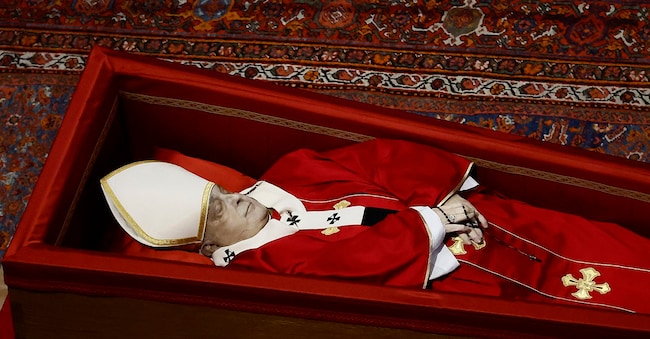
Although the name in Latin recalls an ancient time, its relevance remains very modern: observing a patient's face can tell a lot, sometimes everything, about his state of health. Thus experts, in the last appearance of Pope Francis on Easter Day, identified the signs of the 'Hippocratic facies': sunken eyes, hollowed temples, hollowed-out cheeks and a bruised colour. But also a face devoid of expression and vitality, and a sharp, gaunt, thin nose: all indications of reduced blood flow in the peripheral and non-vital parts of the human body, heralding, in patients suffering from serious, acute or chronic illnesses, the probable and imminent final outcome.
The hollowed-out face signals great suffering
.The face that Pope Francis showed the world on Easter Day also speaks clearly according to infectious disease specialist Matteo Bassetti, the head of the Irccs San Martino polyclinic hospital in Genoa, who comments via social media on the image of the Pontiff during the Urbi et Orbi blessing on Sunday 20 April, the eve of his death at 7.35 a.m. on Monday 21. 'Take a good look at that hollowed-out face, hollowed-out eyes, thinned nose, grey colour,' says the specialist. 'Here, this is the face that we doctors see very frequently a few hours before death, about 24-48 hours. "It is called hippocratic facies," Bassetti points out, "and it is the facial expression of someone who has great suffering, especially linked to states of heart failure, but also to infectious states," particularly "very long-lasting" such as the one that affected Pope Francis. A polymicrobial infection that has affected his lungs, probably sustained by fungi, viruses and other microorganisms, has so undermined his physique 'as to produce in some way also the marks on his face' that are in the eyes of the infectious scientist 'evidently very clear'.
Why it is called Hippocratic facies
This condition was first described by the philosopher and physician Hippocrates, considered the father of medicine. Hippocrates states that clinical observation constitutes the core of the diagnostic and prognostic approach to the patient and refers to the Hippocratic facies as the facial appearance of patients in the terminal stages before death. The Latin term 'facies' thus continues to indicate in medical jargon the physiognomic appearance characteristic of certain diseases or morbid syndromes.
A critical but not always terminal condition
.While the Hippocratic facies is still considered one of the most visible signs of a terminal state, it is equally true that it does not always indicate imminent death. Hippocratic facies can also occur in people suffering from serious illnesses and in acute situations such as peritonitis, severe dehydration, internal haemorrhaging or cardiac and respiratory crises, regardless of the person's age, which can quickly recover.

