
Holland, Wilders' footprint: crackdown on migrants and foreign students
The measures listed by the majority coalition also include a dietrforont on the environment and moving the embassy in Israel to Jerusalem

3' min read
3' min read
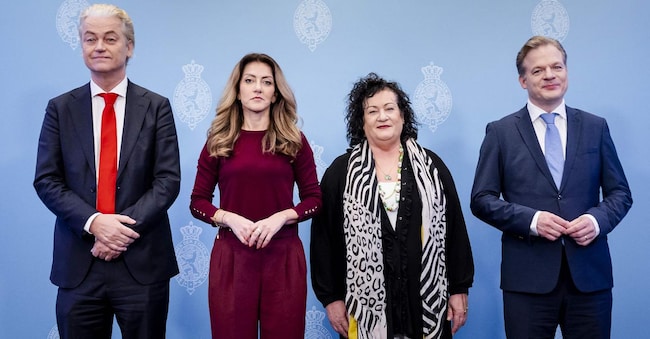
The most right-wing Dutch government in decades throws off the mask before it is even born, with the publication of the coalition programme of the four centre-right parties that agreed on Wednesday after almost six months of negotiations. And the imprint of the Pvv - the populist and anti-Islam party of Geert Wilders, winner in the November elections - is more evident than ever.
In the 26 pages of the programme, called 'Hope, Courage and Pride', ten areas are touched upon, but the most articulate and bound to cause discussion is one: immigration. Wilders' ambition to set the most stringent rules ever on asylum is such that, in his programme, the coalition has made it clear that it wants to ask the European Commission for an opt-out on migration policies. This request will not be easily granted, considering that the EU has just approved the new Pact on Migration (with the Dutch yes) and that, traditionally, derogations are requested during negotiations on treaty changes.
The Netherlands to the Dutch
.In detail, the planned tightening concerns first of all asylum seekers, with intensified border controls, shortened and stricter admission procedures, immediate deportation of migrants who have already been denied asylum in another country, recourse also to forced deportations; furthermore, for admitted refugees, limits on family reunifications and no priority for the granting of social housing.
This plan, Wilders commented, will make the Netherlands less attractive for asylum seekers, 'people in Africa and the Middle East will start to think that they might be better off elsewhere'. "We can be proud of this beautiful Holland again," he added, "The Netherlands will be ours again.
The squeeze, however, also extends to foreign workers and students, especially from outside the EU. There will be, the four parties write, 'additional requirements' and 'controls' for non-EU workers without specific knowledge or skills, who will have to obtain a work permit. Study migration will also be restricted, with the introduction of 'more courses in Dutch', a cap on foreign students and an increase in tuition fees for non-EU students.

