
Homo Extensus: here is the AI-Book written by humans and enhanced by AI
2' min read
2' min read
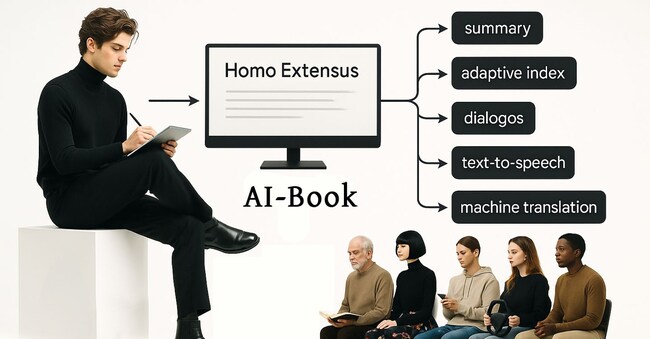
It is called Homo Extensus and represents an unprecedented frontier in the world of publishing: it is not a book written by artificial intelligence models but by humans, and enhanced by AI.
The authors, Gualtiero and Roberto Carraro, with many years' experience in the field of electronic publishing since the days of CD-ROMs and after 11 international awards in digital culture, are back to innovate with a new publishing format: the AI-Book. But how did the project come about? "It consists of two separate ideas that converge in the AI-Book Homo Extensus: the first idea relates to the message of the book, an original and constructive vision on the evolution of human intelligence in interaction with artificial intelligence," explains Gualtiero Carraro, author and CEO of Carraro LAB, and continues "The second idea concerns the medium, the AI-book, designed to enhance - not replace - with AI the content written by the authors. So in this case Mc Luhan's motto was applied: The medium is the message'.
Freely available on the official website, this format differs from ordinary proposals such as printed texts or simple e-books and offers an innovative and interactive reading experience that features an adaptive index, capable of tailoring itself to the reader's profile, thus proposing content in relation to the user's target audience.
Also noteworthy is the activity of the dIAlogos agent which, thanks to conversational, textual and vocal functions, allows the reader to dialogue with the book itself, which in turn plays the role of the author, making the consultation even more unique. Obviously, there were many obstacles to make this idea concrete, the author explains: "There were several difficulties, the first was to ensure a consistency of the answers of the conversational agent, which we called dIAlogos, with the ideas expressed by the authors. This objective seems to us to have been substantially achieved by means of adequate Data Ingestion and a rather detailed System Prompt. The second difficulty was to design a User Interface and imagine a User Experience relevant to the functionality of the AI-Book, and we hope to have succeeded at least partially.
And if on the one hand artificial intelligence could generate a decline in interest and motivation for writing and creativity, with the risk of even forms of mental atrophy, on the other hand there is the opportunity to make a cultural evolutionary leap, the authors explain. Nevertheless, in the future, the application of conversational reading could involve different contexts: "I think that with the AI-book platform, interesting publishing formats could be developed, for example in school publishing and technical manuals: the mediation of AI makes it possible to personalise reading for different targets, while keeping the content of the authors substantially correct. There is also the advantage of simultaneous multilingual translation to consider,' Carraro concludes.

