Round-table discussion

Hormuz Crisis: Customs chiefs from Europe, the United States and the Gulf meet in Rome to rethink global trade routes

An international conference organised by the Customs and Monopolies Agency, in collaboration with institutions, businesses and research centres, took place at the Chamber of Deputies. Sheikh al Khalifa said: ‘We are ready to share our experience of shared management with Italia and the EU.’

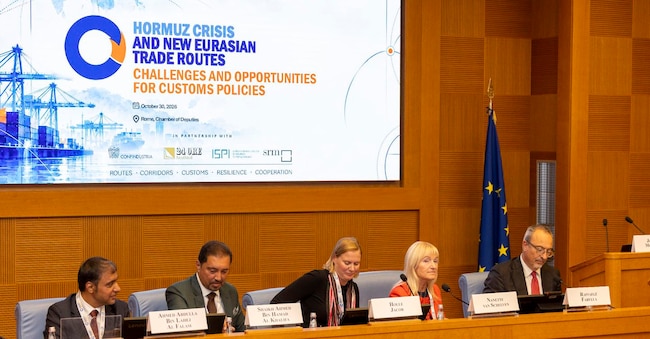
Ospiti dell’evento «Crisi di Hormuz e le nuove rotte del commercio euroasiatico» organizzato dall’Agenzia delle Dogane e dei Monopoli

3' min read

Translated by AI
Versione italiana

3' min read

Translated by AI
Versione italiana

The geopolitical tensions affecting the Strait of Hormuz and the resulting reshaping of global supply chains call for reflection not only on physical infrastructure, but also on the role of customs in ensuring the continuity, security and predictability of international trade.

It was this realisation that led to the international conference, organised by the Customs and Monopolies Agency at the Chamber of Deputies, in collaboration with Confindustria, Il Sole 24 Ore NextMed, ISPI and SRM.

Loading...

It is one of the most important international forums dedicated to the geopolitical and commercial implications of the reconfiguration of trade routes between Europe, the Mediterranean, the Gulf and Asia, bringing together representatives from governments, customs authorities, international organisations, financial institutions, businesses, universities and research centres.

The speakers

The Director of the Agency, Roberto Aless, opened the proceedings by reading out a message of greeting from the President of the Chamber of Deputies, Lorenzo Fontana. Speakers also included, amongst others, the Minister for the Economy and Finance, Giancarlo Giorgetti, via a video message, and the Deputy Ministers Edmondo Cirielli and Edoardo Rixi.

The conference was attended by leading speakers from major international customs and trade organisations. Among them were the Director-General of the European Commission’s DG TAXUD, Gerassimos Thomas , the Deputy Executive Assistant Commissioner of US Customs and Border Protection, Judson Murdock , the Executive Director of the Customs Union Authority of the Gulf Cooperation Council, Suleiman bin Masoud Al-Ghafri, Ambassador Francesco Maria Talò, Italia’s Special Envoy for the IMEC Corridor, which links India and the Middle East, as well as senior customs officials from numerous European, Mediterranean and Gulf countries.

“Today, the quality of a trade route does not depend solely on ports, roads or logistics infrastructure,” explained Alesse. “It depends increasingly on the quality of the procedures that govern the movement of goods. Clear rules, interoperable systems, the timely exchange of information and mutual trust between public authorities are essential elements for ensuring competitiveness, resilience and security in global value chains.”

The importance of international cooperation

During the discussion, it became clear that there is a need to strengthen international cooperation, encourage the proactive sharing of data along supply chains and speed up the mutual recognition of trustworthy operators, thereby reducing time, costs and uncertainty for businesses.

“No logistics corridor can realise its full potential unless it is supported by administrations capable of cooperating effectively and building an ecosystem based on trust ,” added Alesse. “The geopolitical crises of recent years demonstrate that the resilience of supply chains is now a fundamental component of nations’ economic security.”

Once the work was completed, the Agency’s head emphasised the need to consolidate permanent coordination mechanisms between customs authorities and to promote international governance capable of responding swiftly to emergencies that may disrupt the smooth flow of trade.

Specifically, for Italia – a natural crossroads between Europe, the Mediterranean, Africa and Asia – the challenge lies above all in transforming its geographical position into a sustainable competitive advantage, through increasingly modern processes that involve the development of port infrastructure from both an energy and a technological perspective. Ports, in fact, once regarded merely as places through which people and goods passed, now take on the role of genuine strategic and energy hubs, as well as important centres where technology and digitalisation must be developed.

Loading...

The Bahrain case

A key contribution came from the President of the Customs Authority of the Kingdom of Bahrain, Sheikh Ahmed bin Hamad al Khalifa, who spoke about how his country, together with the other GCC nations, had dealt with the crisis during the months when the Strait of Hormuz was under attack from Iranian missiles and drones, whilst never ceasing to ensure exports continued. The Gulf states are developing an IT system that will be ready in 2027 and will allow for the freer movement of goods; consequently, border management will also be easier to handle. Overall, the Sheikh concluded, the collaborative management of trade flows – that is, joint customs clearance – has been a successful experiment, enabling the adoption of new policies. ‘I can say that the Gulf countries are ready to share this experience with Italia and Europe as well,’ concluded Bahrain’s head of customs.

Subscribe to the NextMed newsletter so you don’t miss out on previews and in-depth features

Copyright reserved ©
Loading...

Brand connect

Loading...

Newsletter

Notizie e approfondimenti sugli avvenimenti politici, economici e finanziari.

Iscriviti