
Hormuz, what minesweepers Italy has: from the 'Gaeta' to the 'Vieste', among the best in the world
Their tool for searching for ordnance is sonar, which takes an image of the surrounding seabed like a kind of radar, sending out sound waves whose echoes return the necessary information
Key points
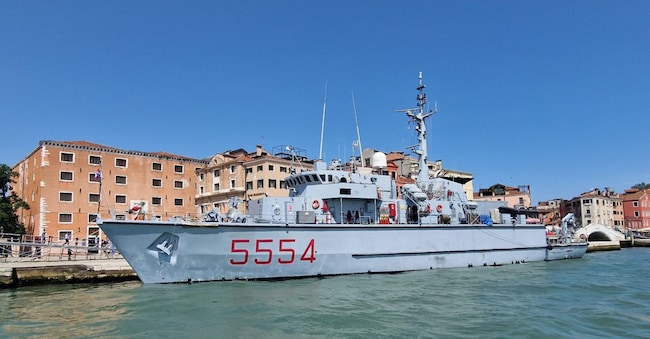
They launch sound waves into the water and then listen to their echoes: this is how the Navy's minesweepers, thanks to sonar, save the lives of crews by finding ordnance to be defused on the seabed. Italia, ready to send them to the Strait of Hormuz once again decades later, represents excellence in this military sector with eight ships of this type, from the 'Gaeta' to the 'Vieste'.
What I am
They are not very large boats, fifty metres long and ten wide, weighing five hundred tonnes, with crews of around fifty people, while the hulls are made of materials that minimise their magnetic signature, such as fibreglass, to avoid the risks of mines detonating. Their device search tool is the sonar, which takes an image of the surrounding seabed like a kind of radar, launching sound waves whose echoes return the necessary information. Once the targets have been identified, the investigation phase begins with an underwater, wire-guided drone with cameras. Also ready to go into action are Navy divers specialised in defusing ordnance, the equivalent of the land-based bomb disposal experts. In other cases, the underwater drones themselves are used, which use their sonar to transmit the information to the mother minesweepers. There is also a hyperbaric chamber on board, to treat any embolism of the diving personnel and thus for any immediate medical rescue activities.
Loading...
Where they are located
In general, it would be possible to map an area of up to ten square miles of minefield in one day, depending on the area in which one operates. Mine destroyers often require a frigate and a support logistics ship, such as the 'Etna', the 'Vulcano' or the 'Atlante'. At the moment, there are at least two of them operating at sea: the 'Crotone' is on its way to Malta for activities within the framework of the permanent naval force on mine countermeasures, while the 'Rimini' is being transferred between Valona and Augusta for 'safe depths', in the direction of the Sicilian coast. Everyone's base is in La Spezia.
L’impiego
These ships, deployed in Hormuz by Italy for the first time in 1987 during the first Gulf crisis, have tracked down thousands of detonators over the years and continue to do so to this day, including with clearance activities off all the coasts of Italy, to remove ordnance dating back to the Second World War and still present in our waters. Their ancestors are the 'minesweepers', which have been in disuse for several decades and used to intercept low-technology vessels. Today, Defence is instead developing new minesweepers, for eight new naval vessels of this type that are expected to arrive in the next few years.
Copyright reserved ©


Brand connect
Loading...
