Advice for students

How to prepare for the Business Studies exam

Every year, in the Ministry’s set paper for the second exam, the company Alfa S.p.A. is on the brink of collapse. And every year, thousands of students try to save it.
by Nadia Didonna

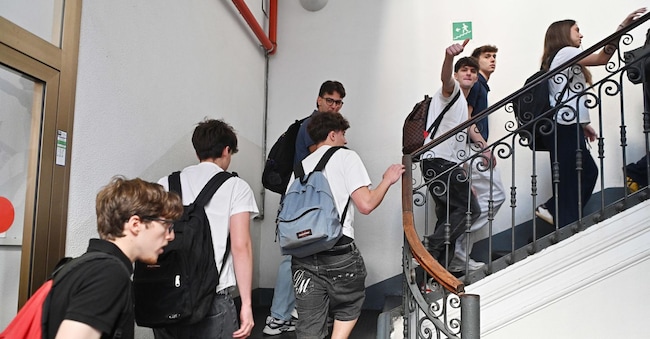
 ANSA/ ALESSANDRO DI MARCO ANSA

4' min read

Translated by AI
Versione italiana

4' min read

Translated by AI
Versione italiana

Every year, in the Ministry’s set paper for the second exam, the company Alfa S.p.A. is on the brink of collapse. And every year, thousands of students try to save it.

It was 1997. Ronaldo won the Ballon d’Or, the world’s most famous young wizard was making his debut in bookshops, and five British girls were shouting ‘Spice Up Your Life’ to the world. I, on the other hand, a student at the ‘Bernardino Grimaldi’ Bookkeeping School in Catanzaro, was in a state of panic – far from ‘Spice Up Your Life’ as the Spice Girls sang: I was staring at the set of questions for the second exam, facing the abyss of a blank sheet of paper, terrified that it would remain so for the next six hours. I was a hard-working student, and yet, looking at that accounting paper, my first thought was: ‘Blimey, this company, Alfa S.p.A., has more problems than I do!’ And it was at that very moment that my state exam began.

Loading...

A reality task

Let’s put it bluntly: the second exam at a technical college specialising in economics is no longer the old ‘accounting essay’. Today, it is a real-life assignment, a short business story in which the student is the protagonist and must bring order not only to the accounts, but above all to their own thoughts.

As a teacher, the question I’m asked most often is always the same: ‘Teacher, what should we study?’. My answer, however unassuring it may seem, is: ‘Everything and nothing! You need to think for yourselves’. I fondly remember an incident that happened in class a few years ago. We were looking at a decline in turnover at the company we were studying and had to come up with some strategies to counter this trend. One student – not much of a studier, but particularly quick-witted – said to me: ‘Sir, wouldn’t it be quicker just to shut this company down and open a beach bar in Foscolo Park in Busto Arsizio (the town where the school I teach at is located)?’ There you go: perhaps he was even right, but as well as pragmatism, we need technical expertise, and our company couldn’t simply be wound up on the spur of the moment.

So, returning to the school-leaving exam, the formulas are important, but we need to understand what is really going on with that imaginary creature that the Ministry still insists on calling Alfa S.p.A. A name that evokes records, but which, in the reality of the exam papers, presents problems worthy of a board of directors under siege.

In recent years, the exam has undergone a transformation. It is no longer a collection of isolated exercises, but an integrated case study. It is no longer simply a matter of calculating ROI, ROE or leverage; students are asked to explain why that ROI has plummeted and what they, in the manager’s shoes, would do to turn the fortunes of our hapless Alfa round. It is no longer enough simply to ‘know’; one must ‘know how to think’.

The paradox is that many students arrive extremely well-prepared, but in the wrong way. They know the chart of accounts and accounting entries — the tools of the trade — but they do not know how to use them to interpret reality. Panic sets in when faced with a forecast balance sheet: that’s where the certainties of the journal collapse and you find yourself without a safety net.

The secret? Reading. But really reading. Understanding the legal form, unearthing the explicit information and, above all, picking up on the implicit details that the question hints at between the lines. During those hours, the student must feel like an economist who decodes reality even before quantifying it. Then, of course, come the figures. I love Business Economics because the figures are honest: there’s no getting away from them – the profit and loss account must show a result and the balance sheet must balance. But the reassuring news is that a calculation error can happen; what is rewarded is the logical thread, the more or less sophisticated reasoning that steers the business from crisis to stability.

If, like Odysseus, you manage to emerge unscathed from the obligatory part (the sorceress Circe), you will find yourself faced with the two ‘monsters’ of choice (Scylla and Charybdis): the questions. Often, the choice falls on what appears at first glance to be the easiest or shortest option, only to discover halfway through hidden pitfalls worthy of an expression involving radicals and fractions. The trick here is strategic: don’t follow your gut; follow your strengths.

The time factor

Six hours seem like an eternity at the start; by the end, they’re never enough. Some people get off to a flying start only to get lost in the maze of calculations that don’t add up. Here too, however, business management offers us the best way to get out of a tight spot and find our bearings in the exam: an entrepreneur plans, organises and monitors. Students must do the same: first analyse, then decide, and finally carry out the task.

The most authentic aspect of this exam is that it requires one to take responsibility, even if only on paper. It serves not only to assess how much one has learnt over five years, but also to give meaning to that journey. It demonstrates that behind every accounting entry there is a choice, behind every balance sheet there is a story, and behind every number there is a living reality. The mark is just a number; the ability to tackle a complex problem and give it shape — your own, unique solution — is the real victory.

As for poor Alfa S.p.A., we can rest easy: it survives thousands of risky manoeuvres every year. Perhaps because, deep down, it was created to teach, not to fail.

Lecturer in Business Economics at the Enrico Tosi Technical and Economic Institute in Busto Arsizio

Copyright reserved ©
Loading...

Brand connect

Loading...

Newsletter Scuola+

La newsletter premium dedicata al mondo della scuola con approfondimenti normativi, analisi e guide operative

Abbonati