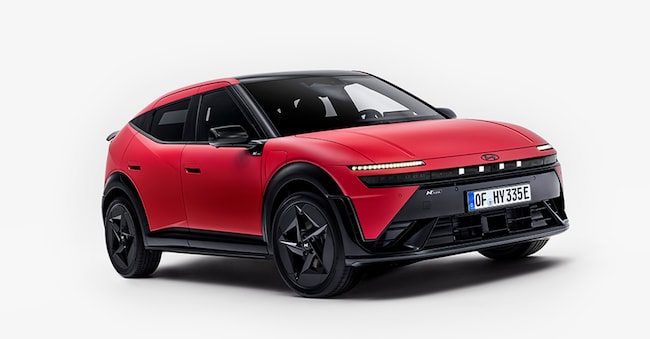
With a length of 4.15 metres, a width of 1.80 metres, a height of 1.50 metres and a wheelbase of 2.65 metres, the smallest of the Ioniqs has a spacious interior even at the rear, thanks to the balanced relationship between body design and dimensions and the rather horizontal design of the roof. The interior design is minimalist and originally hi-tech, albeit somewhat at the expense of ergonomics as almost all car-function controls are integrated into the PleosConnect system display. The infotainment system is Hyundai's first with the Android Automotive operating system integrated with Google's Ai Gemini. It has a display that is either 12.9" or 14.2" depending on the trim, but unlike current trends it does not connect with the instrumentation. In fact, the Ioniq 3 has a small, configurable rectangular digital dashboard resting on top of the dashboard. At the bottom, the latter consists of a long horizontal glovebox, almost a pouch, interrupted in the central area by a dashboard with the air conditioning vents and controls. The presentation of the passenger compartment is pleasing even if it does not completely camouflage hard plastic upholstery. Finally, in terms of loading possibilities, the Ioniq 3, which does not have a front frunk because there is an electric motor inside the bonnet, has a boot with a basic capacity of 322 litres to which is added that of 119 litres under the load floor.
Hyundai Ioniq 3, high-tech standard and long range versions
Based on the smaller version of the 400 V E-GMP architecture designed by the Hyundai-Kia group for native electric models, the Ioniq 3 will be offered in two versions. The standard range powered by an electric unit with 147 horsepower and 250 Nm of torque powered by a 42.2 kWh battery that promises a range of up to 335 kilometres, and the long range. The latter has an electric motor with 135 horsepower, again with 250 Nm of torque, powered, however, by a 61 kWh battery that moves the maximum range up to 490 kilometres. The batteries can be fully recharged either with alternating current at 11 kW, but a 22 kW charger will also be available on request, or with direct current, considering similar models from the Korean group up to 350 kW, which allows topping up from 10 to 80 per cent in half an hour. Both Ioniq 3s hit 165 per hour, but the standard one reaches 100 per hour in 9 seconds and consumes an average of 14.2 kWh/100 km, while the other crosses the 100 per hour mark in 9.6 seconds and has an average consumption of 13.8 kWh. The new Ioniqs are also equipped with Adas for advanced level 2 semi-assisted driving, are prepared for systems to share electricity with the outside world and for the practical Plug&Charge function that avoids fiddling with apps and cards at fast-charging stations.
Motor24 videos