
Hyundai Ioniq 5 N, the sporty electric with gearbox and gears drives like a petrol car
Unique, but not so much for power and performance, but because the first electric of the N category brand can give the same excitement as one with a piston engine.
5' min read
5' min read
The electric car you didn't expect has arrived. Bringing zero emissions together with a unique character in the line-up of full-electric cars is Hyundai's high-performance N atellier with an original and sophisticated interpretation of the Ioniq 5. In fact, the 5 N is a turning point for full-electric cars because Hyundai's development and research centres in Namyang, Korea, and the Nürburgring, which give the letter N to this Ioniq 5, have defined an electric capable of surprising petrol addcitons as much in terms of performance and use as in terms of soundtrack. In short, the Ioniq 5 N on sale for 77,000 euro in a practically full-optional trim is an electric car unlike any other, one that not only aims to impress with its high power and acceleration that glues you to your seat in a straight line, but is also capable of entertaining you in the bends. And even those who don't really want to know about zero-emission traction can, if they take a chance, be convinced.
Hyundai Ioniq 5 N, changing the concept of performance electric
N's first battery-powered car is the most powerful Hyundai in history. It is powered by a twin-engine powertrain that generates all-wheel drive with 609bhp and 740Nm of torque, rising to 649bhp and 770Nm with the boost function, which propels this Ioniq 5 to 260mph and 100mph in 3.4 seconds. And so far there would be little surprise. The real surprise comes from the fact that it can also be driven like a petrol car thanks to the system that simulates an eight-speed dual-clutch gearbox with both automatic and manual modes to be used with the paddles on the steering wheel, which change from braking energy recovery step adjusters to gear selectors.
In this case, even retaining the engaged gear when reaching the rev limiter and bringing out the twin-turbo sound when downshifting, thanks to the soundtrack borrowed from the i30 N's sportier car configuration. The result is the fruit of complex work in which, in particular, the torque loads and delivery of a powerful heat engine were copied to transform the operation of the electric motor. The N also differs from the Ioniq 5 in the geometry and dimensions of the set-up components, the structural stiffening of the body, the self-locking rear differential, the Brembo braking system and the 21" Pirelli PZero tyres developed specifically for this model.
Also specific to the Ioniq 5 N is the complex electronic network of the N configuration with which one can change, for example, the distribution of traction on the two axles through eleven levels, adapt the one pedal mode to sporty driving and obtain more energy recovery from the rear engine to favour cornering, and many, many other functions all aimed at optimising the performance/behaviour ratio. All to be managed in a somewhat complex manner by fiddling with steering wheel selectors and central display screens. The Ioniq 5 N has an 84 kWh lithium-ion battery that promises a range of 448 kilometres with a thermal management designed to limit performance drops in heavy use, recharging on alternating current at 11 kW and on direct current at 240 kW from 10 to 80 per cent in eighteen minutes, thanks to 800 V technology.
Hyundai Ioniq 5 N, sporty outfit and racing-style interior
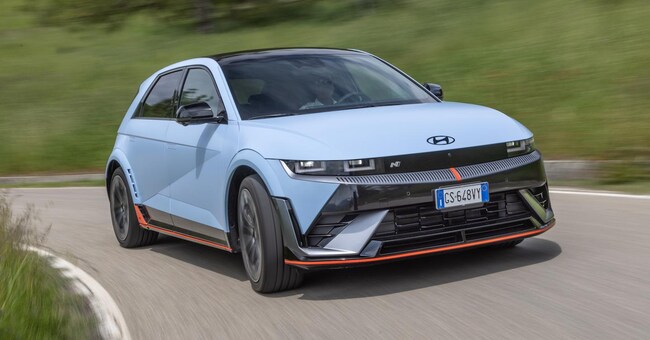
Based on the E-Gmp architecture of the normal Ioniq 5, the N is 4.72 metres long and therefore more than the other due to the specific design of the bumper shields that integrate spoiler and splitter as well as air intakes and vents, 1.94 metres wide due to the effect of the widened mudguards to accommodate the large and wide 21" wheels, 1.59 metres high and has a wheelbase of 3 metres. The appearance is also characterised by a larger spoiler above the rear window than on the regular Ioniq 5, a large rear extractor and the triangular third brake light typical of the N range.In the cabin, there are very snug front seats, padding that prevents hard collisions between the knees of those sitting in the front and the central tunnel, as well as 12.3-inch instrument and infotainment displays with graphics and functions for sports and track driving according to the complex settings to be made by scrolling through the infotainment menus.

