
Immigration, for the Supreme Court a balance is needed between security and reception
The reasons of human solidarity are not per se contrary to the standards. After Cutro, the guarantees of the ECHR and the Charter of Fundamental Rights remain valid

"The reasons of human solidarity are not per se at odds with the rules on immigration provided for in order to ensure an orderly migratory flow and an adequate accommodation and integration of foreigners". The passage of the Supreme Court (judgement 29593/2025) gives an account of the complexity of the task of finding a balance between recent regulations - which have tightened the mesh for obtaining or maintaining an entry permit for foreigners, whether asylum seekers, refugees or economic migrants - and respect for human rights. A 'square' that the jurisprudence of legitimacy seeks.
Special protection
It was precisely the 29593/2025 judgment that dealt with irregular migrants who invoke the protection of private and family life, provided for by the Consolidated Immigration Act, the reference to which was removed by the so-called 'Cutro Decree' (Decree-Law 20/2023). For the judges of legitimacy the guarantees remain. Ensuring them is precisely the Consolidation Act on Immigration which, in Article 19, refers to 'constitutional and international' obligations. Super-ordinate and binding sources, such as Article 8 of the CEDU and Article 7 of the Charter of Fundamental Rights of the European Union, which continue to guarantee respect for private and family life. Special protection - the Supreme Court specified in Ordinances 5084/2025 and 6775/2025 - must be ensured to an immigrant even if he/she does not have close family members in Italia, if he/she is well settled, speaks Italian and participates in the community. Even the work requirement (Ordinance 27453/2023) can become less stringent by taking into account problems, to be tackled politically, such as that of precarious relationships, of "undeclared work" and the context of "vulnerability" in which those who are forced to accept casual, underpaid jobs and with precarious housing accommodation find themselves.
In these cases it is not easy to find actual integration. Then protection will be admissible even "with a proportionally lower degree of integration of the applicant in Italia". Elements that it is up to the judge to ascertain. No automatism on repatriation, even if there is a conviction with a plea-bargained sentence (sentence 20088/2025), the judge must assess the social and current dangerousness of the foreigner, who cannot feel safe from expulsion, if he has committed serious crimes, just because he is married to an Italian citizen.
Maritime Rescue and Landings
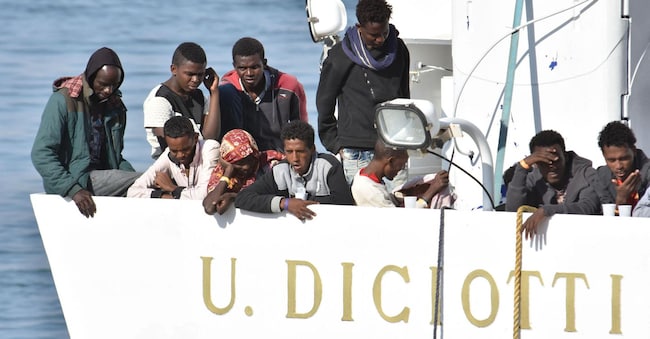
The judges of legitimacy (Ordinanza delle Sezioni Unite 5992/2025) on the case of the ship "Diciotti" addressed the issue of rescue at sea and the detention of migrants on board. While affirming the right to compensation for failure to disembark, they recalled that the obligation of rescue at sea is the basis of the main international conventions and prevails over bilateral rules and agreements, aimed at combating irregular immigration. Member states are obliged to guarantee assistance to those in distress at sea, providing first aid and transferring people to a safe place. The state responsible for the rescue, which is not necessarily the flag state, must organise disembarkation "as quickly as possible".
The judges therefore ruled out that the refusal to authorise the disembarkation of migrants rescued in the 'Search and Rescue' (SAR) zone could represent a political act. It was, in fact, an administrative action to be carried out within the perimeter of the Constitution and internal and supranational rules that require respect for fundamental human rights.

