
Impeccable deep black for Armani Privé, transitional sobriety for Chanel
Although absent from Paris for the first time in 20 years, Giorgio Armani followed every detail with the passion of the master. For Chanel, a drier collection awaiting the debut of Blazy in October

2' min read
2' min read
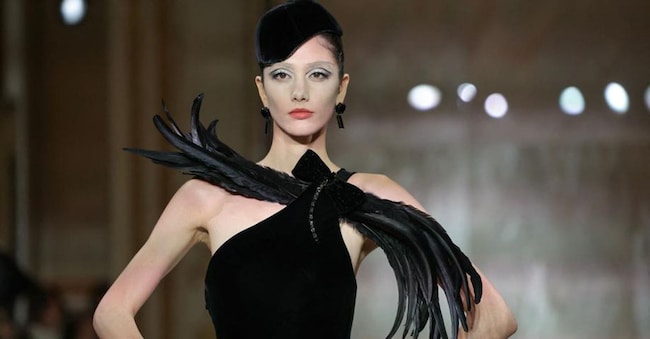
The couture that parades these days in Paris is predominantly black, and in any case sober. Giorgio Armani, now recovered but still not in town on the precautionary advice of doctors, remotely declares about Armani Privé: "Black is, for a designer, the most classic of colours and at the same time the most difficult test. When you work with black you can't afford to make mistakes: every detail has to be perfect, because black brings out the essence of a suit. In this collection I concentrated on black to enhance its nocturnal and seductive allure in the endless waltz of masculine and feminine. I imagined long, absolute silhouettes that move like ink marks on the catwalk and shine discreetly, without blinding".
The proof is a new and reassuring expression of the magnificent spirit of synthesis that makes Armani, Armani. Not everything is colourless, not everything is graphic and absolute - the digressions into territories of dreamy exoticism are numerous - but it is to black - alone or cut from platinum, always brilliant, embroidered, glittering - that the message is entrusted. Once again, Armani opposes and reconciles masculine and feminine, contrasting garçonne in tailcoats and dinner jackets with sciantose in long mermaid fourreaux. There is not a single smudge. The master's hand can be felt on everything. He concludes: 'If I have come this far, it is because of the iron concentration and maniacal attention with which I control everything. I'm still doing it now. Although I was not in Paris, I followed and supervised every aspect of the fashion show remotely, via video link, from the fittings to the sequence and make-up. What you see has my approval and my signature'.
At Chanel, for the last time, it is the Creation Studio that conceives the fashion show before the start of the new course by Matthieu Blazy, scheduled with the prêt-à-porter at the beginning of October. It is yet another rehearsal of a long and organic handover, but the winds of change are already blowing: the lines are drier, the allure harder, the frivolities are tamed by the prevalence of tweeds that become more decidedly masculine, almost rustic and country-like, while from start to finish it is tall and sturdy boots that set the pace, even with the few draped and languid dresses.
The brief text presenting the collection describes it as pastoral, understated, refined, and indeed one could speak of a serious tone of expression, a pervasive sobriety. Not everything works, but the arrival of the creative director will finally impose a decisive and unambiguous point of view. The tabula rasa, meanwhile, is healthy.

