
Trump in Saudi Arabia: trillion-dollar investments
Riyadh first stop, trip with economic rather than political expectations. The war in Gaza will prevent the president from announcing the normalisation of Arabia-Israel relations

3' min read
3' min read
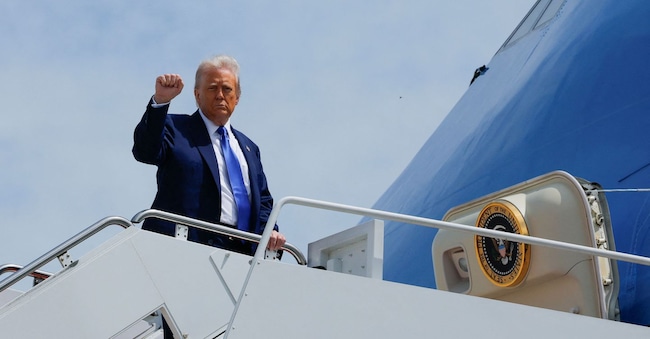
Donald Trump arrived in Riyadh in Saudi Arabia greeted by lavish ceremonies, gilded palaces, and the prospect of concluding economic agreements that could bring trillion-dollar investments to the United States. But the ongoing war in Gaza will prevent the American president from achieving a goal he set himself in his first term: the normalisation of relations between Saudi Arabia and Israel.
Behind the scenes, US officials are pressuring Israel to accept an immediate ceasefire in Gaza, one of Saudi Arabia's preconditions for any resumption of normalisation talks. But Israeli Prime Minister Benjamin Netanyahu - unhesitatingly supported by the Republican administration in Washington - insists on war against Hamas, thereby also obstructing the expansion of the Abrahamic Accords, which should also bring the United Arab Emirates, Bahrain, Sudan, and Morocco to recognise Israel. Today, however, not even Saudi Arabia recognises the State of Israel: the two most advanced economies and military powers in the Middle East do not therefore maintain formal diplomatic relations.
For the White House, the normalisation of relations between Arab states and Israel should bring stability and prosperity to the region, while counteracting the influence of Iran. The historical phase is very delicate; according to many observers, normalisation, without the creation of a Palestinian state, would risk encouraging armed struggle by groups such as al-Qaeda, the Islamic State and the Houthis. 'Saudi Crown Prince Mohammed bin Salman needs the Gaza war to end and a credible path to a Palestinian state to be defined before he can take up the issue of normalisation again,' said Dennis Ross, a former US negotiator.
Political difficulties and the ongoing war in Gaza will force Trump to focus on business. The trip to Saudi Arabia, and then to Qatar and the United Arab Emirates - the US president's first official visit to the region since returning to the White House and his second abroad after his brief stay in Rome for the funeral of Pope Francis - will aim to bring investment to the US. leaving the clashes in the region in the background. "My trip to the Middle East will be historic", assured, shortly before leaving the White House, Trump who between cryptocurrencies, skyscrapers and golf resorts has also woven many personal deals with the Gulf countries.
Trump can count on privileged relations with the three allied countries that own some of the world's richest sovereign wealth funds. Mohammed Bin Salman promised $600 billion in investments in the US over the next four years soon after the tycoon took office, but he does not seem to be satisfied. 'Last time,' Trump said from the Oval Office in March, 'they invested $450 billion. But they got rich in the meantime. So I said they will have to pay $1 trillion to American companies over four years, and they agreed.' A business forum with local and US companies will be held in Saudi Arabia focusing on technology, artificial intelligence and energy, which is expected to be attended by many of America's most powerful CEOs, from Elon Musk to Sam Altman, from Mark Zuckerberg to Larry Fink.


