‘In Europe, there are increasingly close ties between far-right parties and the Russia-China axis’
This is revealed in a new report presented in London by Action for Democracy, a US-based non-profit organisation

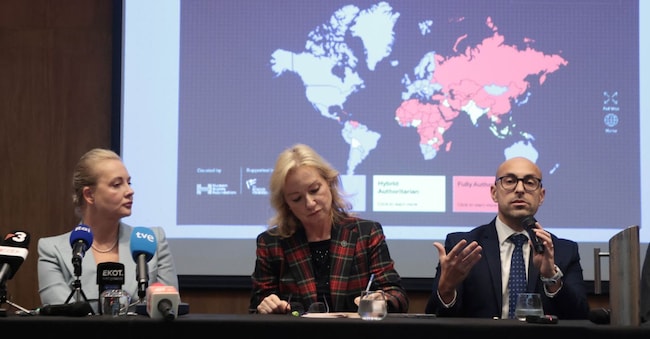
LONDON – As Europe heads into a period of crucial elections, far-right parties are forging ever-closer bilateral ties, coordinated by the Russia-China axis that funds them: this is revealed in a new report presented today in London by Action for Democracy, a US-based non-profit organisation.
The Authoritarian Collaboration Index, for example, traces the evolution of relations between Reform UK, the party led by Nigel Farage, and Marine Le Pen’s Rassemblement National, which have formalised a partnership with a commitment to tackle immigration together in the run-up to a possible election victory. The two parties agree that sovereignty takes precedence over international law, including the European Convention on Human Rights.
The links between the AfD and Russia
Another revelation is that the AfD, Germany’s far-right party, has been dependent on Russian funding since 2016, but the flow of money has increased over the last six months and the link with Moscow has intensified in tandem with their electoral success. Following the AfD’s recent victories in the local elections in Saxony-Anhalt, “Russia’s support has gone far beyond traditional funding, evolving into a close dialogue that recognises the AfD’s importance as a future governing party”.
These parties, which also include Vox in Spain, have not formed a single bloc but prefer to strengthen bilateral ties, which give them greater legitimacy, whilst employing common tactics and methods.
An ever-expanding network
“What emerges from the report is that an increasingly dense network of collaboration is forming between governments, parties and authoritarian movements at a global level, one that utilises every possible means of repression,” explained Domonkos Kovacs, head of the Authoritarian Collaboration Index and director of Action for Democracy. “ ‘These movements used to be isolationist, but they have now learnt to collaborate using technology and social media. The only possible response is to establish an equally intensive collaboration between democratic parties, governments and movements.’