Elections in Germany

Salvini, Vannacci and Musk celebrate the AfD’s victory in Saxony. Tajani: ‘Terrible news’

‘Another Europe is possible’, says the League leader; ‘Nessun dorma’, says Futuro Nazionale. “Well done!”, posts the owner of X. Meloni remains silent and the right splits: for Deputy Prime Minister Tajani, the AfD is the antithesis of “liberal and Western values”

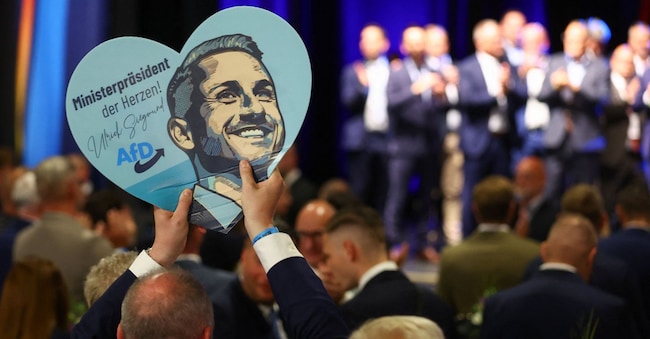
Un sostenitore tiene in mano un cartello con l'immagine del candidato di punta del partito di estrema destra “Alternativa per la Germania” (AfD), Ulrich Siegmund, durante la festa elettorale dell’AfD, dopo la diffusione dei sondaggi a exit poll sulle elezioni regionali in Sassonia-Anhalt, a Magdeburgo, in Germania, il 6 settembre 2026. REUTERS/Thilo Schmuelgen REUTERS

4' min read

Translated by AI
Versione italiana

4' min read

Translated by AI
Versione italiana

Matteo Salvini didn’t even wait for the results. As early as Sunday morning, he sent a message to Alice Weidel – a message of congratulations, but also a signal that looks beyond Germany’s borders: enough of brandishing the Alternative für Deutschland as a bogeyman; the vote must be respected. A few hours later, the results came in and the cheering turned into a celebration. It is a ‘resounding success’ that proves ‘another Europe is possible’, declared the League leader, responding to those who see the rise of the AfD as a danger with one word in capital letters: ‘Democracy’.

Roberto Vannacci is the one pushing the narrative even further to the right. “Europe is changing,” exclaims the leader of Futuro Nazionale, before launching a scathing attack on Chancellor Friedrich Merz, who “has an ulcer”, and warning the entire continent: “Nessun dorma”.

Loading...
Elezioni regionali Germania, exit poll: AfD al 44,5%. I festeggiamenti dei sostenitori

The vote in the heart of eastern Germany has thus opened a rift in the majority. Salvini’s toast to his ‘friend Alice’ immediately met with resistance from Antonio Tajani, who distanced himself from a force that is ‘antithetical to liberal and Western values’. His statement, observes the leader of the Azzurri – Merz’s European ally – is ‘very bad news’.

“A worrying sign, certainly. But also a local and regional vote,” the Foreign Minister goes on to point out, adding that “Germany is Germany”, whilst “Italia is Italia. They are completely different situations; there is still discontent there over the unification of the two Germanys. Of course, we must respond. Europe must change: no more fundamentalism, no more Green Deal, less bureaucracy, yes to the single market. In general, less ideological choices that are closer to the people.”

Of the two partners, Meloni has chosen to remain silent, leaving it to FdI to interpret a result which – as Emanuele Loperfido, a member of the Italian parliamentary delegation to the OSCE, merely analyses – represents a ‘clear call for a change of direction’.

Reactions from overseas

The far-right’s victory in Saxony has been met with praise even across the Atlantic. “Well done!” wrote Elon Musk on his platform X , in response to a post by AfD co-leader Alice Weidel, who was congratulating the party’s lead candidate, Ulrich Siegmund, on the result achieved.

Siegmund promptly replied to Musk, thanking him for his ‘support’ and explaining that he would ‘very much welcome the opportunity for strong and constructive cooperation. Germany would once again become a place worth investing in. Best regards from Saxony-Anhalt!’.

Richard Grenell, the former US ambassador to Germany, also congratulated the AfD on X: ‘A resounding victory and a new dawn for Germany. Whilst the government-funded media in Germany (most TV broadcasters) are in decline, the people are ready for change.”

Protests in Germany and concern across Europe

Italian Foreign Minister Tajani is not the only one to be concerned about the outcome of the Magdeburg by-election. ‘In Poland, only idiots or traitors can rejoice at the AfD’s triumph in Germany. There are plenty of them in the Confederation and the PiS’ – two Polish opposition parties, Ed. – according to a social media post by Polish Prime Minister Donald Tusk.

“The AfD’s victory in Saxony? I am horrified. Their appalling message is reminiscent of what the Nazis espoused in the past. And we know where all that led us,” insisted former British Labour leader Jeremy Corbyn, speaking at a rally organised by the Alliance of Greens and the Left, warning that fascism can arise anywhere.

Loading...
Elezioni in Sassonia, Fratoianni e Bonelli: "Costruire alternativa ad Afd in Ue e in Italia"

A horror shared by the German Jewish community as well. “A party classified as firmly far-right is a hair’s breadth away from forming a single-party government in a German federal state,” Josef Schuster , President of the Central Council of Jews in Germany, told Die Welt , adding that he was “personally horrified by this election result”. As Schuster points out, the positions set out in the party’s manifesto have been clear for months: they include the establishment of a task force to speed up deportations, the resumption of school exchanges with Russia, the creation of segregated classes for the children of asylum seekers, and a ban on rainbow flags in schools. “Those who voted for them today, despite or because of these objectives, bear responsibility for this result,” he said.

Many people, who share a sense of revulsion and fear for the future, took to the streets on Sunday evening.

Protests against the AfD took place in several German cities : in Frankfurt am Main, according to police figures, around 2,500 people demonstrated to call for the possibility of initiating proceedings to ban the far-right party to be considered. In Berlin too, hundreds of people took to the streets in the evening with similar demands. In Mainz too, people demonstrated for the same reason. This was reported by the DPA. In the evening, a protest march passed through Berlin’s government district under the slogan ‘Let’s defend democracy! – Ban the AfD now!’.

Regional election results in Saxony-Anhalt

The AfD has secured success in the Saxony-Anhalt regional elections, though it failed to secure an absolute majority of seats in the regional parliament of the eastern state. According to the provisional figures released, the far-right party has won the election with 43.8 per cent of the vote (up from 20.8 per cent in the 2021 state election), overtaking the conservative CDU, which remained at 17.2 per cent.

Three left-wing parties – Die Linke, the Greens and the SPD – have cleared the 5 per cent threshold, each securing around 9 per cent of the vote. The populist Sahra Wagenknecht Alliance (BSW) also cleared the 5 per cent threshold, thereby gaining a seat in the regional parliament. The liberals of the FDP, on the other hand, secured just 2.6 per cent of the vote, failing to reach the necessary threshold.

Voter turnout stood at 77.8 per cent, the highest recorded in Saxony-Anhalt since reunification.

Elezioni in Sassonia, Siegmund (AfD): "Non scenderemo a compromessi"

Despite the AfD’s election victory, it is still unclear who will lead the next government of this small federal state with a population of 2.1 million, as the established parties are refusing to cooperate with the far-right Alternative for Germany, employing a strategy known as a “cordon sanitaire”. “If necessary, there would simply be new elections, and then we would win 50 or 55 per cent,” Siegmund declared on ZDF that evening in the wake of the victory. “Because the future is Alternative für Deutschland,” he added.

Copyright reserved ©
Loading...

Brand connect

Loading...

Newsletter

Notizie e approfondimenti sugli avvenimenti politici, economici e finanziari.

Iscriviti