
In search of the five most innovative (and most desired) gadgets of 2025
Wearable devices with Ai have been a flop. But artificial intelligence has already decided how it will make consumer electronics more innovative (and perhaps useful)

When writing about technology, the first question should not be how powerful a product is or how much artificial intelligence it is dressed up, but whether it is really new. New in the sense of useful, of decisive, of necessary. It is a distinction that in 2025 was seen particularly clearly in the downward parabola of 'Ai-centric' gadgets: hundreds of devices heralded as the alternative to the smartphone - smart speakers, voice badges, headsets with virtual assistants - have shown structural limits in their promises of automation and recognition. Despite the promises, the 'AI generation' of gadgets has stagnated: voice assistants have not become more reliable, automations have not become smarter, and the idea of a device that can replace the phone has remained little more than a slogan for now.
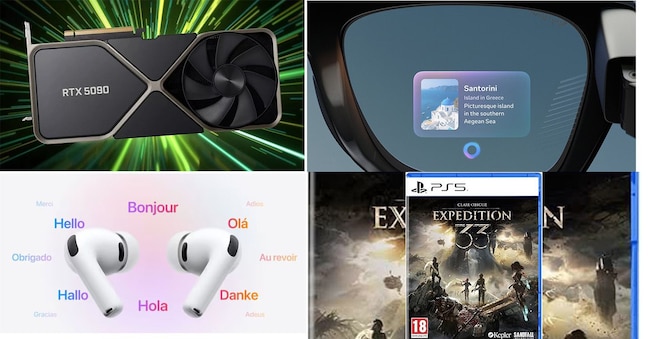
Yet something truly innovative exists. While we wait to better understand Sam Altman and Jony Ive's project to 'cure' us of our screen addiction, the most credible candidate for the post-smartphone era is a pair of glasses. Meta presented for the United States the Ray-Ban Meta Display, glasses with a micro-display integrated in the glass, available from 30 September 2025 for $799. In Europe we will have to wait. The idea is to bring the minimum necessary information - messages, directions, notifications - into the corner of your eye without taking your smartphone out of your pocket. Google is also ready to come out with a similar product but enhanced with Gemini. The useful image is that of an augmented windscreen: one no longer looks at the instrument, but at the world filtered by small doses of data.
If spectacles point in the direction of the future, smart headsets represent the more functioning present. In 2025, Apple, Google and Samsung introduced simultaneous translation systems directly into the earphones, without apps and without friction. A conversation between two people speaking different languages becomes a continuous flow: what reaches the ear is already translated. It is a function that solves a concrete, everyday and measurable problem. The AI, in this case, does not erase the smartphone but reduces its role in language intermediation. The headphones become a small personal infrastructure: audio, communication, contextual speech recognition.
In the world of computers, the frontier is power. The Nvidia RTX 50 series, especially the 5090, define the metrics of 2025: higher performance, acceleration for local AI, more sophisticated upscaling with DLSS 4. For those working with 3D models, simulations and advanced gaming, it means loads handled in half the time; for those experimenting with offline generative AI, it means reduced dependence on the cloud. The limit is the price: a single GPU costs as much as a high-end laptop. It is concrete but not yet democratic innovation, a piece of the future coming through the premium department.
A taste of domestic robotics also arrived at the end of October. Norwegian company 1X announced NEO, described as 'the first consumer-ready humanoid robot designed to transform domestic life'. It can fold laundry, arrange shelves, move objects, respond to voice commands or a touch. We don't know exactly how and if it works, but we do know how much it costs: $20,000 or a $499 per month subscription with a six-month lease. It is still a very high-end object, closer to a car than an appliance. But it introduces an important step: domestic robotics is trying to move out of the floor - where robot hoovers have reigned for years - and into handling tasks.


