
In Sicily, desalination plants are operating at full capacity, but the water networks are struggling
The first phase of the regional programme to tackle water shortages is now up and running. Average water losses are often between 45 per cent and over 55 per cent, meaning that around half of the water supplied is lost.

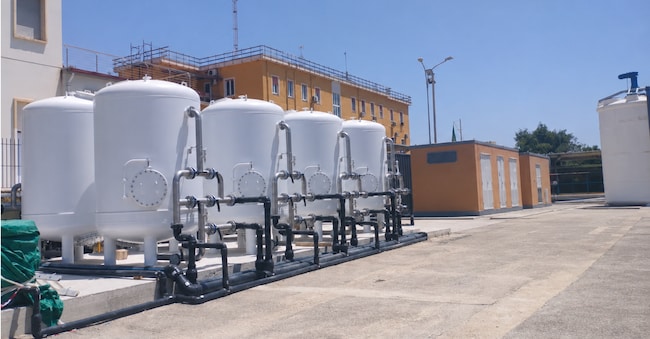
On the one hand, the figures seem, for the first time, to support the decision to install desalination plants. On the other hand, the taps tell a different story. In July Porto Empedocle, Gela and Trapani fed 664,416 cubic metres of drinking water into the network, with an aggregate average flow rate of around 248 litres per second out of a nominal 288: over 86 per cent of theoretical capacity.
Porto Empedocle produced 227,491 cubic metres, Gela 213,840 and Trapani 223,085.
Since the three plants began operating, production has reached almost 4.9 million cubic metres. This figure is taken from the report updated in July and submitted by Siciliacque to the Regional Government following the urgent request of 5 August. The three mobile modules were built by Acciona Agua in 120 days. The project began with a budget of 100 million euros — 90 million from the FSC and 10 million from the regional government — which subsequently rose to 121 million with additional central government funding.
The plants that have come into operation are just the first module: each has a capacity of 96 litres per second.
The regional plan envisaged an initial total output of 288 litres per second, provided by the three 96-litre-per-second modules, and a second phase – which has so far remained on paper – to increase capacity to around 500 litres per second, by supplementing desalination with springs, wells and reservoirs.


