
Industrial 5G is growing by 15 per cent, but the market is still worth 15 million
The Politecnico di Milano: PoliMi: still a niche market, but with a 175 million project from Terna. For 65 per cent of businesses, the main obstacle is measuring the benefits of the investment

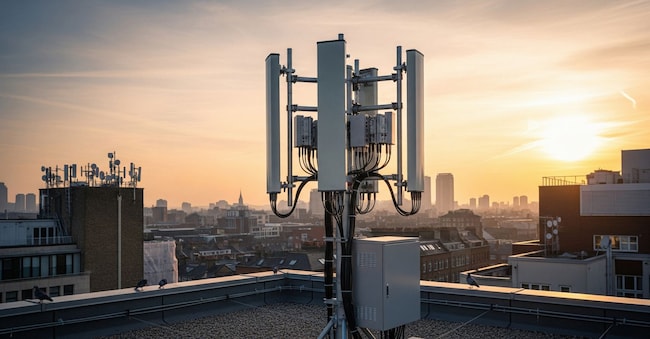
Italia’s industrial 5G sector currently amounts to just two figures. Expenditure is estimated at 15 million euros for 2026, whilst the value of a single project – Terna’s – stands at 175 million, spread over several years. The 5G & Connected Digital Industry Observatory at the Politecnico di Milano excludes this investment from its market estimate. Yet it is precisely that project which demonstrates the potential of a private network. Terna aims to remotely monitor power stations and high-voltage lines, even in areas where public coverage is weaker, and to intervene on the infrastructure before a fault disrupts the service.
Excluding Terna, the market is set to grow by 15 per cent by 2025, with nine new projects joining the 29 already up and running. Logistics leads the way in terms of the number of initiatives, accounting for 24 per cent of the total, whilst universities and innovation centres top the list in terms of cumulative expenditure. In ports, where people and vehicles move across vast yards, a dedicated mobile network can provide coverage and continuity that are difficult to achieve with other technologies. Elsewhere, Wi-Fi has the edge. 96 per cent of the large and very large enterprises surveyed use at least one fixed-line or Wi-Fi network for their core activities. And amongst those using mobile networks, 84 per cent rely on public 4G and 50 per cent on standard 5G.
“Private 5G, which seemed to offer an opportunity for telecoms companies to take on a new role in corporate strategies,” says Marta Valsecchi, director of the 5G & Connected Digital Industry Observatory, “has remained a niche market. This limited growth is also influenced by the perception of connectivity as a commodity, rather than as a strategic element of business development.”
Indeed, the survey reveals that for 65 per cent of businesses, the biggest obstacle is measuring the benefits and drawing up a plan that justifies the investment. Only 3 per cent of respondents regard connectivity as a lever for changing their business model. Of course, as Antonio Capone, scientific director of the 5G & Connected Digital Industry Observatory, points out, a key factor is ‘the economic fragility of operators, whose capacity for investment has been eroded by years of fragmented market management’.
Brussels can have an impact on the cost side. The EU has harmonised the 3,800–4,200 MHz band for local networks, and 79 per cent of the companies surveyed report a medium or high level of interest in dedicated frequencies. The German experience illustrates the transition from licences to roll-out. In an adjacent band, there have been nearly 500 local allocations since 2019, but according to the Politecnico, only a small proportion of these have resulted in operational projects. The advantage of common rules could be to replicate the same solution across several countries, thereby reducing the cost of each new installation.


