
Inflation: benefit corporations are better at protecting employees’ purchasing power
This is revealed by the 2026 sector study. Over the three-year period 2022–2024, against a cumulative inflation rate of 16.5 per cent, labour costs rose by 17 per cent

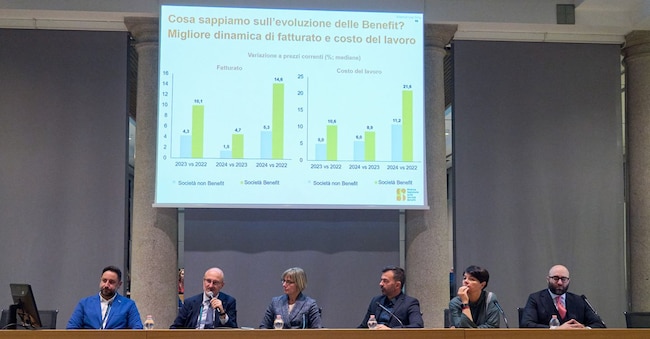
The figures for benefit corporations are no longer surprising. Even in the new 2026 edition of the national survey, there has been a rise in the number of this particular type of company: +7.7% (5,968) as at 30 June 2026, compared with the end of 2025, with 260,000 employees and a production value of 71.3 billion euros (equivalent to 2.5% of the national total). The study was carried out by Nativa, the Research Department of Intesa Sanpaolo, InfoCamere, the University of Padua, the Brindisi-Taranto Chamber of Commerce and Assobenefit.
Protecting purchasing power
The most interesting finding, however, emerges from the econometric analysis carried out by economists at Intesa Sanpaolo, which highlighted the ability of benefit-providing companies to safeguard their employees’ purchasing power.
Economists compared 2,000 benefit corporations with an equal number of non-benefit corporations, matched for company size, sector of activity, age of the firm and geographical location. Well, as the research states, ‘a positive association emerges between the benefit model and growth: over the period 2022–2024, the estimated effect of benefit status is +13 per cent for turnover, +17 per cent for labour costs and +12 per cent for value added’.
As explained by Giovanni Foresti, an economist in Intesa Sanpaolo’s Research Department, ‘price trends in Italia recorded a cumulative increase of 16.5 per cent over the three-year period 2022–2024. In the face of this price shock, benefit corporations shared a greater proportion of the value generated with their employees. The rise in labour costs within benefit corporations exceeded the cumulative inflation rate, and these firms managed to preserve and restore the real purchasing power of their employees’ households, unlike what occurred in the rest of the production sector’.
And that’s not all. “This financial support for families,” added Foresti, “has not compromised the financial stability of companies: the focus on human capital, welfare and wellbeing has led to greater labour productivity, enabling benefit corporations to offer higher wages whilst maintaining an operating margin entirely in line with that of non-benefit enterprises”.


