Inflation jumps to 3.3 per cent in August, driven by high fuel prices. Highest level since September 2023


In August 2026, according to Istat, inflation jumped to 0.5 per cent month-on-month and 3.3 per cent year-on-year (up from 2.9 per cent the previous month). Analysts’ forecasts had predicted an annual rate of 3.4 per cent. This is the highest figure since September 2023. High fuel prices are the main factor: the rise in inflation – as the statistics office points out – is primarily driven by trends in the prices of Energy, both unregulated (from +11.4% to +16.9%) and regulated (from +14.8% to +18.8%); by contrast, prices for recreational, cultural and personal care services (from +3.0 per cent to +2.6 per cent) and transport-related services (from +1.6 per cent to +0.9 per cent) are slowing down.
The burden of high fuel prices
In August, ‘core’ inflation – calculated excluding the most volatile items, namely energy and fresh food – slowed slightly (from +1.6% to +1.5%) as did inflation excluding energy prices alone (from +1.8% to +1.7%), indicating that, for the time being, the rise in fuel prices has not yet been passed on to other goods. The monthly change in the overall index also reflects, above all, the rise in prices of regulated energy products (+3.2 per cent) and unregulated energy products (+2.8 per cent), transport-related services (+1.4%), processed food (+0.4%) and durable goods (+0.3%). The projected inflation for 2026 (the rate that would result if the cost-of-living index remained at August’s level for the rest of the year) stands at +2.9 per cent for the overall index and +1.9 per cent for the core component (On 17 July, the Bank of Italy estimated inflation for 2026 at 3.1 per cent).
The shopping trolley
In August, the year-on-year rate of change in the prices of the so-called ‘shopping basket’ (food, household and personal care products) remained stable (at +1.0 per cent), not being immediately affected by high fuel prices. Meanwhile, the rate for products with high purchase frequency rose (from +3.4% to +4.3%).
Energy
Prices in the goods sector mainly reflect pressures in the energy sector (rising from +11.6 per cent year-on-year in July to +17.0 per cent year-on-year in August; +2.8 per cent compared with July), which are affecting both components. For regulated energy products (from +14.8% to +18.8%; +3.2% on July), prices for town gas and natural gas in the protected market are rising faster (from +21.8% to +31.3%; +6.5 per cent compared with July), whilst electricity prices in the protected market remain stable (at +9.7 per cent; no change month-on-month). As regards unregulated energy products (from +11.4 per cent to +16.9 per cent; +2.8 per cent compared with July), there has been a general increase in the rate of price growth, particularly for heating oil (from +18.2 per cent to +31.7 per cent; +10.6 per cent compared with July), petrol (from +8.0 per cent to +16.3 per cent; +6.3 per cent compared with July), diesel for transport (from +18.8 per cent to +26.7 per cent; +5.2% compared with July), electricity on the open market (from +13.9% to +17.9%; +0.8% compared with July) and town gas and natural gas on the open market (from +7.4% to +11.3%; -0.2 per cent compared with July).
Food
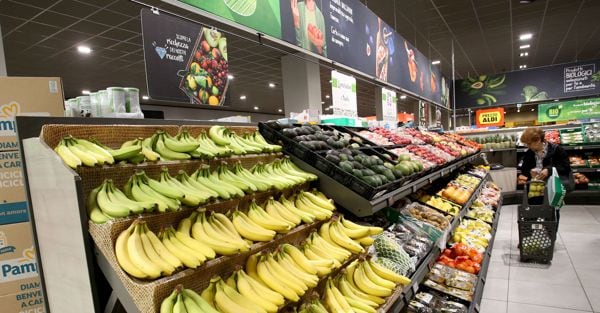
The food sector as a whole is showing stable price growth (at +1.1%; +0.2% compared with July). In particular, as regards processed food products, the year-on-year price trend remains slightly negative (at -0.2%; +0.4 per cent compared with July), whilst unprocessed products show a very slight acceleration on an annual basis (from +3.6 per cent to +3.7 per cent; -0.1 per cent compared with July), which mainly reflects the increase in the rate of price growth for vegetables, tubers, plantains, cooking bananas and pulses (from +2.6 per cent to +3.8 per cent; +2.0% on July), partly offset by the widening decline in prices for fruit and nuts (from -0.7% to -1.7%; -4.2% on July).