
Iran crisis, Supreme Defence Council meeting on Friday. Sending the Samp/T to the Emirates also on the table
Foreign Minister Tajani: 'When and where will the Samp/T that we decided to give to the United Arab Emirates be relocated? I think it is a matter of a short time, the Emirates will then decide where to deploy it. We will also help Kuwait with other defence instruments'. On Wednesday Prime Minister Meloni also spoke in parliament on the Middle East crisis

Key points
The war in Iran and the Middle East, and the analysis of the international situation and the effects of the current crisis are the topics on the agenda of the Supreme Defence Council, which has been convened by the President of the Republic Sergio Mattarella for Friday 13 March, at 10 a.m. This body of constitutional importance responsible for examining general political and technical problems relating to security and national defence meets at least twice a year, and is chaired by the Head of State in his capacity as commander of the armed forces.
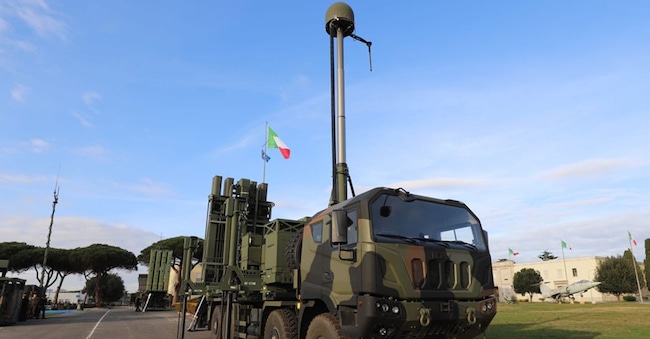
Among the topics that will come to the table is that of the possible granting of a Samp/T to the United Arab Emirates, which has requested one. A final word on the issue should come out of that meeting. "When and where will the Samp/T ramp that we have decided to give to the United Arab Emirates be located? I think it is a matter of a short time, the Emirates will then decide where to relocate it,' Foreign Minister Antonio Tajani explained in the last few hours. 'Awe will also help Kuwait with other defence instruments,' the head of the Farnesina added.
What is Samp/T
The Samp/T is the surface-to-air system that intercepts and then neutralises threats from the sky with missiles, two of which have already been supplied to Kiev (one, however, was destroyed by Moscow troops). It is assembled in cooperation with France and the production of its components takes a long time. Italy should currently have another four at its disposal: one is in Estonia and would remain in Eastern Europe to guarantee the security of the area, two others are in Sabaudia to defend national borders, and a third is in Mantua. Therefore, if it were eventually decided to support the Emirates, Italia would be left with two Samp/Ts to protect its national territory. The Gulf countries would have expressly asked Italia for this and one of the devices would have to be transferred, as Tajani confirmed, to the Emirates. But this at the moment remains only an option on the table, waiting for the NATO Council to agree to send it: the outcome of the decision, therefore, is by no means a foregone conclusion.
The unknowns associated with an air defence system deployment in the Gulf
On the whole, the fact that, with reference to this weapon system, the blanket is particularly short makes it opportune to reflect on the advisability of depriving another country of it. It would certainly not be an easy operation and it will be necessary to understand whether, with a progressive reduction in the Iranian arsenal, the use of the Samp/T will actually prove necessary or whether it will be deemed more opportune not to uncover the national territory. The use of the Italian-French anti-aircraft would then require a team of at least seventy people specially trained and capable of operating in the various positions, from the command post to the radar to each launcher. The logistical problem, which is not insignificant, would instead concern the transport of the entire system, equipped with a multifunction radar, a command and control module, some truck-mounted vertical launchers and Aster interceptor missiles. The hypothesis could be that of a collaboration with other allied armed forces, such as the USA, for example, to transport the modules on board a US Boeing C17: in this case, the Samp/T would have already arrived at its destination within two days.
Then there is another aspect to consider. Italia's decision to supply the Samp/T to Abu Dhabi could be seen by Iran as a concrete support to what is, for all intents and purposes, an enemy country. In short, the issue is particularly delicate, and reflection is still open. In the last few hours, Palazzo Chigi sources reported, there was a summit with Defence Minister Guido Crosetto, the Undersecretary to the Prime Minister's Office with responsibility for the Security of the Republic, Alfredo Mantovano, and military and intelligence officials. It was an opportunity to take stock of the situation on the military and intelligence aspects of the crisis in the Gulf area. And one of these was likely to be the concession of the Samp/T to the Emirates. Some indications could also come from Giorgia Meloni. On Wednesday, 11 March, the premier will speak in parliament for communications in view of the European Council of 19 and 20 March. But the speech will also address the crisis in the Middle East, and Italia's moves.

