The impact of the raids

Iran: 'Significant damage to nuclear facilities'. Trump threatens to sue CNN and Nyt

The programme was only delayed for six months, the 007 claims. 'False', insists Donald Trump
Articolo aggiornato il 26 giugno 2025

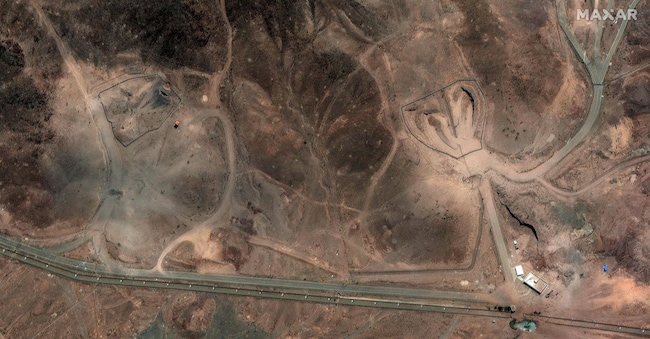
I crateri provocati dai raid a Fordow, uno dei siti nucleari iraniani

5' min read

5' min read

Iranian Foreign Minister Abbas Araghchi today described the damage to his country's nuclear facilities caused by the 12-day war with Israel as "significant", adding that Tehran has begun assessing the impact of the conflict. "Experts from the (Iranian) Atomic Energy Organisation are currently conducting a detailed assessment of the damage," he told state television, adding that "discussion on the damage claim" is now high on the government's agenda.

The FBI is investigating how the preliminary intelligence assessment on US attacks on Iranian nuclear sites became public. This was announced by Defence Secretary Pete Hegseth. According to the report, the sites were not destroyed and the uranium was transferred before the bombing. The Iranian nuclear programme, it is concluded, has only been delayed for a few months.

Loading...

US President Donald Trump said on Wednesday that the damage to Iran's nuclear sites caused by the weekend's missile attacks was severe, while acknowledging that available intelligence information on the issue was inconclusive.

His comments followed reports by Reuters and other media outlets on Tuesday revealing that the US Defense Intelligence Agency (DIA) had estimated that the attacks had set back Iran's nuclear programme by only a few months, despite administration officials claiming that the programme had been annihilated.

"The intelligence information has been very inconclusive," Trump told reporters before attending the NATO summit in The Hague. "The intelligence information says we don't know. It could have been very serious. That's what the intelligence information suggests." Later, Trump argued that Iran's nuclear programme has been set back "practically decades, because I don't think they'll ever do it again".

The US president threatens to sue CNN and the New York Times for publishing articles on the preliminary intelligence assessment of the US bombing of Iran. In a letter to the New York Times, the president's personal lawyer claimed that the article damaged Trump's reputation: he called it 'false', 'unpatriotic' and 'defamatory'. The lawyer also asked the newspaper to 'retract and apologise'. The New York Times rejected the president's demands and so, the newspaper reports, did CNN.

Iran, Hegseth: "Attacco Usa è stato un successo incredibile e schiacciante"

Trump was seated next to Secretary of State Marco Rubio and Defence Secretary Pete Hegseth, who both raised doubts about the reliability of the DIA assessment. Rubio claimed that the US was opening an investigation into the leak of the DIA report. He also insinuated that the contents of the report had been misrepresented in the media.

Before the attack, wrote the New York Times, US intelligence agencies had said that if Iran tried to speed up bomb production, it would take about three months. After the US bombing and days of Israeli Air Force attacks, the Defense Intelligence Agency report estimated that the programme had been delayed, but by less than six months.

The report also stated that much of Iran's stockpile of enriched uranium had been moved before the attacks, which had destroyed only a small part of the nuclear material. Iran may have moved some of it to secret locations.

Some Israeli officials said they believed that the Iranian government had kept small enrichment plants secret so that it could continue its nuclear programme in case the larger plants were attacked.

Other officials noted that the report found that the three nuclear sites - Fordow, Natanz and Isfahan - had suffered moderate to severe damage, with the Natanz facility damaged the most. Former officials said that if Iran tried to quickly develop a bomb, it would be a relatively small and rudimentary device. A miniaturised warhead would be much more difficult to produce and the extent of damage to this more advanced research is unclear.

Prior to the attack, current and former military officials warned that any attempt to destroy the Fordow facility, buried more than 76 metres under a mountain, would likely require waves of air strikes, with days or even weeks of bombing at the same locations.

Instead, Trump insisted that the US attack on Iran was a success. A success, he said, that "I don't want it for me. I want it for the pilots. I want it for the military. They did a great job." 'If you were in the Situation Room with me,' he continued, addressing the reporter in The Hague, 'with the generals and all the people who did a great job. And then they are humiliated by these idiots at CNN who can't get ratings. A (media) place that is dying. Nobody wants to waste their time, not even to go on their shows. So they make a deal with the New York Times, which is dying. Also, without Trump, there would be no New York Times'.

"The cars and small trucks at the site belonged to the cement workers who were trying to cover the top of the shafts. Nothing was taken out of the structure. It would have taken too long, it would have been too dangerous, too heavy and too difficult to move!" further clarified Trump, responding to Financial Times rumours that uranium was moved from Iranian nuclear sites before the US raids.

Cia, 'credible intelligence' on nuclear programme 'severely damaged'

The CIA later corrected the reports in the US media and thus proved Trump right. The CIA has 'credible intelligence' information showing that Iran's nuclear programme was 'severely damaged' in the US-led raids on Saturday night. In a note released on X, the Langley-based agency's director, John Ratcliffe, points out that this information includes "new intelligence from a historically reliable and accurate source/method" showing that the affected facilities were destroyed.

"We have gathered evidence indicating that Iran's nuclear sites have been devastated and will take years to rebuild," said Ratcliffe who was present in the Situation Room with Donald Trump at the time of the attack. "We have new information from a historically reliable and accurate source that several major Iranian nuclear facilities have been destroyed and will need to be rebuilt over the years," Ratcliffe said in a note.

Israeli Defence Minister Israel Katz revealed in an interview with Channel 13 that Israel had intended to eliminate Iran's Supreme Leader, Ayatollah Ali Khamenei, but the opportunity never presented itself. "Had he been in our sights, we would have eliminated him," Katz said, adding, "We wanted to eliminate Khamenei, but there was no operational opportunity." Asked if Israel had sought American approval for such an action, Katz replied, "We do not need permission for such things."

June 26 US Senate briefing on attacks on nuclear sites

The confidential all-Senate briefing on the situation in Iran has been scheduled for Thursday, 26 June at 2.00 p.m. (8.00 p.m. in Italy), after having been postponed earlier in the week. This was reported by CNN sources. The House is expected to receive a briefing on Friday. The Trump administration has been criticised by Democrats for its lack of communication on the US attacks in Iran.

The United States is currently engaged in a diplomatic effort with Iran and maintains contact with Tehran, said White House spokeswoman Karoline Leavitt.

"We are currently on a diplomatic track with Iran. President [Trump] and his team, particularly Special Envoy [Steven] Witkoff, continue to be in contact with the Iranians, and particularly our Gulf and Arab partners in the region, to reach an agreement with Iran," he explained.

Copyright reserved ©

Brand connect

Loading...

Newsletter

Notizie e approfondimenti sugli avvenimenti politici, economici e finanziari.

Iscriviti