Military operation

Iran, Trump's ultimatum: 'Agreement within 10 days or it will be war'

According to the Wall Street Journal Donald Trump would consider an initial limited attack to force Iran to negotiate and accept American demands in the nuclear deal

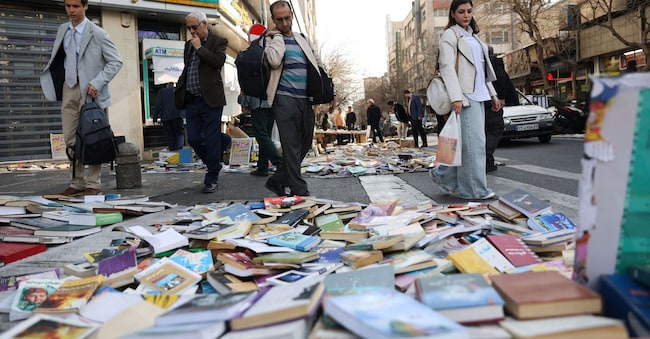
Persone guardano dei libri in una strada di Teheran, Iran, 19 febbraio 2026. Majid Asgaripour/WANA (West Asia News Agency) via REUTERS ATTENZIONE REDATTORI - QUESTA FOTO È STATA FORNITA DA UNA TERZA PARTE

3' min read

Translated by AI
Versione italiana

3' min read

Translated by AI
Versione italiana

Tensions in the Gulf, the scene of yet another tug-of-war between President Donald Trump's US and Ayatollah Ali Khamenei's Iran, are at an all-time high: the Islamic Republic has '10 days' to come to a 'serious agreement' on its nuclear programme or 'bad things will happen', is the White House's new ultimatum.

Trump, who launched his screeches against the Islamic Republic while speaking at the first meeting of the Board of Peace in Washington, is strong with his 'grand Armada' deployed in the Middle East chessboard, with a massive military deployment of men and means of all kinds not seen since the invasion of Iraq in 2003. And a firepower, state-of-the-art weapons, and technology amassed in the region that is perhaps unprecedented, and certainly not comparable to that of twenty years ago or the last century.

Loading...

According to the Wall Street Journal Donald Trump would consider an initial limited attack to force Iran to negotiate and accept American demands in the nuclear deal. According to the WSJ's sources, the attack, if authorised, could take place within days and target some military and government sites. If Tehran continues to refuse to negotiate, then the US would respond with a full-scale attack, potentially aimed at toppling the regime.

In the coming days, the aircraft carrier Gerald R. Ford, the world's largest, is expected to arrive and be stationed off the coast of Israel, with the task of protecting Tel Aviv and other cities in the country from a possible retaliatory attack by Iran.

Usa, Trump all'Iran: "Negozi accordo o prossimo attacco sarà molto peggiore"

"We are ready for any scenario, if the ayatollahs attack, they will suffer a response that they cannot even imagine," warned Israeli Prime Minister Benyamin Netanyahu, however. The US and Israeli media bet on the imminence of military action as early as next weekend, an eventuality that prompted Polish Prime Minister Donald Tusk to appeal to his compatriots to leave Iran 'immediately'.

But from the White House come conflicting signals about the real intentions of the American president, who after a series of meetings with the military leadership would still have sounded out partners and analysts to assess which path to take, that of war or that of understanding.

What is certain is that during the same threatening speech in Washinton, Trump was keen to stress that the United States 'has good relations' with Tehran's negotiators, and that 'we will find out what happens with Iran in about 10 days', reiterating that the regime cannot have the atomic weapon. It has been leaked by his staff that after the Geneva talks, which although they remain on an uphill slope, have nonetheless made progress, the White House expects a written counter-proposal from the Iranians to reach an agreement.

From Tehran, the head of the atomic agency Mohammad Eslami reiterated that "no country can deprive the Islamic Republic of its right to nuclear enrichment and the right to peacefully benefit from this technology". The ayatollahs' regime, apparently having survived yet another popular uprising suppressed with the blood of thousands of anti-government demonstrators, is refreshed by the renewed support of Moscow and Beijing. Which at this stage seems to go beyond the diplomatic terrain: in the last few hours Iran, Russia and China have concluded a joint naval military exercise in the sea of Oman.

Iran, la Cina agli Usa: no ad avventurismo militare

The Kremlin, through its spokesman Dimitri Peskov, "calls on all parties, including Tehran, to show restraint and diplomacy". The European Union, which has formally decided to add the Iranian Pasdaran to the list of terrorist groups, calls for avoiding escalation. "The EU maintains that a sustainable Iranian nuclear deal can be reached through diplomacy, but Iran must show seriousness," stressed EU Foreign Affairs Commission spokesman Anouar El Anouni. 'A military escalation risks having serious consequences for the stability of the region'.

Copyright reserved ©
Loading...

Brand connect

Loading...

Newsletter

Notizie e approfondimenti sugli avvenimenti politici, economici e finanziari.

Iscriviti